Vice, Corruption and Decay

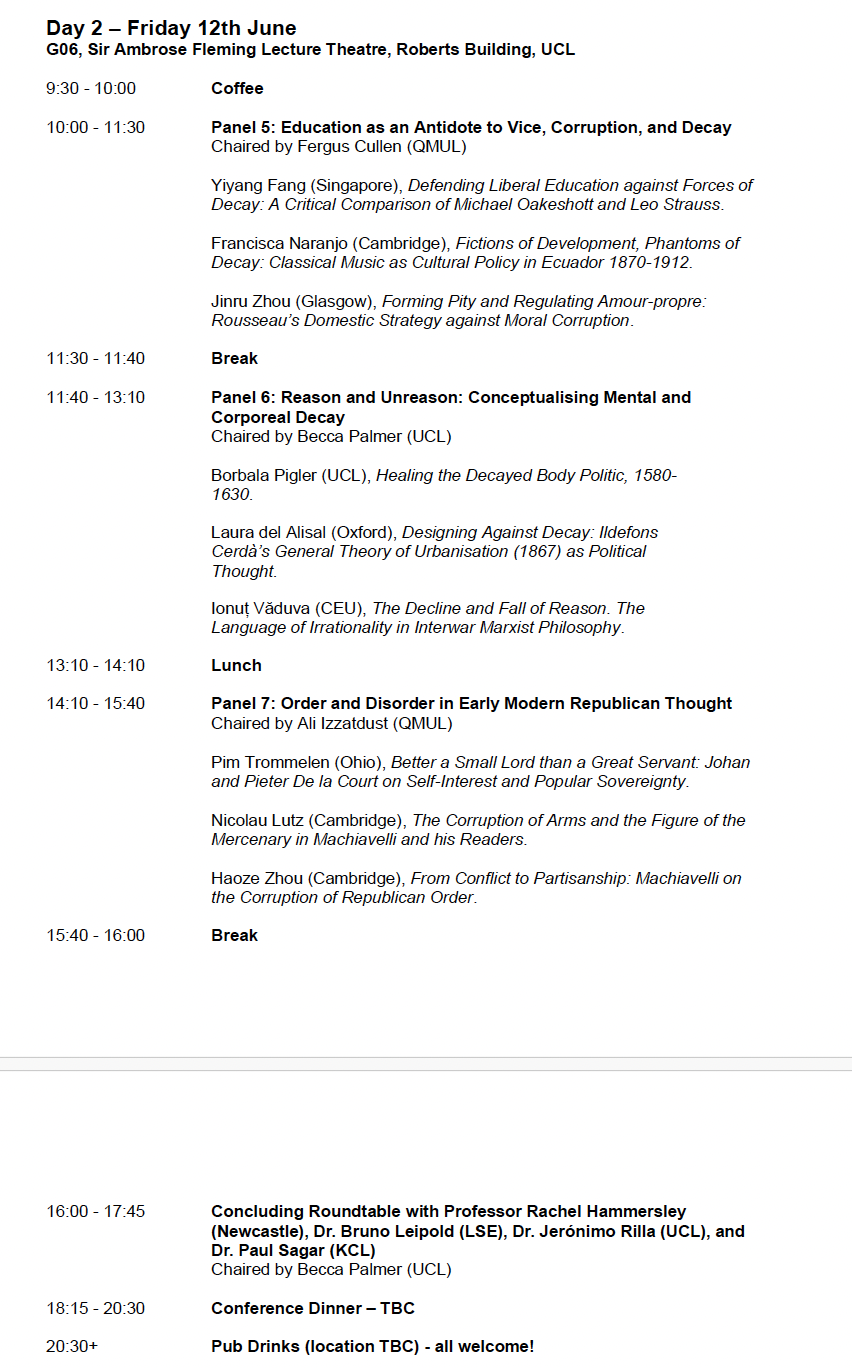
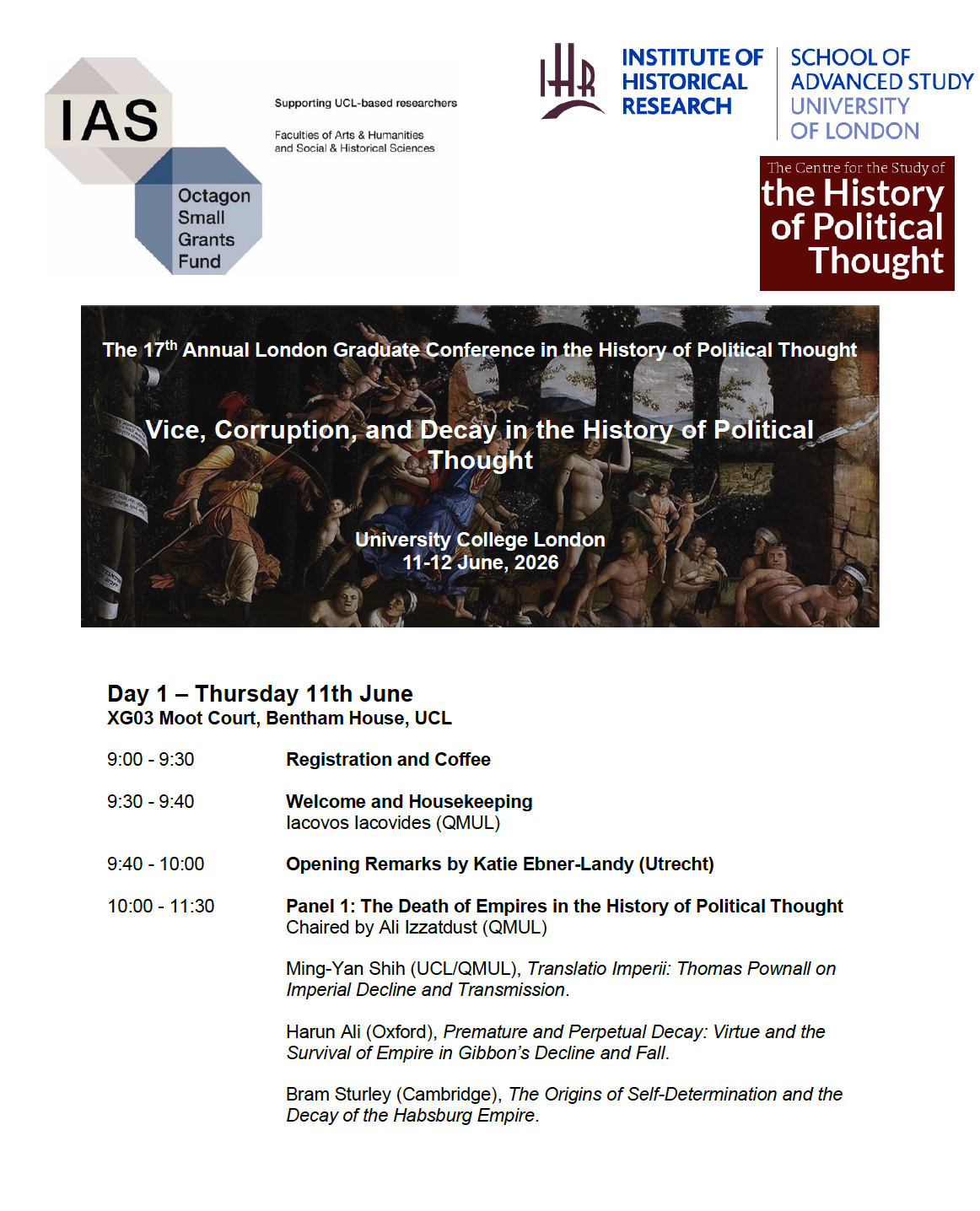
In June I attended the 17th Annual London Graduate Conference in the History of Political Thought. As several participants noted, it seemed sadly fitting to be at a conference on the theme of 'Vice, Corruption, and Decay' on the opening day of the 2026 World Cup. Despite the potentially depressing theme, the conference proved remarkably stimulating and upbeat. As always, what follows are my personal reflections on the event.
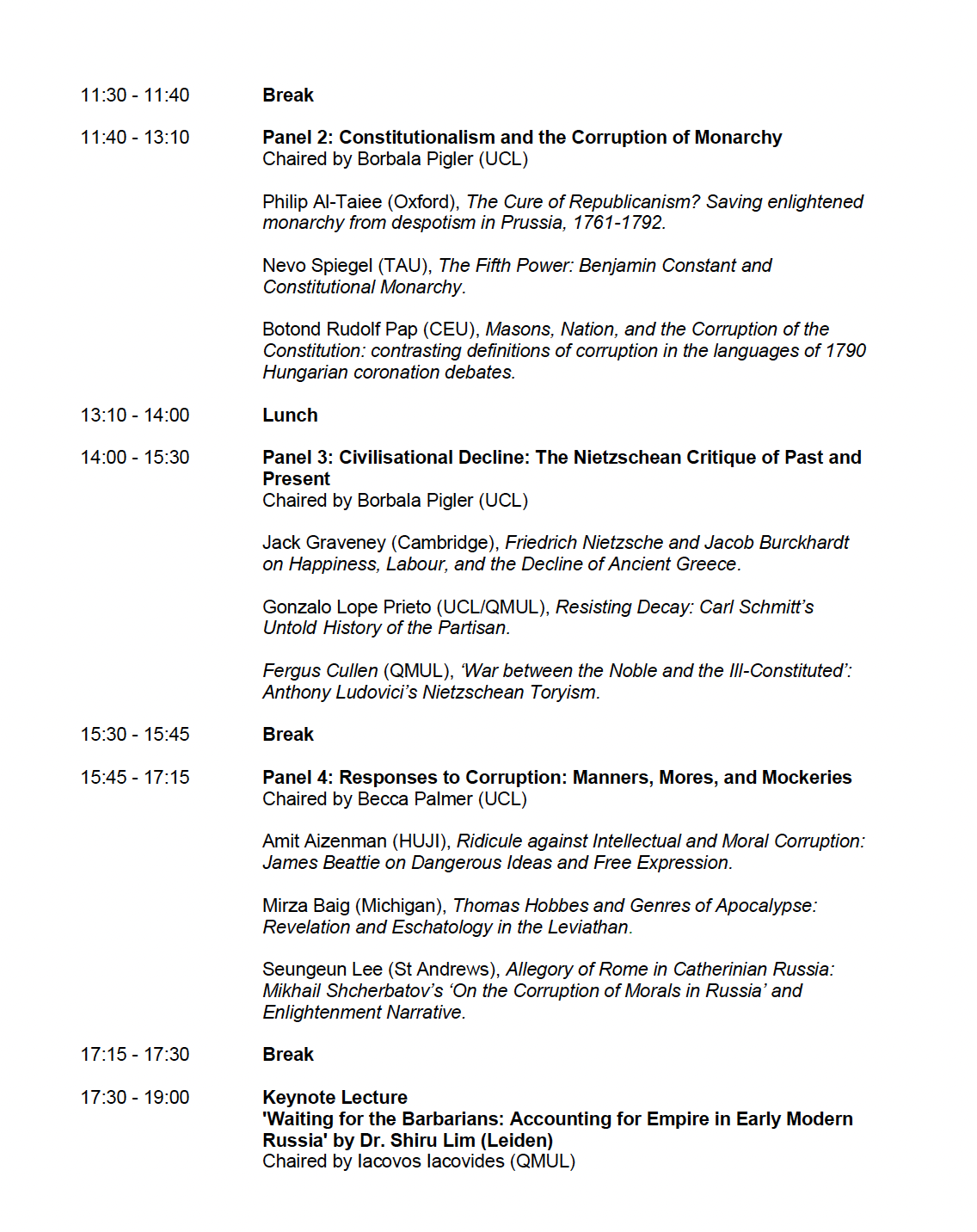
While the three words of the conference title are closely related, each has a different meaning and distinct connotations. One contrast drawn out in the papers was between cyclical and terminal decline. Platonic and Aristotelian ideas of political corruption involve states cycling through a series of constitutional models with a degeneration from one to the next. Consequently, this can be viewed as a process of constant change. By contrast the biological image of decay implies that the decline is terminal and that the result will be complete destruction or death.
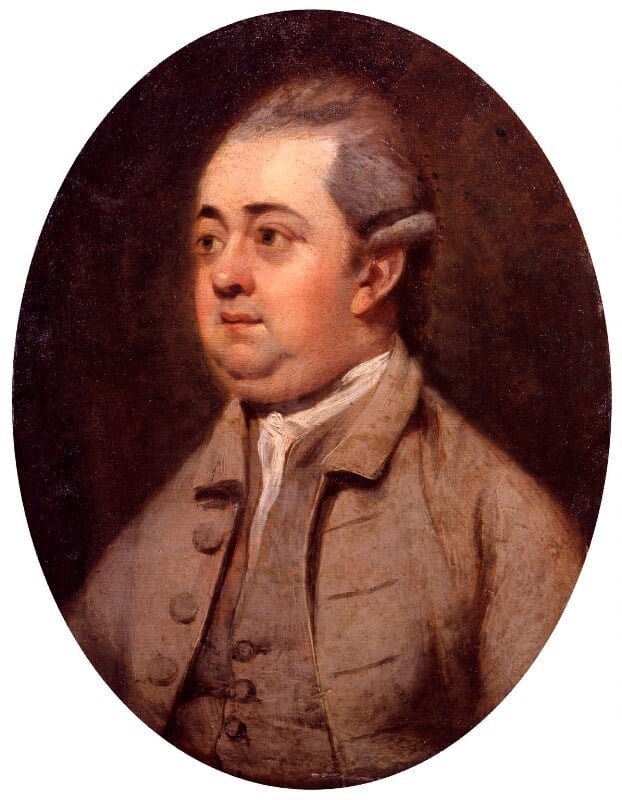
Edward Gibbon by Henry Walton, 1773. National Portrait Gallery, NPG 1443. Reproduced under a Creative Commons Licence.

Several papers explored the possibilities for interrupting or postponing decline. Ming-Yan Shih presented the ideas of Thomas Pownall, a British politician and Governor of the Province of Massachusetts Bay. Pownall drew on the medieval idea of Translatio Imperii to suggest that the decline of the British Empire could be delayed by shifting the centre of the empire westward from London to the American continent. Similarly, Harun Ali observed that Edward Gibbon's well-known account of the decline and fall of Rome was complicated by the need for him to address the Eastern portion of the Empire, which survived the fall of Rome albeit in a state of 'premature and perpetual decay'. Harun pointed out that this means that Gibbon's 'decline' narrative is not quite what it seems. Mirza Baig's exploration of Hobbes's use of an apocalyptic narrative presented a similar disruption of the expected model. Having demonstrated that the apocalyptic was a standard literary genre at the time, Mirza went on to show how Hobbes re-temporalised that narrative. He thus presented the apocalyptic as marking the end of a world, rather than the end of the world, and consequently a moment of renewal or regeneration rather than destruction. Finally, Francisca Naranjo pointed out that progress and degeneration are not always in opposition but can exist simultaneously with degeneracy operating as a kind of shadow of development.

These issues were further explored in our closing discussion. Mirza observed that a cyclical model need not always return to the point of departure - as illustrated by the image of a spiral. Paul Sagar raised the question of whether there is a distinction between attitudes to corruption and decline on the Left as compared with the Right. Paul suggested that there is a tendency for the Right to think in terms of decline from a past golden age, whereas those on the Left are perhaps more likely to look forward to a better future. Yet Ionut Vaduva's paper provided an interesting counterpoint to this - in looking at the discourse of the decline and fall of reason in the writings of the Marxist philosophers György Lukács, Herbert Marcuse and Ernst Bloch. They perceived a contrast between the rationalism of the Enlightenment which was then developed by Hegel and Marx and the irrationalism of the ideas of counter-revolutionary thinkers such as Schelling, Schopenhauer and Kierkegaard, perhaps leading to Fascism. While Ionut's paper and other participants made clear that the picture is more complex, there did seem to be something in the notion of the Right seeing the move from aristocracy to democracy as a sign of corruption. This was, of course, central to Nietzsche's understanding, which was touched on in several papers.

Jack Graveney compared Nietzsche with his contemporary Joseph Burkhardt. For Nietzsche the slavery of the masses was necessary for the flourishing of the few. Burkhardt rejected Nietzsche's notion of the happiness of the past as an optical illusion, suggesting that Nietzsche's idea that the slave was happy on account of being free from modern delusions was a myth. Fergus Cullen showed how Nietzsche's veneration for aristocracy was picked up by the conservative Anthony Ludovici who contrasted a positive image of ancient aristocracy with a notion of modernity as marking the triumph of the weak and ugly. While not presented in the same Nietzschean vein, Gonzalo Lope Prieto's account of Carl Schmitt's idea of the partisan offered a similar notion of decline from an aristocratic original to a corrupt democratic form.
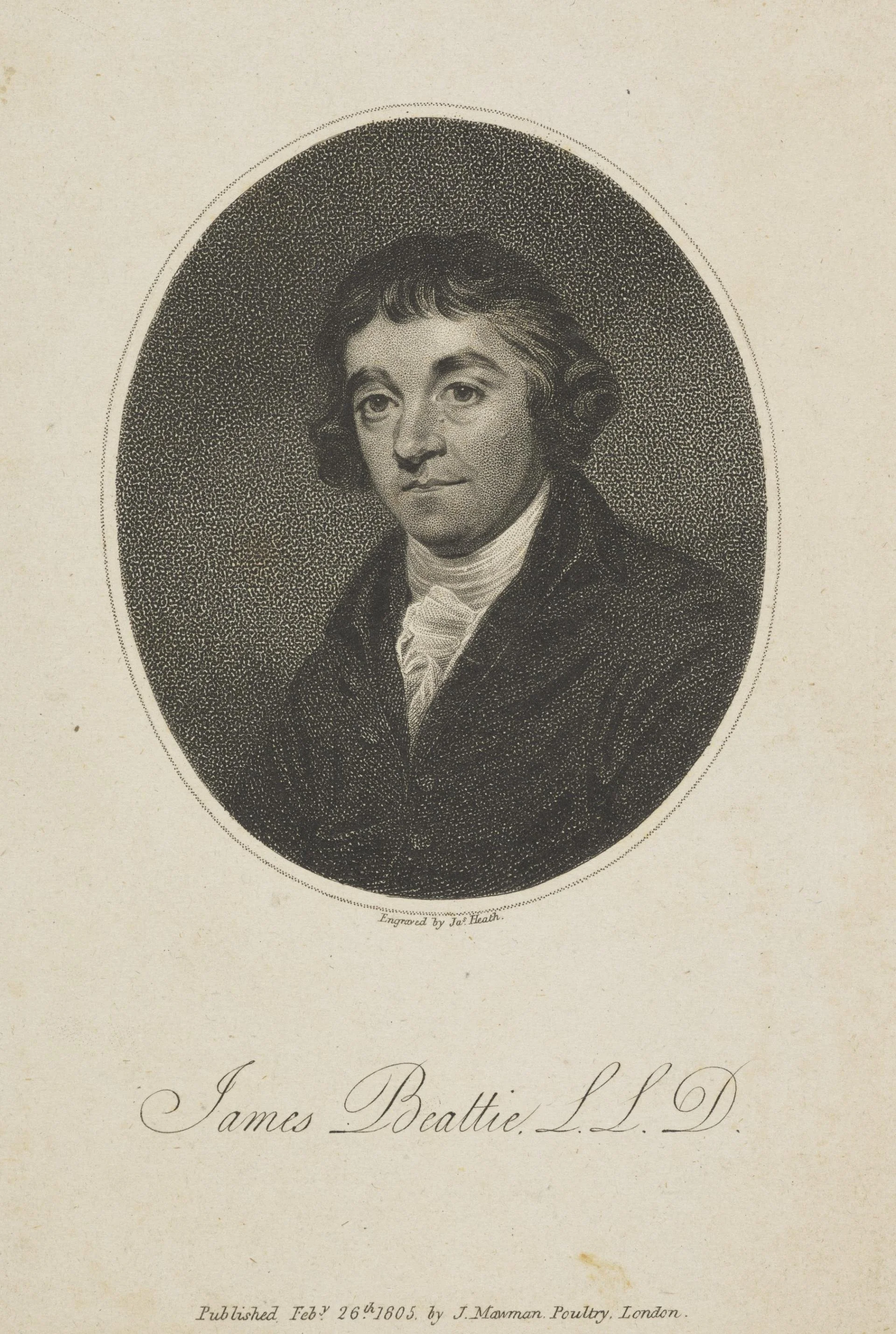
James Beattie, 1735-1803. Poet and moral philosophe. Image engraved by James Heath and published by J. Mawman, 1805. ‘National Galleries of Scotland’.

Other papers reflected the shift from aristocracy to democracy as constituting decline in more practical terms. Botond Rudolf Pap showed that for at least one of the late eighteenth-century Hungarian thinkers he studies, the nobility were the true and sole proprietors of the nation and any weakening of their power was viewed as decline. Seungeun Lee suggested that Mikhail Shcherbatov adopted a similar perspective on corruption in eighteenth-century Russia. He looked back to the noble virtues of the past and insisted on the need for the monarch to be tempered by aristocratic restraint. Similarly, Leo Strauss's concept of a Liberal Education - which was explored by Yiyang Fang - was designed to cultivate the 'perfect gentleman' and motivated by a rejection of mass democracy and culture. A similar sort of aristocratic disdain was even documented in Amit Aizenman's paper on James Beattie. Amit showed that Beattie's concern about Hume's scepticism was less about the ideas themselves, than their becoming fashionable among the general population. As Amit explained, this was why Beattie's solution was to challenge Hume's position via ridicule - since this was a means of damaging the social standing of the ideas and the philosopher associated with them.

As Botond noted, one person's decline is another's progress, and this was brought home in Pim Trommelen's paper on the De la Court brothers. In contrast to many republican thinkers, they did not favour aristocracy over democracy, nor did they believe that the cultivation of virtue was necessary to prevent corruption. Instead, they argued that the advancement of each person's self-love is an expression of the common good and on this basis argued that popular government is actually the best form. Bad behaviour on the part of the mob, they argued, is not due to human nature and so must instead be the result of material inequality. If that inequality is reduced and all are given the opportunity to participate in politics then vicious actions can be avoided.

Pim's paper was not the only one to address potential solutions to the problem of corruption. Some of the solutions explored across the 23 papers were familiar and expected, others less so.
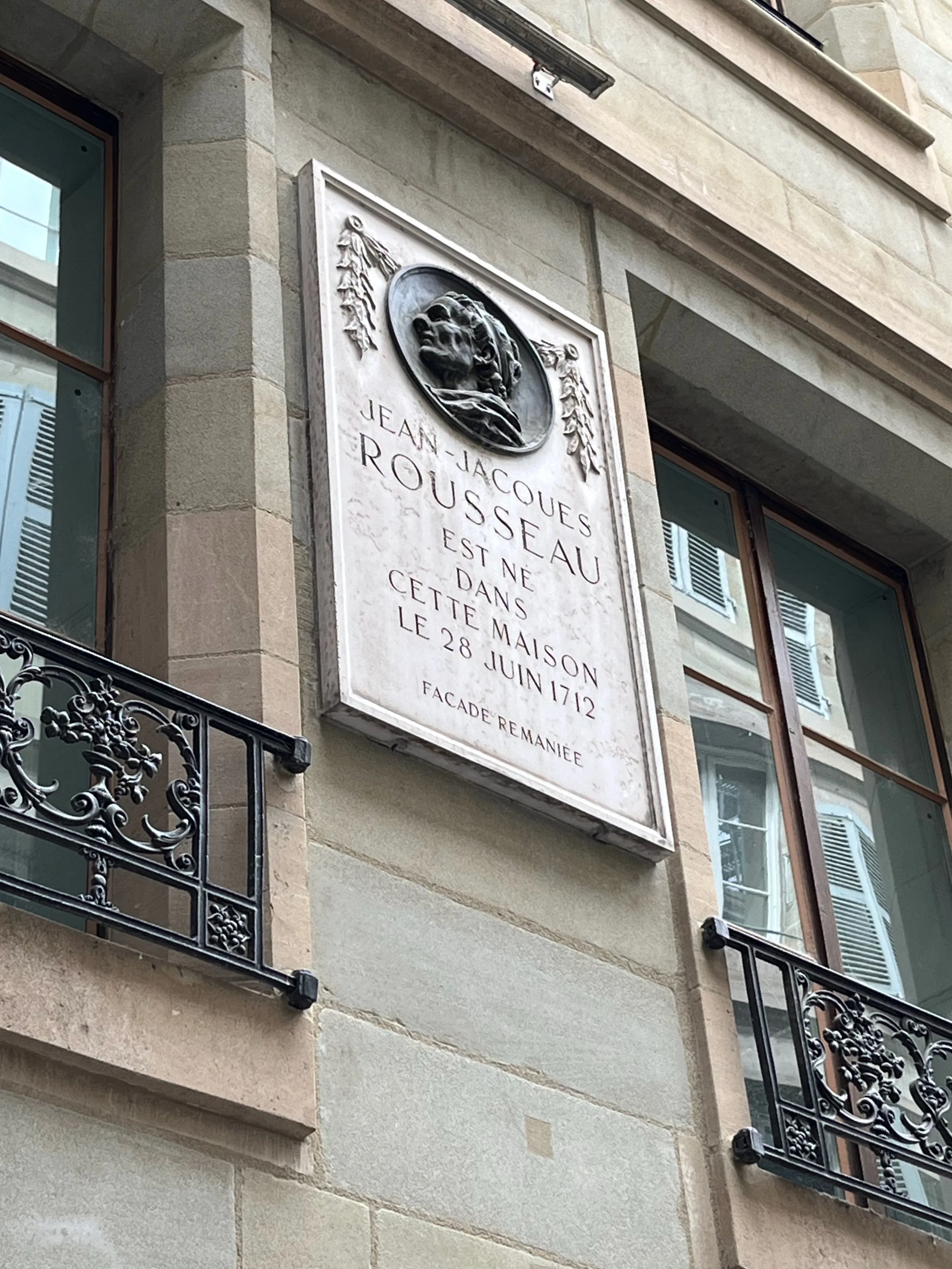
Plaque commemorating Jean-Jacques Rousseau’s birthplace in Geneva. Image by Rachel Hammersley, 2025.

Panel 5 as a whole focused on education, though what was interesting here was the diversity in how education was conceived. Yiyang compared the Liberal Education programmes of Michael Oakeshott and Leo Strauss. Both advocated reading the 'great books' in the history of political thought as crucial training, but Yiyang suggested that whereas for Strauss the goal of this programme was to seek the truth, for Oakeshott it was more about students being initiated into a tradition. Francisca highlighted the importance of music education in the new Equadorian republic in the late nineteenth century. In an historical context in which Latin America was seen as a developing region, while the West was perceived to be in decline, classical music was viewed simultaneously as a symptom of decay and a potential antidote to it. While Rousseau also valued music, his approach to addressing moral decay, as Jinru Zhou demonstrated, centred on the notion of pity. Jinru drew out the contrast between the natural pity of the Second Discourse - which is instinctive and anterior to reason - and the refined pity of Emile, which required imagination and judgement and which, if cultivated, could offer a domestic remedy to human corruption

Legal frameworks offer another conventional solution to the problem of corruption. Laws are a means of controlling the flawed behaviour of human beings and the rule of law can even constrain the actions of the ruler. In this vein, Philip Al-Taiee noted the rejection of personal decrees in a Prussian context and Botond observed that his Hungarian thinkers criticised breaches of the law by rulers such as Joseph and Maria Theresa. As Bram Sturley demonstrated in his discussion of the writings of early twentieth-century Austrian socialists, laws also have to be adapted to fit new circumstances - not least when seeking to incorporate different nationalities within the Hapsburg Empire.
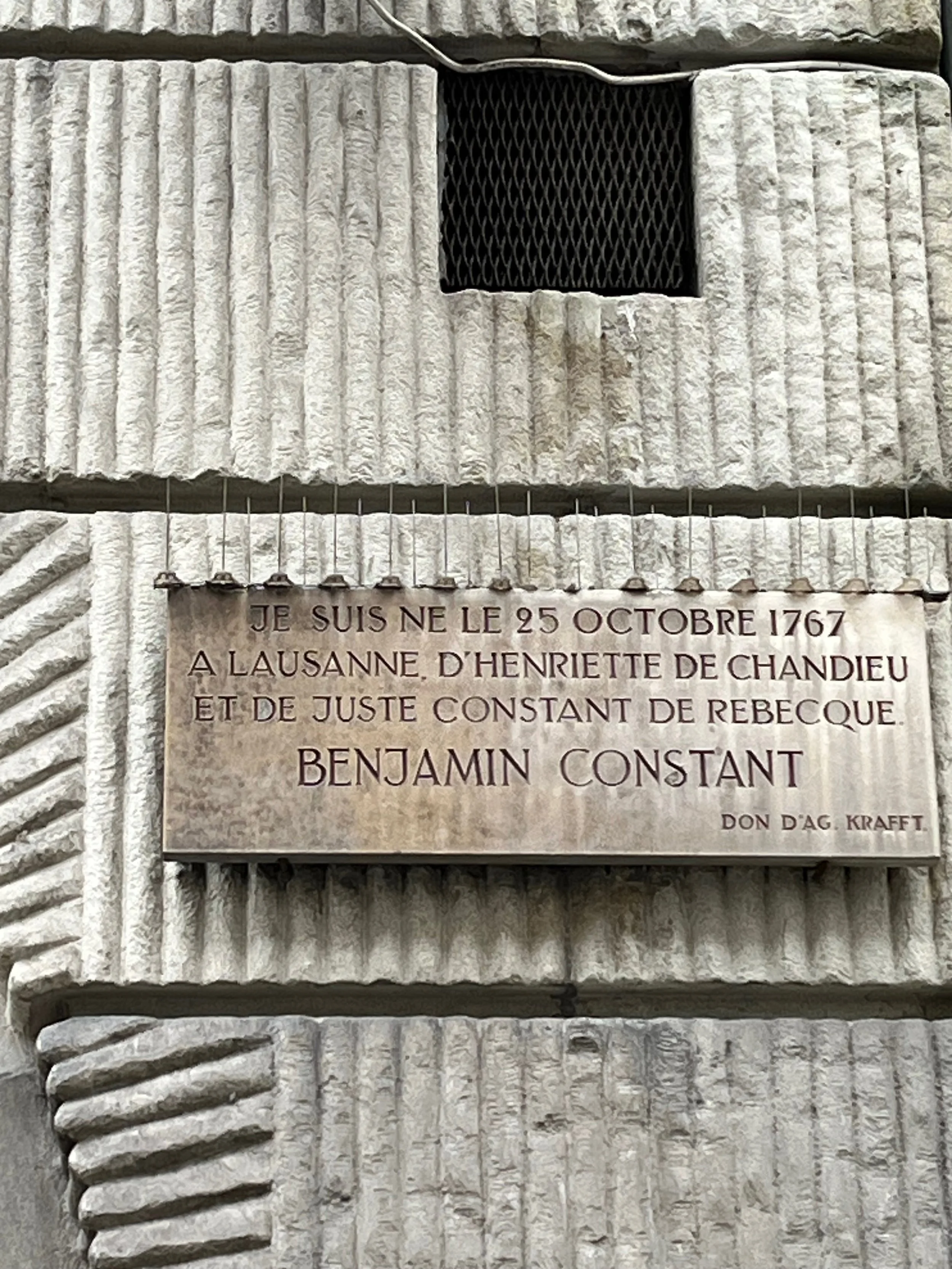
Plaque commemorating the birthplace of Benjamin Constant in Lausanne. Image by Rachel Hammersley, 2025.

Closely linked to the rule of law is the idea of a mixed constitution. The original formulation - dating back to Polybius - featured relatively little in our discussions, but we did explore modern adaptations. Philip revealed that some of his Prussian intellectuals used republican solutions to protect monarchy from slipping into despotism. In the same panel, Nevo Spiegel showed how Benjamin Constant's later writings advocated a monarch as a vertical balancing power to solve the republican problem of resolving conflicts between the legislative, executive, and judicial branches of the constitution. Pim reminded us that not all republican writers favoured the mixed constitution. Dutch thinkers like the De la Courts explicitly rejected that model on the grounds that it introduces competition into the system and so is liable to generate civil conflict.

For Machiavelli civil conflict was, of course, part of the solution rather than the problem, with active citizenship, tumults, and armed citizens all working to postpone decline. Yet, even here, the papers suggested that the story is more complex than we might think. Haoze Zhou showed that while the account offered in the Discourses is that conflict between the patricians and plebs rendered the Roman republic free and powerful, in the History of Florence civil conflict is a source of political decay. Haoze showed that the key for Machiavelli was to have conflict without sects and that this required good institutions that could contain private interests. Nicolau Lutz's paper complicated another key aspect of Machiavelli's thought - his preference for citizen soldiers over mercenaries. Nicolau showed that while Machiavelli saw mercenaries as morally corrupt, the Straussian critique of the civic humanist position, which suggested that Machiavelli believed strong leadership could make mercenaries more like citizen soldiers, is not entirely incorrect.

Interestingly religion as a solution to the problem of moral corruption was less prominent in the papers. It only surfaced in the final panel when Haoze presented religious institutions as one means by which Machiavelli thought private interests could be contained. Its almost complete absence from our discussions probably says as much about twenty-first-century intellectual historians' preoccupations as the importance of religion to the topic itself.
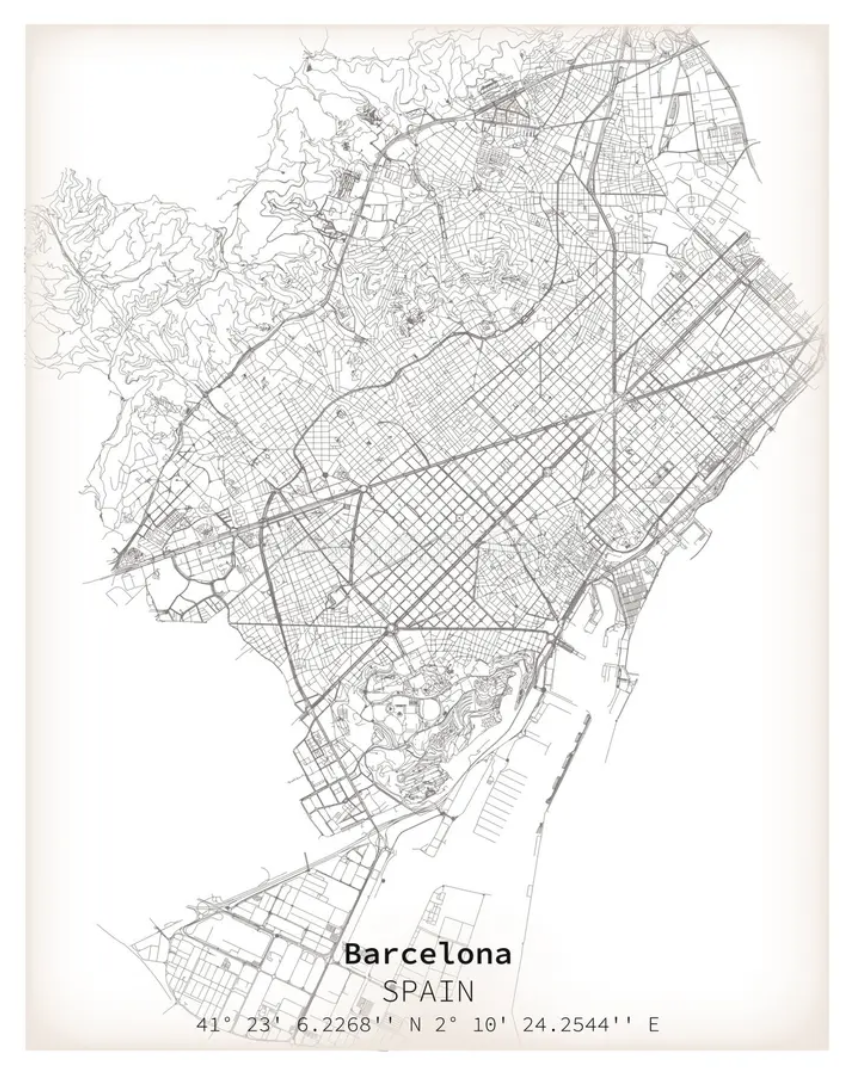
Map of Barcelona which was remodelled according to Cerdàs’s plan. Taken from narodnatribuna.info.

Alongside these conventional solutions were some that were more surprising. In her paper on the political thought of the architect Ildefons Cerdàs, Laura des Alisal highlighted Cerdàs's belief that making improvements to the environment in which people live not only improves their physical well-being but can also have moral and political implications. She convincingly argued that his book General Theory of Urbanisation, which is usually viewed as a manual for urban planners, can also be read as a text in political thought.

While imperial expansion was a source of corruption in the Roman, British, and Hapsburg cases, two papers presented it as a potential solution. Borbala Pigler showed how in early modern England, colonisation was seen as a solution to the problem of overpopulation. The issue, as she explained, was not simply quantity - that there were too many people - but also quality - the type of people - in particular those who were idle. Following medical models relating to an excess of blood, advocates of colonisation called not merely for bloodletting, but insisted on the need to purge the state of the idle by sending them to the colonies. This would both cleanse the English body politic and reform those individuals through hard work. In her keynote address Shiru Lim suggested a similar model was at work in the Russian Empire. Here Siberian exile was used as a means of purging a sick body politic by using it to absorb prisoners of war and political prisoners.
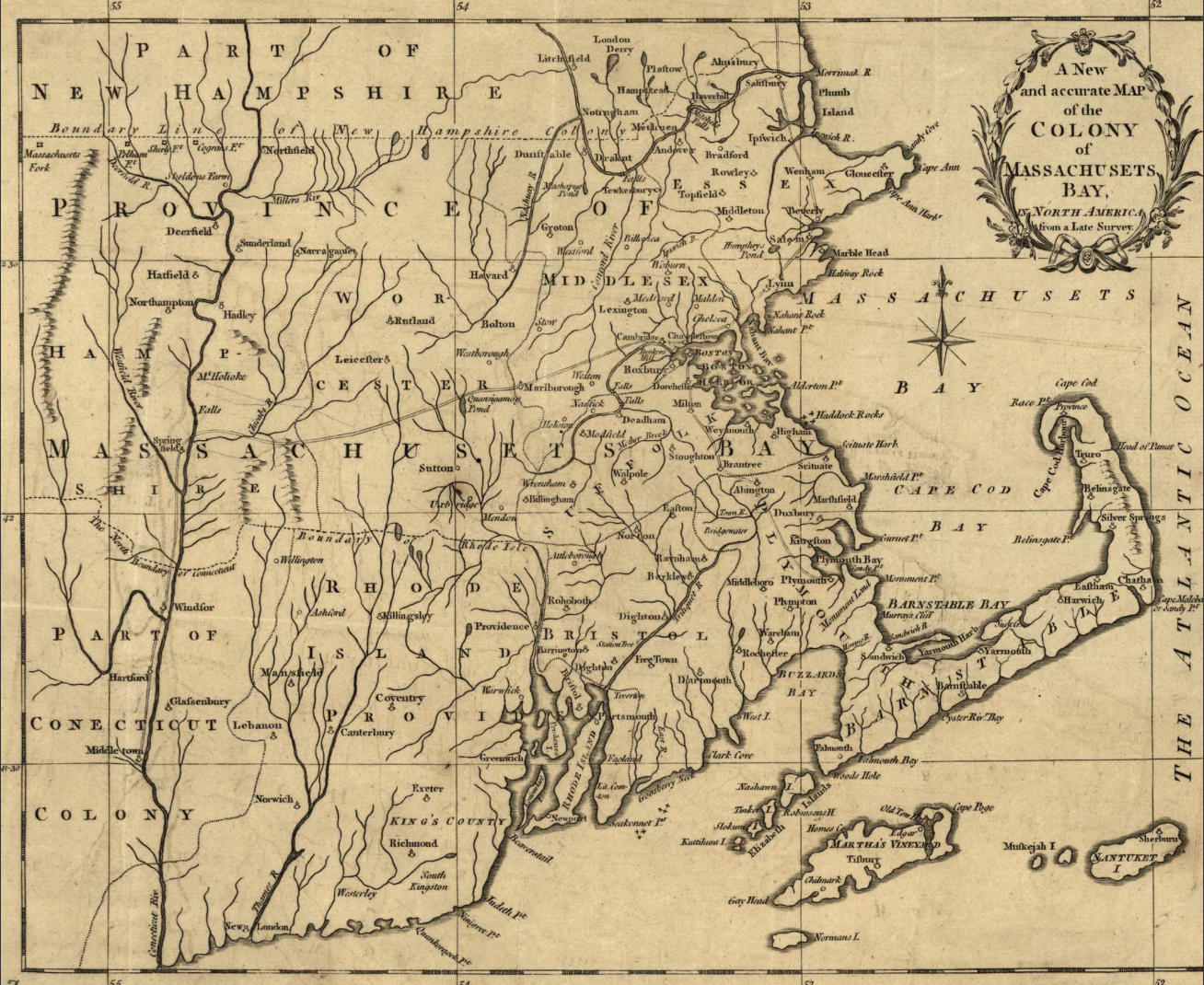
Early map of Massachusetts Bay from https://pacificpalisadesmap.github.io/new-rdcrrp-charting-the-beginnings-a-journey-through-the-map-of-the-massachusetts-bay-colony-yckbkr-pics/#

Finally, I was struck by the fact that while we did discuss Machiavelli, Hobbes, Rousseau and Nietzsche, we also had many papers on less well-known thinkers who were engaged in day-to-day politics. Ming-Yan showed how Thomas Pownall had interesting things to say about empire and imperial fragility that were influenced by his practical experiences of governing. Philip talked about his thinkers 'grappling' with the problems of the day. Nevo reminded us that constitutional theorists cannot rely solely on rules and idealisations but must attend to their particular historical moment. Perhaps the topic encouraged this practical focus but I cannot help thinking that it is also a reflection of the current state of the field. If that is the case, then we are perhaps heeding Georges Dumézil's point as highlighted in Katie Ebner-Landy's opening talk. Katie compared the methodologies of Harold Bloom and Quentin Skinner and sought to explain why the former is - to use Dumézil's phrase - now of 'mere historical interest', while the latter remains relevant. Dumézil's point was that in order to avoid decline a methodology must continue to be useful. This means that it must not simply be frozen in time but must instead be 'transformed by future generations'.
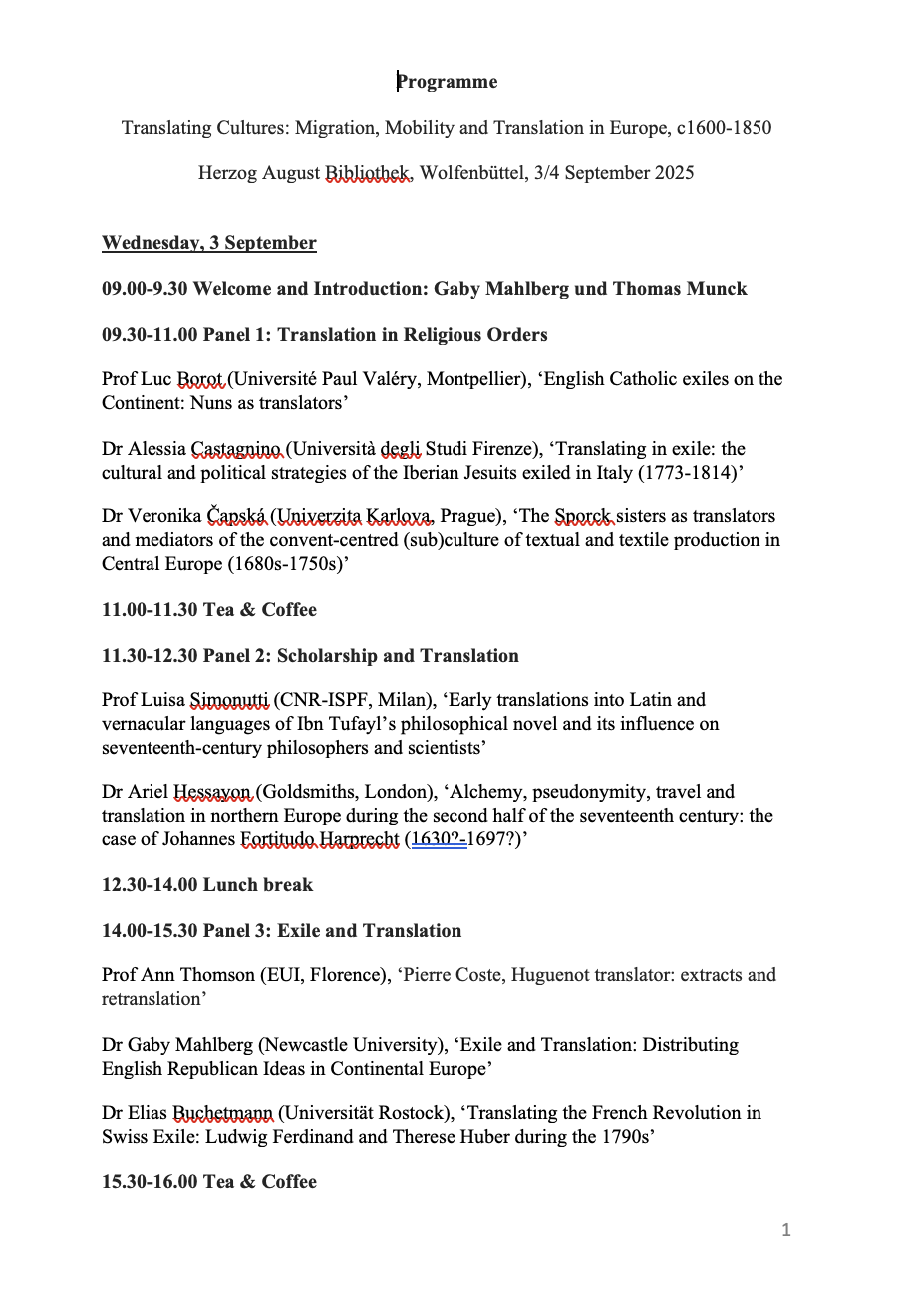
Migration, Mobility and Translation in Europe

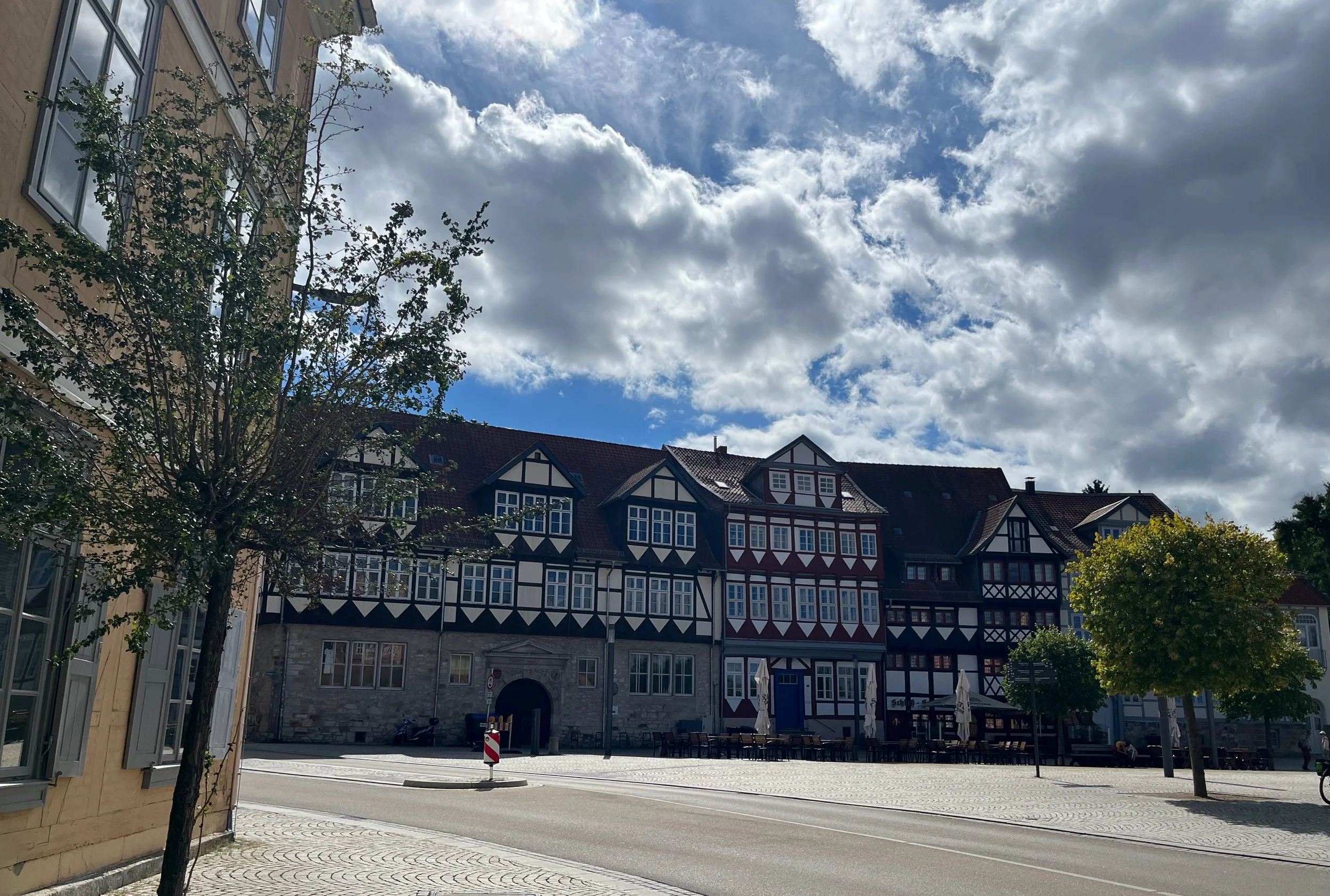
Wolfenbüttel’s main square. Image by Rachel Hammersley, 2025.

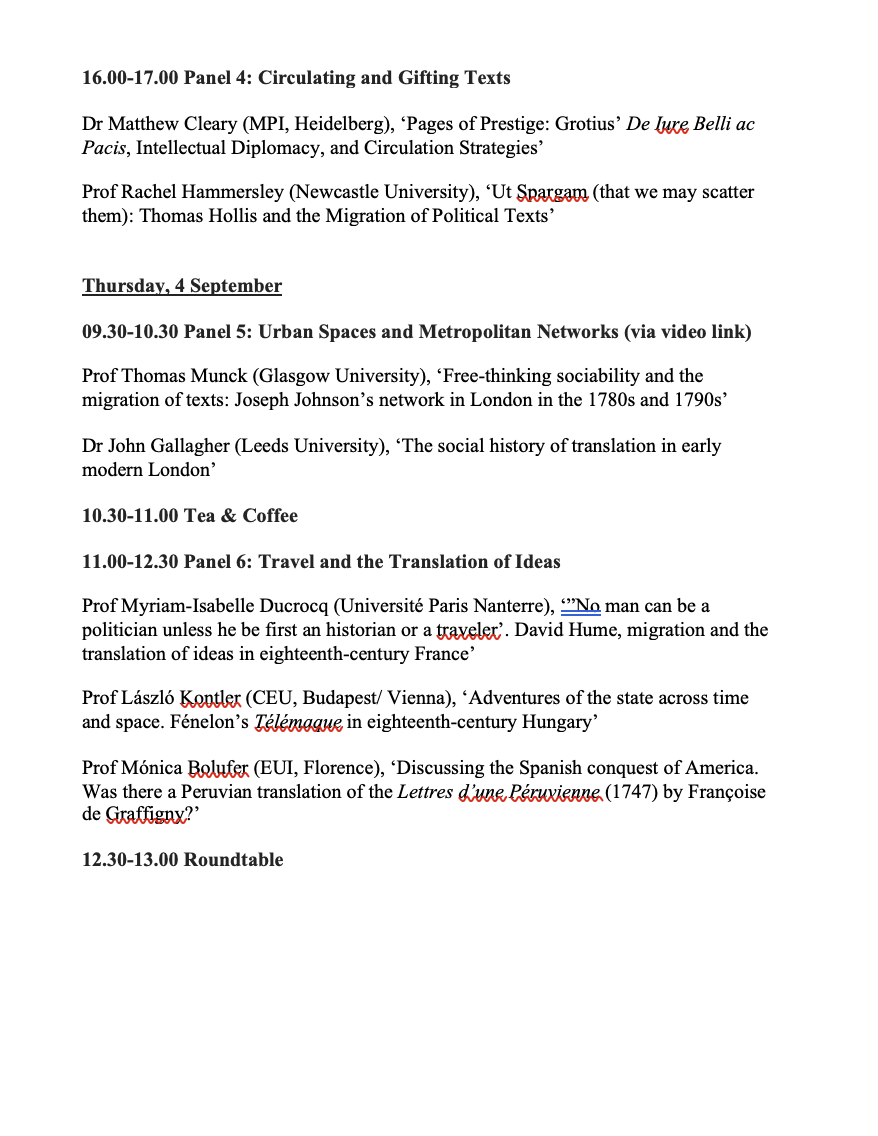
At the beginning of September I had the opportunity to return to the beautiful German town of Wolfenbüttel in Lower Saxony for another meeting of the Translating Cultures research group with which I have been associated for almost ten years. The group draws together scholars from across Europe who work on cultural translation in the early modern period. Last year we published a volume comprising chapters developed at our previous workshops. On this occasion we welcomed several new members as we turned our attention to how translations and translators are impacted by migration and mobility. As always with this group, the papers were, without exception, excellent and prompted much thought and discussion. In this blogpost I offer my personal reflections on three key themes that emerged from our discussions.

The title of Myriam-Isabelle Ducrocq's paper referenced James Harrington's suggestion that a politician must first be either an historian or a traveller. In a similar vein, several papers suggested that translation could offer an alternative to travel for those unable to do so. This was particularly true for women in holy orders including British Catholics who became nuns in convents on the Continent during the sixteenth century. Luc Borot discussed translations by these women using material from the Early Modern English Nuns in Exile database, produced by Caroline Bowden and others. Luc highlighted that while early modern men who took holy orders were often still able to travel - not least as missionaries - this was not typical for women. These women would travel to a continental convent but would then remain cloistered there unable to travel further or to return home. Translating spiritual and devotional texts was not only important for their own faith, but was also a means of maintaining connection with the outside world - and with their homeland. Veronika Čapská made a similar point about translation offering compensation for immobility, even suggesting that nuns used translation as their own version of missionary travel.

It was not only nuns for whom books acted as surrogates for travel. Veronika argued that the translations produced by the Sporck sisters - Maria Elenora and Anna Catharina - were used by their father (who often selected the books to be translated and checked the finished product) to make connections. He sent them as gifts to places where he (and certainly his daughters) could not go themselves.

High De Groot (Hugo Grotius) by Willem Jacobsz Delff, after Michiel Jansz van Mierevelt. National Portrait Gallery. NPG D26250. Reproduced under a Creative Commons Licence.

Something similar is true of the copies of De Iure Belli ac Pacis, that were distributed by their author Hugo Grotius, as discussed by Matthew Cleary, and of the books that Thomas Hollis sent abroad which were the focus of my paper. After returning from his grand tour in 1755, Hollis spent most of his time in London until retiring to his Dorset estate in 1770, yet through his gifts of books and the letters that accompanied them he built relationships with colonists in North America and with individuals and institutions in Europe; though the building of these relationships was limited by the fact that he insisted on making many of his donations anonymously. Grotius was restricted in where he could travel having been first imprisoned in 1619 and then (after escaping in 1621) exiled from the Dutch Republic. While Grotius's own freedom of movement was therefore limited, his books could go where he could not. Drawing on research conducted as part of the Census Bibliography project, Matthew demonstrated that Grotius used presentation and gift copies of his work to reward the loyalty of his supporters and to attract potential patrons, but also to engage opponents and rivals. Matthew used the phrase 'portable ambassadors' to describe the role that books played for Grotius. The idea of books acting as a surrogate for him when his own freedom of movement was restricted is only enhanced by the knowledge that his escape from the Dutch Republic in 1621 involved him hiding in a book chest.

In the same way, László Kontler's paper on eighteenth-century Hungarian translations of Fénelon's Télémaque showed how this book allowed his ideas to exercise an influence in very particular political situations in Hungary, despite Fénelon himself never venturing there. The use of books to spread ideas to wider audiences than could be achieved by travelling was also reflected in both Alessia Castagnino's paper on translations by Jesuits and Ariel Hessayon's on translations of works of early modern alchemy. Ariel noted the paradox that while alchemical texts were deliberately obscure to ensure that they could only be fully understood by the 'right' people who had the required knowledge, their authors nonetheless wanted them to be disseminated widely - so that they could reach the appropriate audiences wherever they were. Translations were crucial in facilitating this. Alessia argued that the Jesuits deliberately used books - and especially translations - to advance their cause among people whom they would not meet personally. She used the case study of the 1794 translation by Domingos Teixeira of William Robertson's An Historical Disquisition Concerning the Knowledge which the Ancients had of India to illustrate this. This work was chosen less for the information it offered and more because Robertson was a popular author whose work would be widely read. At the same time, Teixeira 'corrected' Robertson's depiction of the Portuguese Empire and Jesuit history, and adapted the work to advance the Jesuit cause. This involved rewriting and adding to the text, but also providing a new table of contents to draw the attention of the reader to particular parts of the work.

Here then we move to a second theme that repeatedly appeared - the idea of translator as author. This point was initially raised by Luc who noted that in French law the translator of a work is legally defined as its author. As is evident from Alessia's case study, this could be true in a direct sense. The 1794 translation of Robertson's work is almost twice as long as the original and Teixeira's corrections and additions change the focus and purpose of the text so that the authorial intention behind the translation is different from that of the original.

The title page of Pierre Coste’s 1792 translation of Locke’s Essay. From Wikimedia Commons.

Other contributors to the workshop told similar stories. The Huguenot Pierre Coste, who was the focus of Ann Thomson's paper, aspired to be an author but was so good at translations that he rarely had time for his own works. Nonetheless, Ann showed how when translating John Locke's correspondence with Bishop Stillingfleet, Coste operated in crucial ways as an author rather than a translator. He produced two versions of this exchange. The first in Nouvelles de la République des lettres in late 1699 and the second in the translation of Locke's Essay Concerning Human Understanding that appeared in 1729. Though the two versions differed in important ways - the former being more fideistic in tone, the latter more deistic - neither properly reflected what Locke actually wrote but were rather Coste's own work. As Ann explained, this is significant because the latter was crucial in setting the tone for the reception of Locke's ideas in eighteenth-century France.

Edmund Ludlow by an unknown artist. National Portrait Gallery. NPG D19486. Reproduced under a Creative Commons Licence.

In the same session, Gaby Mahlberg discussed the translations of The Speeches and Prayers of the Regicides and of Edmund Ludlow's Memoirs that appeared in Europe in the late seventeenth century. Both works were subject to significant re-structuring by their translators to reflect the views of their respective audiences. Gaby showed how the French translation of The Speeches and Prayers: Les Juges Jugées, which was facilitated by Ludlow himself, presented a different title and structure so as to make it more accessible to an audience less familiar with the events. The Yverdon-based printer who produced the work also added accounts of the persecution and trials of others, including Henry Vane, John Lambert, John Barkstead, Miles Corbett and John Okey. The last three were captured in the United Provinces and Ludlow was angry with the Dutch for collaborating with George Downing in handing them over. This incident then impacted the Dutch translation of Ludlow's Memoirs, the third volume of which was very critical of the Dutch. Though the translation was generally faithful to the original, it did not include the controversial third volume.

The case of the Spanish translation of the epistolary novel Lettres d'une Péruvienne, discussed by Mónica Bolufer, had many similarities with Alessia's Jesuit case. Here the 1792 Spanish translation by Maria Roméro Masegosa y Cancelada included a wealth of additional material, including a preface, lengthy footnotes expressing the translator's views, and two additional letters which served to change its ending. The purpose of these alterations was to offer a more positive account of the Spanish conquest of South America, about which the original had been critical.

This was one of several cases of translation providing the opportunity for a woman to act as an 'author' - in this case commenting directly on a political topic. The issues surrounding female authorship were highlighted in Veronika's reference to the fact that the translations by the Sporck sisters are sometimes referred to on the title page and spine as being by their father. Similarly, in his paper on Therese Huber, Elias Buchetmann noted that Therese worked closely with her second husband Ludwig Ferdinand Huber, so that it can be difficult to separate their works. Moreover, she continued to attribute some of her works to him even after his death.

Finally, almost all of the speakers engaged in some way with the fact that translations inevitably involve - indeed require - a wider network of collaborators beyond the author and the translator. Several different types of networks were explored across the workshop.

Joseph Johnson by William Sharp, after Moses Haughton the Elder. National Portrait Gallery. NPG D3316.

The first, and most obvious, is of course intellectual networks. These alone can take different forms. They might be tangible and even formal as in the case of John Locke's links to Arabic scholars at Oxford. In her paper Luisa Simonutti noted that Edward Pococke senior, who was Chair of Arabic at Christ Church, taught Locke and that Locke in turn taught Edward Pococke's son. Thomas Munck's paper focused on another tangible intellectual network, that of the printer Joseph Johnson, which operated via the dinners that he regularly hosted and his extensive correspondence with authors and translators. In his paper Thomas set out three potential methods for establishing who was part of this network: by analysing Johnson's surviving letter book - which is a rich source - but which only covers a small period of his life; by examining the Analytical Review that Johnson edited between 1788 and 1798 to identify the works reviewed and (where possible) those who wrote the reviews; and by identifying all the books that Johnson printed himself - a huge but potentially rewarding task.

Of course, not all intellectual networks are synchronic. Luisa's paper, in focusing on the translations of a philosophical novel by Ibn Tufayl (born c.1100), also demonstrated Locke's connection to a wider cross-generational network comprising Tufayl himself and other writers inspired by his ideas including Baruch Spinoza, Robert Boyle, Daniel Defoe and Jean-Jacques Rousseau. Similarly, the other paper in that session, by Ariel Hessayon, demonstrated the vast transnational intellectual network that developed as a result of the translations and correspondence of Johannes Fortitudo Harprecht. Moreover, translations and correspondence worked in tandem here, since fully understanding the alchemical texts that Harprecht translated often depended on interpersonal relationships. Elias's paper on the Hubers also highlighted the importance of intellectual networks. For example he showed the close connection between the Hubers and Isabelle de Charrière, whose works they translated, as well as noting the ways in which Therese Huber's individual intellectual network interacted with that of each of her husbands. Here, as elsewhere, there was overlap between intellectual and family networks.

Kinship was also important in the building of religious networks including those, discussed by Luc Borot, which made it possible for English Catholic women to establish themselves in convents on the Continent, and those that operated via the Stranger churches in London as discussed in John Gallagher's paper. For religious exiles arriving in London in the late sixteenth and seventeenth centuries, the churches were a crucial venue for the forging of connections and establishing oneself in a new country. John showed how these communities relied on translators who worked as notaries, and who used their linguistic skills both within the church and at the Royal Exchange. John's paper was particularly important to our discussion in that it highlighted the fact that not all early modern translation concerned key literary or political texts. Notaries translated various documents including those required to facilitate transnational trade and the wills of foreigners based in London. Despite being prolific translators their work remains largely unknown.

The edition of Algernon Sidney’s Discourses Concerning Government (London, 1751) that Thomas Hollis sent to the Library at Bern. Bern, UB Münstergasse, MUE Hollis 66. Reproduced with permission. Image by Rachel Hammersley.

The idea that there was a close connection between translation and trade was also noted in other papers in relation to literary and political translations. Miriam-Isabelle Ducrocq showed how the circulation of the philosophical and historical writings of David Hume depended not only on those conventional intellectual networks that we might expect but also on less obvious connections. In particular the wine merchant John Stewart of Allenbank (1723-1781) and his son were crucial to the dissemination of Hume's works in France. Most interestingly, they were responsible for putting Hume in touch with Montesquieu and in facilitating the exchange of books between the two. While this case was unusual, it is important to remember the production and dissemination of books often relied on trade and craft as well as intellectual networks. In my research on Hollis's dissemination project I have identified various individuals including booksellers, printers, engravers, bookbinders, and shipping merchants on whom Hollis relied. While his focus was the dissemination of books and ideas, the practical skills of these artisans and traders were crucial to the fulfilment of his aims.

Encountering Political Texts at the National Library of Scotland 1: An Appetiser

The National Library of Scotland. Image by Rachel Hammersley

Next week the exhibition 'Encountering Political Texts' opens at the National Library of Scotland (NLS). This is the second exhibition related to the 'Experiencing Political Texts' project (an account of the first, which was held at Newcastle University's Philip Robinson Library last summer, can be found here). It is also our final Experiencing Political Texts event. Though the general themes are similar to those in the Newcastle exhibition, the focus of each cabinet and the items on display are different. Next month's blog will offer a full account of the exhibition, this month I provide a quick taster, discussing what are perhaps my favourite items in the exhibition - the volumes produced by Thomas Hollis.

I have discussed Hollis in previous blogs, and so will not repeat those details here. Instead I will focus on the volumes in the NLS collection, some of which feature in our exhibition. These volumes originally formed part of the Advocates Library of Edinburgh. This was a law library that was officially opened in 1689. From 1710 it became a legal deposit library, meaning that it received a copy of every book published in the United Kingdom. Between 1752 and 1757 the Keeper of the Advocates Library was the philosopher and historian David Hume. In 1925 the National Library of Scotland was created by an Act of Parliament

Hollis made donations to the Advocates Library at various points during the 1760s and 1770s, at a time when he was also sending books to Oxbridge college libraries and to public and university libraries in Europe and North America. Many of the NLS Hollis volumes include a dedication, written in Hollis's hand. Though the messages vary slightly from copy to copy the basic formula is this:

Henry Neville, Plato Redivivus, or a dialogue concerning government (London, 1763). National Library of Scotland: ([Ad]. 7/1.8). Image credit: National Library of Scotland.

An Englishman, a lover of liberty, citizen of the world, is desirous of having the

honor to present this to the Advocate's Library at Edinburgh.

Henry Neville, Plato Redivivus, or a dialogue concerning government (London, 1763). National Library of Scotland: ([Ad]. 7/1.8). Reproduced here under a Creative Commons License with permission from the Library

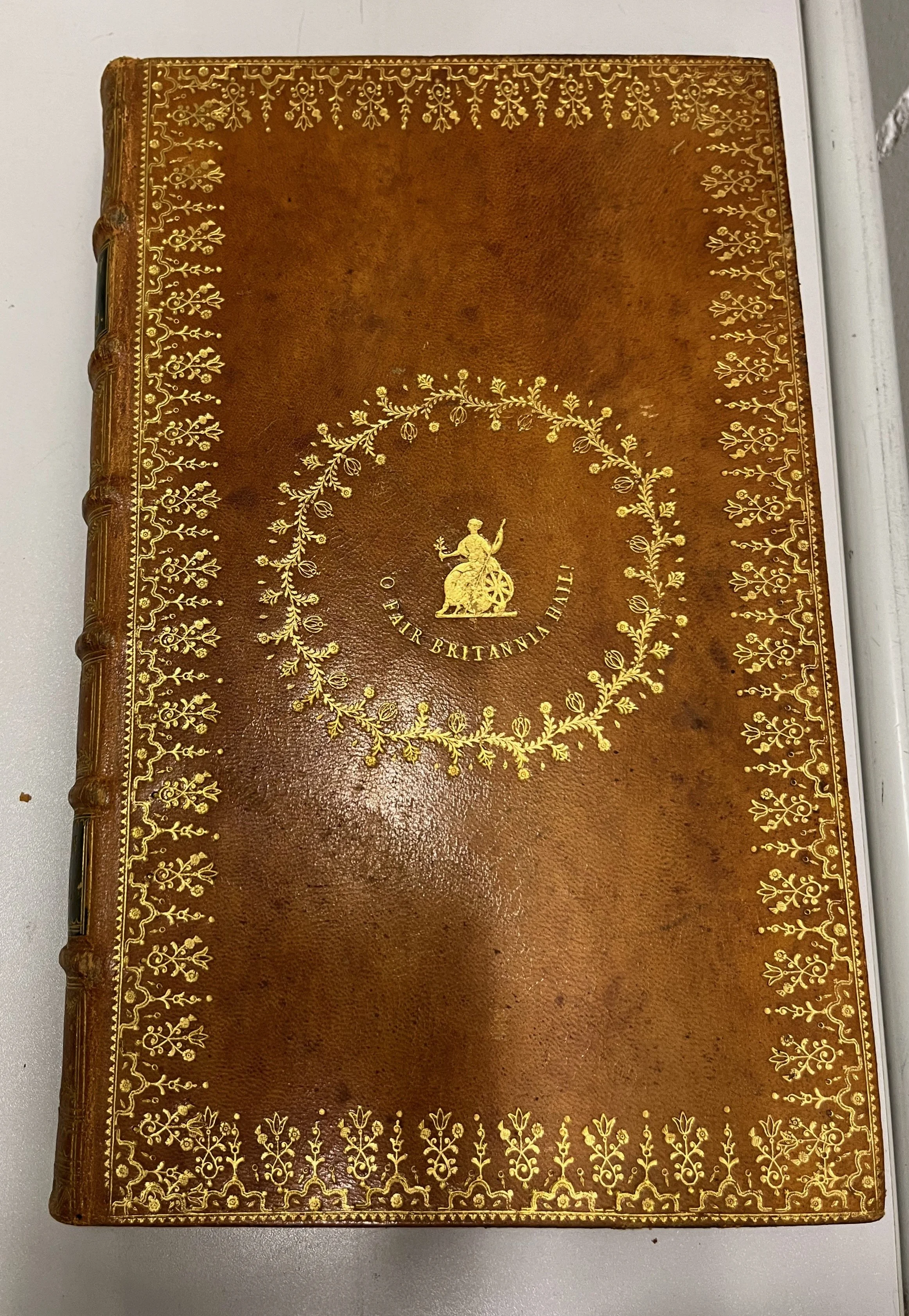
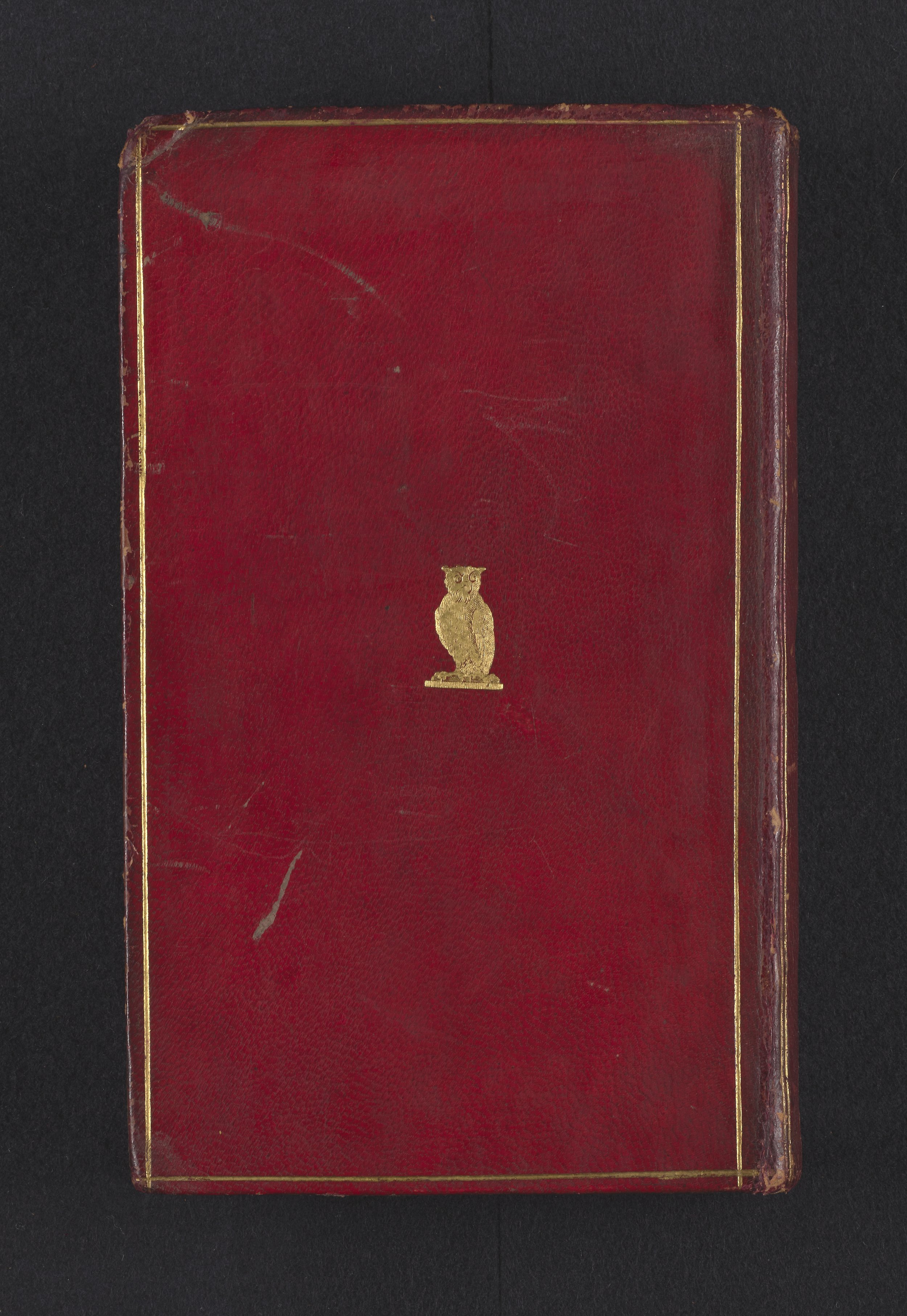
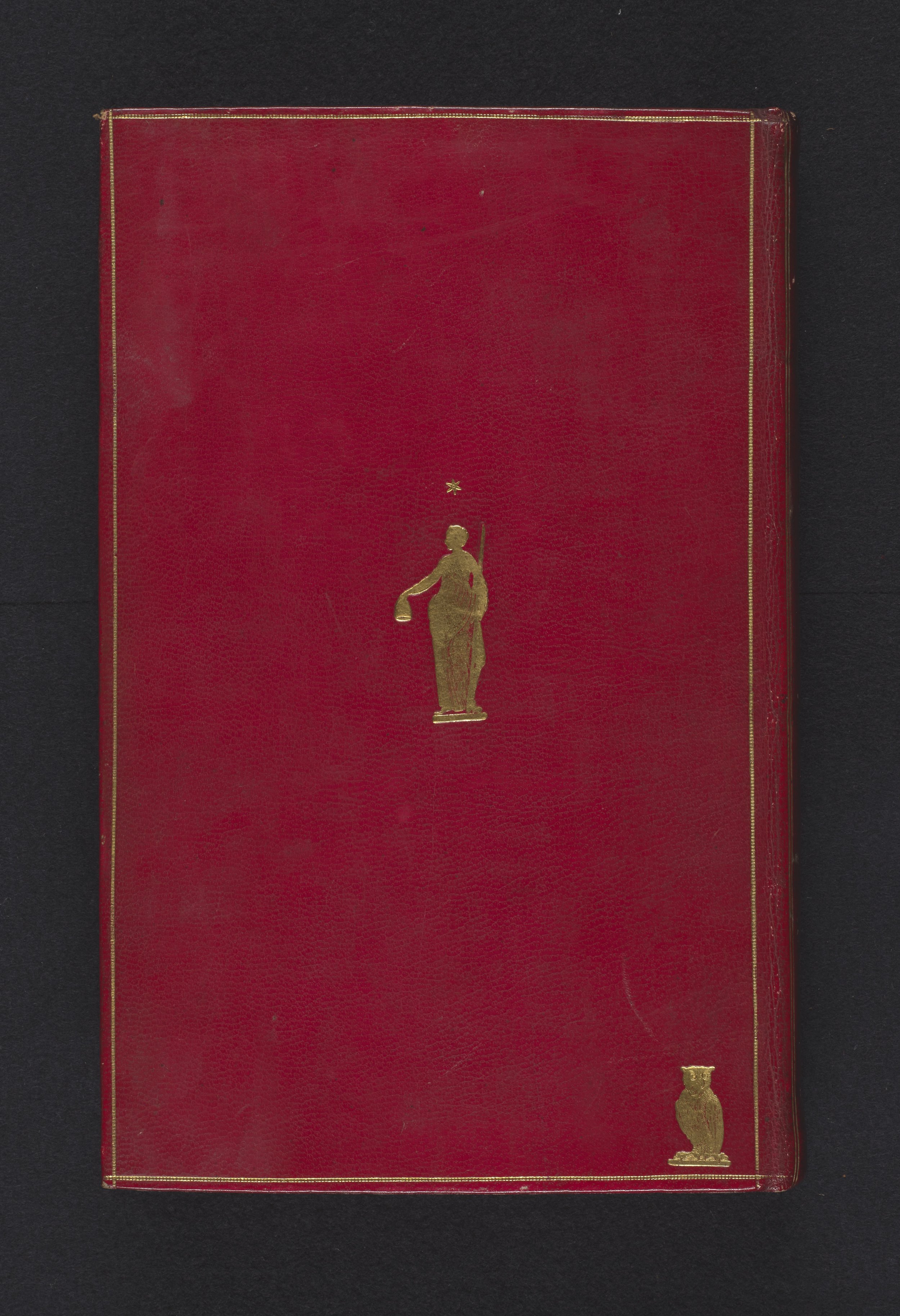
Most of the Hollis volumes at the NLS are bound in red Morocco with symbols added to the cover in gold tooling and stamped in black ink on the inside pages. They were the work of John Matthewman, who was Hollis's main bookbinder until around 1769 when he absconded due to a debt.

Henry Neville, Plato Redivivus, or a dialogue concerning government (London, 1763). National Library of Scotland: ([Ad]. 7/1.8). Image credit: National Library of Scotland.

Among the volumes sent to the Advocates Library were several works from the commonwealth tradition. These include Henry Neville's Plato Redivivus, which had first appeared in 1681 at the time of the Exclusion Crisis. It sought to apply the principles set out by Neville's friend James Harrington in The Commonwealth of Oceana (1656) to the very different political situation of the 1680s. The work was republished by Andrew Millar in 1763. Hollis seems to have been quick to call for a second edition since an entry in Hollis's diary for 15 November the following year records a conversation Hollis had with Millar in which he 'Engaged him to reprint, that master-work intitled "Plato Redivivus. Or a Dialogue concerning Government", written by Harry Neville the friend of James Harrington, and like him ingeneous.' (The Diary of Thomas Hollis V from 1759 to 1770 transcribed from the original manuscript in the Houghton Library Harvard University, ed. W. H. Bond. Cambridge, Mass., 1996. 15 November 1764). The dedication in the Neville volume is a little fuller than the basic version reproduced above, with Hollis declaring himself a lover not merely of liberty but also of 'the Principles of the Revolution & the Protestant Succession in the House of Hanover'. The tools on the cover of this volume are a cockerel on the front and an owl on the back, with a Pilius (liberty cap) on the spine. The cockerel symbolises alertness or vigilance, the owl - wisdom, and the Pilius - liberty. Inside the volume is a stamp depicting Athena (the Greek goddess of wisdom) and one of Britannia (NLS: [Ad].7/1.8).

Also in the collection, though not in an original Hollis binding and probably not donated by Hollis himself, is a copy of Algernon Sidney's, Discourses Concerning Government. First published in 1698 by John Toland, the volume was reprinted several times during the eighteenth century with additional material being added each time. The copy in the NLS is a 1772 reprint of the 1763 edition printed by Andrew Millar that was edited by Hollis and which marked the high point of the work in terms of size, incorporating a biography of Sidney, additional works by him, and letters taken from the Sidney papers. This version includes an Advertisement signed by J. Robertson and dated 21 October 1771, which explains that various corrections (not previously picked up) had been made regarding the names old English names and places. The volume also includes the famous engraving of Sidney that Hollis commissioned from Giovanni Cipriani in which Sidney is dressed in armour and enclosed within a laurel wreath. Below that image, and repeated on the title page and later in the work, is a small Pilius, highlighting Sidney's commitment to liberty.

John Milton, The Life of John Milton (London, 1761). National Library of Scotland, Dav.1.2.10. Image credit: National Library of Scotland.

As well as publishing the first version of Sidney's Discourses, Toland had also published the works of John Milton in 1698. To accompany this, he wrote and printed The Life of John Milton which was then reprinted by Millar in 1761. This was another of the works that Hollis sent to the Advocates Library in the 1760s. It is particularly interesting because it has not one but three gold tools on both the front and the back. On the front is Athena with a branch on one side of her and a feather on the other. On the back the cockerel, Britannia, and the owl. The proliferation of gold tooling perhaps reflects the particularly high esteem in which Hollis held Milton. Hollis referred to Milton as 'divine' and 'incomparable'. And as well as collecting and disseminating Milton's works, Hollis had a picture of him in his apartment and even managed, in 1760, to purchase 'a bed which once belonged to John Milton, and on which he died'. This he sent as a present to the poet Mark Akenside, suggesting that if 'having slept in that bed' Akenside should be prompted 'to write an ode to the memory of John Milton, and the assertors of British liberty' it would be sufficient recompense for Hollis's expense (Memoirs of Thomas Hollis. London, 1780, pp. 93, 104, 112).

Following J. G. A. Pocock, a sharp distinction has tended to be drawn between the commonwealth writers (including Milton, Sidney and Neville) and John Locke. Now much questioned, this distinction also does not appear to have existed for Hollis who felt quite able to celebrate Locke as well as Milton. Several copies of Locke's works appear among the Hollis volumes in the NLS. One of these (a copy of the 1764 edition of Two Treatises of Government produced by Millar) resembles the commonwealth works in depicting Athena on the front and the Pilius on the back (with stamps of a Harp and Britannia on the fly leaves). Another emphasises the association of Locke's works with liberty by repeatedly using the Pilius image (NLS: [Ac].4/1.7).

Finally, several of the volumes donated by Hollis to the Advocates Library focus on religious rather than political matters, including several by the clergyman and religious controversialist Francis Blackburne (1705-1787). Born, like Hollis himself, in Yorkshire, Blackburne lived most of his life in Richmond. Though he became a clergyman in the Church of England, Blackburne subsequently refused to subscribe again to the Thirty-nine Articles, the defining statement of the doctrines and practices of that Church. His best known work The Confessional (which Hollis had persuaded him to publish and to which he gave his commendation 'Ut Spargum' - that we may scatter them) engaged with the history of the Church of England and the controversies over subscription. It was a text that prompted a fierce pamphlet exchange, allegedly amounting to ten volumes worth of material (B. W. Young, 'Blackburne, Francis', Oxford Dictionary of National Biography). The presentation copy of The Confessional that Hollis gave to the Advocates Library bears a stamp of Athena inside the front cover and one of an owl in the back. The front bears a gold tool of Caduceus or staff of Hermes, a symbol of peace and rebirth, and the back a gold-tooled branch with leaves (NLS: Nha.Misc.32).

Francis Blackburne, Considerations on the present state of the controversy between the Protestants and Papists of Great Britain and Ireland (London, 1768). National Library of Scotland: Nha.Misc.31. Image credit: National Library of Scotland.

Hollis also presented a copy of Blackburne's Considerations on the present state of the controversy between the Protestants and Papists of Great Britain and Ireland (1768) which, like the Milton volume, bears more than one emblem on the front and back covers. In the centre of the front cover is a gold-tooled Britannia, with a cockerel placed in the bottom left corner. The back depicts Athena centrally with an owl bottom right. The spine features the Caduceus (Nha.Misc.31).

Though he remained within the Church of England, Blackburne had close family connections to Theophilus Lindsey and John Disney who were involved in the establishment of Unitarianism, suggesting a link to Hollis's own Dissenting position. Moreover, just as Hollis devoted his life to preserving the memory of great thinkers of the past and present, so Blackburne played a crucial role in preserving the memory of Hollis himself. Following his friend's death, Blackburne produced a two-volume account of Hollis's life, which has been described as a 'memorial to Hollis's radical tradition' (Young, 'Blackburne, Francis', ODNB).

A number of the Hollis volumes described in this blogpost will be on display at the 'Encountering Political Texts' exhibition at the National Library of Scotland between Friday 8th December 2023 and Saturday 20th April 2024.

Moderation and Enlightenment

The week commencing 17 January 2022 was a bumper one for conferences at Newcastle University, with not one but two events organised by members of our Ideas and Beliefs research strand in the School of History, Classics, and Archaeology. Both hosted excellent papers, and so, while it means a disruption to the series on British Republicans that I started in January, it seems appropriate to devote a blogpost to each conference.

Here, I will focus on 'What was Moderate about the Enlightenment? Moderation in Eighteenth-Century Europe', organised by Dr Nick Mithen - a Marie Sklodowska-Curie Fellow currently based at Newcastle University. This conference grew out of Nick's research project Via Media Italica: The Scholar, the Jurist, the Priest: Moderation on the Italian Peninsula, 1700-1750. As the title of the conference indicates, the aim was to explore the complex relationship between moderation and enlightenment.

Of course, a conference on the theme of moderation inevitably sparks discussions over how that term should be understood. In this regard I was struck by the parallels between the difficulties that arise when applying the term 'moderation' to the eighteenth century and those surrounding early modern 'radicalism'. In the case of 'radicalism' a key issue is that the term was not coined until 1819, so it may be argued that it is anachronistic to apply it to the seventeenth and eighteenth centuries since no-one engaged in politics at that time would have called themselves 'radicals'. By contrast, 'moderation' was a term used in the eighteenth century and several thinkers discussed at the conference did use it to describe themselves. In his keynote address, John Robertson provided examples of David Hume's use of the term. Yet, understanding what figures like Hume meant by it - or what we might mean by applying it to the period of the Enlightenment - remains a tricky issue. In part this is because, just like 'radicalism', 'moderation' is often understood in relative rather than absolute terms. As one contributor, Doron Avraham, asked explicitly - can we speak of a 'moderate ideology' or is moderation always just a middle way between two other positions?

This leads on to the question of whether we can describe specific individuals as 'moderate'. To return to Robertson's keynote, Hume might appear quintessentially 'moderate' on a range of issues and was explicit about the value of moderation in relation to party politics but it is difficult to understand either his religious views or his attitude to race in this way, making it problematic to regard him as a proponent of Enlightenment moderation. Damien Tricoire prompted similar arguments in relation to Denis Diderot. Diderot has often been presented as a 'radical' thinker, yet a convincing case was put for him being seen as a 'moderate', since he rarely questioned the existing political order of his society and was careful about what he said publicly. Working in the opposite direction, Carlos Perez Crespo challenged the idea that Emmanuel-Joseph Sieyès's conception of sovereignty was an act of moderation, arguing - on the basis of a careful dissection of Sieyès's position - for his radicalism on this point. Other contributors provided examples of individuals who appeared moderate at one point in their careers, but not at others. For example, Niklas Vogt, the subject of Matthijs Lok's paper, constantly adjusted his position in response to changing political circumstances. As well as defining and redefining their position in relation to events, individuals might also do so in relation to others. Vera Fasshauer's paper on Johann Konrad Dippel's quarrel with the Halle Pietists demonstrated this very clearly. She ended her paper by raising the pertinent question of which position was more moderate - that of the Pietists who sought to avoid confrontation or that of the radicals who insisted on the toleration of different opinions? The question of what constitutes a 'moderate' position is a particularly difficult one to answer in the case of eighteenth-century women writers. Simply writing and publishing could be seen as a radical act for an eighteenth-century woman, but acknowledging this makes it difficult to distinguish between what we might think of as more clearly 'radical' writers and more 'conservative' ones. This is an issue that Geertje Bol is addressing directly in her work on Mary Astell and Catharine Macaulay, and her discussion of Astell's clever redefinition of moderation as 'zeal directed towards the proper (spiritual and moral) ends' was revealing in this regard.

Anna Letitia Barbauld by John Chapman after unknown artist. Stipple engraving. 1798. National Portrait Gallery, NPG D4457. Reproduced under a creative commons licence.

A number of papers presented the idea of moderation as a tempering tendency that might be applied to a range of different views. Thus Nicolai von Eggers presented the idea of the comte de Montlosier moderating the counter revolution, while Natasha Lomonossoff described Anna Barbauld's position as one of 'moderate radicalism'. Similarly, Elad Carmel began his paper by telling us that in an unsent letter to Hume, Robert Wallace had described himself as a 'moderate freethinker', while Mark McLean showed how Lord Hailes (Sir David Dalyrmple) combined the moderation of the Scottish Enlightenment with Christian orthodoxy.

All of this raises the question of how moderation was to be enacted and here too there was a range of interesting responses. For some of the authors discussed, it was a question of balance, whether through the mediating role of a particular group such as the nobility or whether through a careful institutional system of checks and balances. For others it was about identifying and following a middle way. As Matilda Amundsen Bergström showed, Hedvig Charlotta Nordenflycht sought a via media between Enlightenment thought and more traditional Swedish ideas. Similarly Anna Barbauld sought a middle way between stasis and revolution, and Robert Wallace attempted to navigate between those who rejected Christianity and those who rejected any investigation of religion.

Philip Doddridge by George Vertue after Andrea Soldi. Line engraving. 1751. National Portrait Gallery, NPG D2278. Reproduced under a creative commons licence.

A moderate position was often associated, as Shiru Lim reminded us, with the promotion of civility and the banishing of disagreeability, and also with the adoption of peaceful rather than violent means. Lim's own paper explored the role that theatre was seen to play by some in the moderation of the passions. Other papers placed emphasis on the dissemination and discussion of a range of ideas in the spirit, pace Anna Barbauld, of using persuasion rather than force and of convincing rather than imposing one's views on others. Pauls Daija's fascinating paper on the Baltic case, focused on the use of education for the purposes of moderation, with books being deliberately directed at Latvian peasants to prepare them for freedom. In this case there was some care taken over the type of material that was shared, with an emphasis on useful knowledge and civilising literature rather than overtly political works, but in other cases a more open policy was adopted. For example, Robert Strivens demonstrated that Philip Doddridge presented texts expressing a wide variety of opinions to his students, deliberately exposing them to writings that opposed his own views. Similarly, Doron Avraham mentioned a multilingual version of the New Testament produced by the Pietists, which was designed to meet the needs of all confessions within the German lands.

Portrait of Hedvig Charlotta Nordenflycht by an unknown artist. Reproduced from Wikimedia Commons.

The very notion of a multilingual Bible as an agent of moderation highlights the importance of genre and the role it could play in the process of moderation. This theme, which is close to my current interests, was also reflected in Bergström's discussion of Nordenflycht's writings. Her use of poetry to discuss philosophical matters may seem strange to twenty-first century eyes, but Bergström made clear that it was not unusual for Swedish writers at the time. However, the particular form Nordenflycht adopted in one of the texts discussed - with a first section consisting of questions addressed to a leading Swedish scholar and a second part offering replies - was particularly appropriate to the pursuit of a moderate line. Similarly as Marc Caplan demonstrated, Isaac Euchel's play Reb Henoch: Oder Woss tut me damit? deliberately used linguistic pluralism as a means of reflecting different viewpoints.

As is often the case with such discussions I came away less sure of what 'moderation' means in the context of the eighteenth century than I was at the start, but I was certainly more enlightened!

An Interlude: Thinkers as Readers

Programme for the workshop ‘David Hume as Reader: The Authors who Provoked Hume’, 03.05.19.

Programme for the workshop ‘David Hume as Reader: The Authors who Provoked Hume’, 03.05.19.

In my last few blogposts I have been examining some of the thinkers whose works influenced James Harrington's The Commonwealth of Oceana. There are more figures I want to explore in future posts, but this month I want briefly to digress, by looking at someone who was influenced by him: David Hume. This is prompted by the fact that on 3rd May I attended a stimulating workshop at the Institute of Advanced Studies in Edinburgh entitled 'David Hume as a Reader: The Authors who Provoked Hume'. The workshop was organised by Max Skjönesberg and Robin Mills and included excellent papers by various scholars each of whom examined the ways in which the works of a particular thinker or genre influenced - or, in the words of the workshop’s subtitle, provoked - Hume. Working on my own paper for this workshop, at the same time as thinking about the various authors who inspired Harrington, led me to reflect more generally on this approach to the history of political thought, what it reveals, and how it could be used to enhance and enrich more conventional studies.

Of course, focusing on authors as readers of other authors immediately brings to the fore various problems. Several speakers at the workshop raised the question of what might constitute reliable evidence of one author having read another. The catalogue of a thinker's personal library, or one to which we know that thinker had access (as in the case of Hume and the Advocates Library), can be useful in this regard. The presence in such a catalogue of a particular book makes it possible, in some cases even probable, that the thinker had read that work, but on its own it cannot prove that (s)he did so. Even when it can be established that a thinker did read a particular work - for example where annotations in their own hand are found in a copy of the work, or where references are made in a commonplace book, diary or correspondence - it does not necessarily follow that that reading then influenced their own thought or writings. 

A more fruitful indication is evidence of one author borrowing (whether explicitly or implicitly) from another. In future, further advances may be made in this area as a result of improvements in digital technology, such as the development of sophisticated machine reading software. Yet it is also important to remember that a lack of critical engagement with a work does not necessarily constitute proof that the author has not been influenced or provoked by it. Furthermore, awareness of the ideas of a particular thinker may develop by reading abridgements or reviews rather than the work itself, or via discussions in settings such as debating societies or political clubs.

Statue of David Hume on the Royal Mile in Edinburgh.

Statue of David Hume on the Royal Mile in Edinburgh.

A second observation to be made is that influence itself does not always take a simple form. This is something that I was particularly aware of in exploring Hume's reading of Harrington. Occasionally it is possible to identify an example of one thinker directly appropriating an idea from another. Hume, for example, adopts Harrington's preference for the rule of laws rather than men, though we might query whether he derived this directly from Harrington's works or via an intermediary and, indeed, whether Oceana was the true origin of that idea. Elsewhere we can find examples of thinkers embarking from a similar starting point, but moving in different directions, or of them using different methods to achieve similar ends. Alexandra Chadwick offered an example of the former in her paper on Hobbes and Hume, where she showed that they started from similar foundations in terms of their views of human nature and psychology, but diverged with regard to the vision of mankind and society that they sought to paint. Working the other way around, I noted that Hume shared Harrington's concern with accountability, but rejected his mechanism of rotation of office, and instead sought alternative measures to achieve that end. 

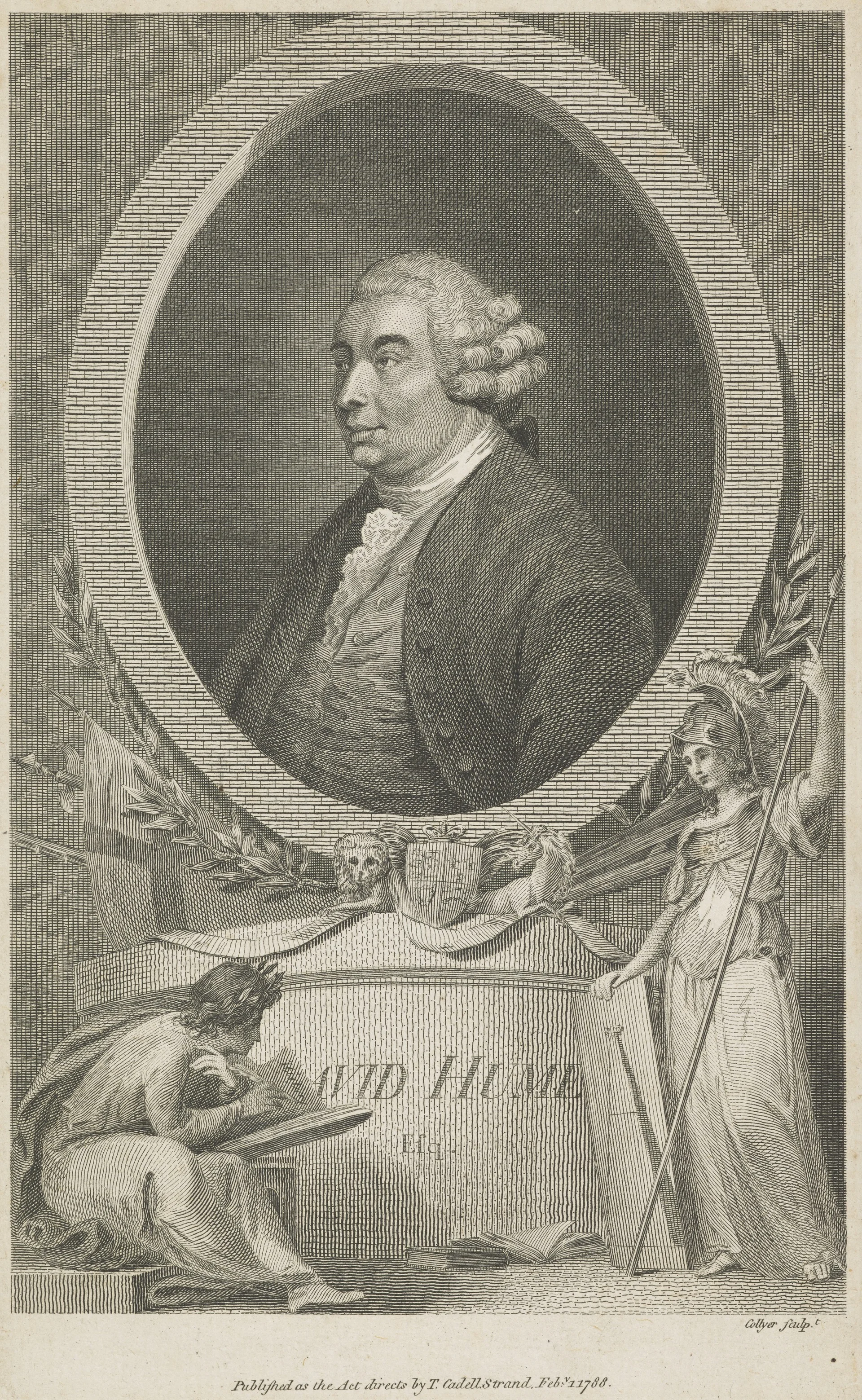
Joseph Collyer, portrait of David Hume, Scottish National Portrait Gallery SP IV 7711.

Joseph Collyer, portrait of David Hume, Scottish National Portrait Gallery SP IV 7711.

This idea shades into another way of thinking about influence, which was explicitly articulated by Tim Stuart-Buttle, whereby one thinker generates problems or questions that are then addressed by later generations. This astute observation raises further questions and complexities. It might equally be the case that two contemporary thinkers engage with similar problems or adopt similar approaches not because one has influenced the other, but simply because they are operating within a common political and cultural context. Tim Hochstrasser suggested that this perhaps explains at least some of the affinities between Voltaire and Hume. Richard Whatmore complicated the idea in a different way, suggesting that it sometimes appears as though an author is only influential when (s)he is totally misunderstood by the next generation. Among the papers at the workshop there were certainly several examples of reading against the grain. For instance, Danielle Charette suggested that Hume did not read Machiavelli in the traditional way, but instead sought to move beyond the moralism of many eighteenth-century accounts, modelling instead how Machiavelli might be read fruitfully in the modern world.

While undoubtedly complex, there can be no doubt that juxtaposing authors in this way and examining in detail the connections - and the divergences - between their ideas, can enrich our understanding of the thought of both thinkers. On the basis of this, I was led to wonder whether focusing on reading might provide us with a new dimension to the exploration of intellectual history. Reading offers a middle way between the traditional 'great thinkers' approach to the history of political thought and the contextual methodology pioneered by members of the Cambridge School. Cambridge School historians quite rightly challenged the assumption that the great thinkers of the past were simply conversing with each other and were unaffected by the historical events and more trivial and quotidian intellectual debates going on around them. They have shown, for example, that Hobbes was deeply affected by the experience of living through the English Civil War and was responding to contemporary debates, such as that surrounding the swearing of the Engagement Oath - an oath of loyalty to the new regime in the aftermath of the regicide. Yet this emphasis on historical and intellectual context can sometimes lead us to forget that these people also read and responded to the writings of prominent thinkers who had gone before them. By adding some consideration of who and what thinkers of the past were reading, alongside what they were experiencing and which intellectual debates they were engaging with, we can perhaps produce a richer and more nuanced understanding of the genesis of their ideas.