Republican Bodies

Durham on the morning of Thursday 18th September 2025. Image by Rachel Hammersley.

On Thursday 18th September I enjoyed a last fling of summer freedom before term began in earnest. On a bright and sunny morning I took the train to Durham for a workshop I had planned alongside two colleagues, Jamie Gianoutsos and Amanda Herbert. The seed had been sown at a conference almost exactly two years earlier, when I heard Jamie speak about her research on the medical writings of Marchamont Nedham and their relevance for his political ideas. It struck me that there were interesting similarities between Nedham's thought in this area and the ideas of his fellow republican author James Harrington. Both men drew on Helmontian thought, particularly the notion of vital spirits; and in both cases there appeared to be a direct connection between medical theories and republican politics. My intellectual biography of Harrington includes a chapter on his natural philosophy in which I explored his ideas on this topic, but I had always felt that there was more to be said

The plan to pursue our shared interests in this topic was encouraged by two factors. First that Jamie, who is based in Maryland in the US, was going to be in Dublin for the autumn semester of 2025, and secondly that in the intervening period I kept coming across other scholars whose work seemed to touch on similar ideas - including Gio Maria Tesserola on Harrington and John Streater and Tom Ashby on Algernon Sidney. Slowly, the plans for the workshop began to take shape. IMEMS at Durham very kindly agreed to host us. Keen to keep things as informal as possible - and to involve colleagues based abroad who could not travel to Durham for the occasion - we opted for a hybrid format and for sharing and discussing primary sources rather than presenting full papers. By the beginning of September we had nine speakers and several other interested participants. What follows are my reflections on some of the themes that emerged from our discussions.

The metaphor of the body politic was not distinctive to republican thought, it had also been central to traditional monarchical understandings of kingship. James VI and I drew on the idea in The Trew Law of Free Monarchies:

And the proper office of the king towards his subjects agrees very well with the

office of the head towards the body and all members thereof, for from the head,

being the seat of judgement, proceeds the care and foresight of guiding, and 

preventing all evil that may come to the body or any part thereof. The head cares

for the body: so does the king for his people. As the discourse and direction flows

from the head, and the execution according thereunto belongs to the rest of the

members, every one according to their office, so it is betwixt a wise prince and his

people.
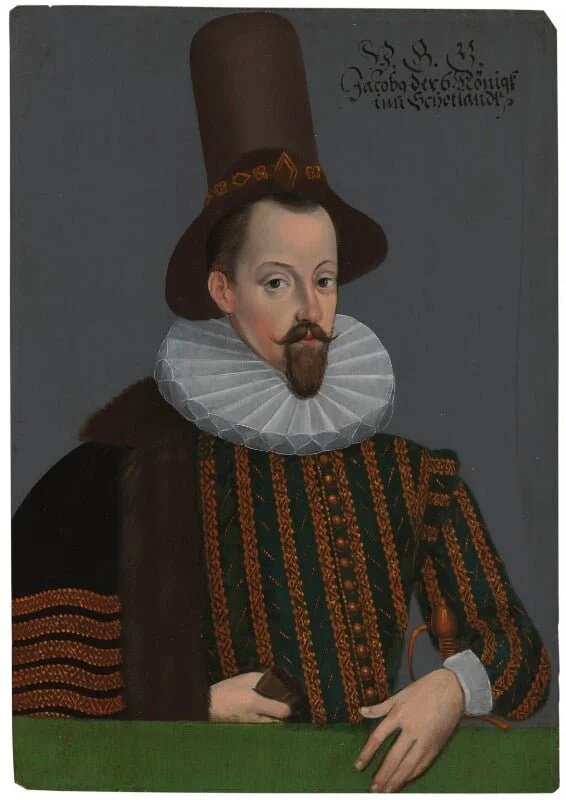
(James VI and I, The Trew Law of Free Monarchies (London, 1598).

The body politic metaphor was also deployed by Thomas Hobbes who described the state as a union understood as a civil person or an artificial man. This raises the question of why republican thinkers of the seventeenth and eighteenth centuries drew on this monarchical commonplace of the body politic to articulate their understanding of politics?

One obvious reason for the widespread deployment of this metaphor is its utility. Like human bodies, bodies politic tend to be subject to periods of health and sickness, and just as doctors seek ways of establishing and prolonging health and preventing illness in their human patients, so those interested in politics and government are keen to promote the well-being of the body politic and stave off corruption and decay.
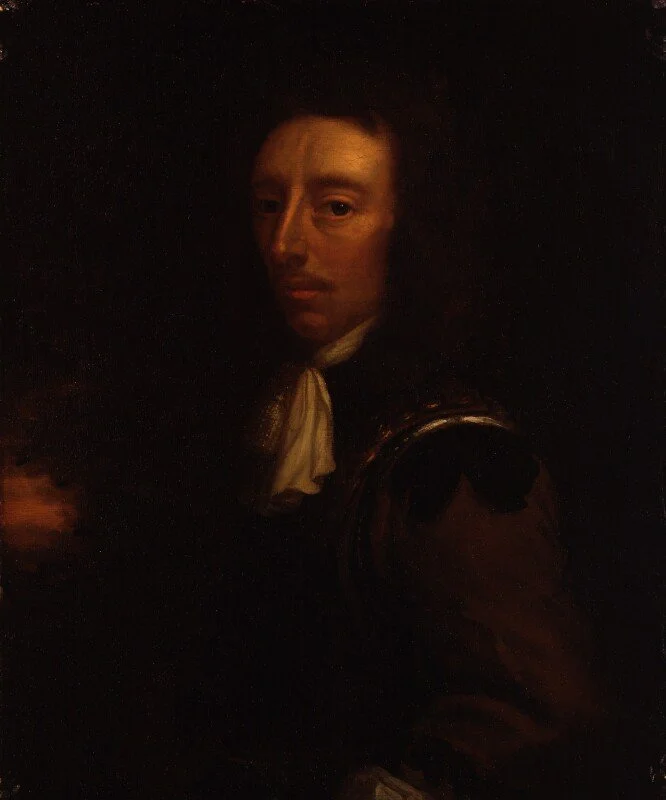
Algernon Sidney, after Justus van Egmont, based on a work of 1663. National Portrait Gallery, NPG 568. Reproduced under a Creative Commons Licence.

In this regard, the experience of ancient Rome was an obvious exemplum for early modern thinkers. Several workshop contributors commented on the fact that the decline and fall of Rome often served as a reference point. For example, Jamie noted that the advanced age (and associated corruption) of the Roman state was said to be reflected in the fact that the men were perfumed and had soft hands. In his paper, Tom Ashby pointed to Algernon Sidney's views on this issue. Sidney insisted, that owing to the Fall, corruption and death (of both the human body and the body politic) were unavoidable and the perfection of virtue impossible. He used analogies with athleticism and physical perfectibility to illustrate this. In the Discourses Sidney described the accumulation of wealth in Rome by the state and by private men as 'a most dangerous disease, like those to which human bodies are subject when they are arrived to that which physicians call the athletick habit, proceeding from the highest perfection of health, activity and strength' (Algernon Sidney, Discourses Concerning Government, Chapter 2, 14). Sidney saw value in striving for perfection (even if it was unattainable), but he cautioned that as the state got close to the peak of perfection greater vigilance was needed to maintain health and stave off corruption.

Other papers, too, emphasised this idea of vigilance. In her discussion of colonial America, Becca Palmer noted the intertwining of the moral and the political in the republican ideal of a watchful citizenry. In this colonial context, the vigilance of citizens was deemed crucial to the preservation of both bodily and state health and the avoidance of decay. Jamie demonstrated that vigilance was also an important concept for Marchamont Nedham, who emphasised the threat of disease and corruption coming not just from outside the body but also from within. He spoke of the craftiness of disease and of the need to be on guard to prevent it from taking hold.

While some early modern writers stressed the need for vigilance, others insisted on the need to purge corrupt elements. Borbala Pigler noted that in the sixteenth century colonisation was seen as a means of purging a diseased and stagnant body politic, by offering an outlet for the excessive or corrupt elements of the population. By the eighteenth century, as Amanda explained, the purging of the body through blood letting was likened to elections - for example by Benjamin Rush. On his account, elections were a means of casting out corrupt members and replacing them with fresh alternatives.
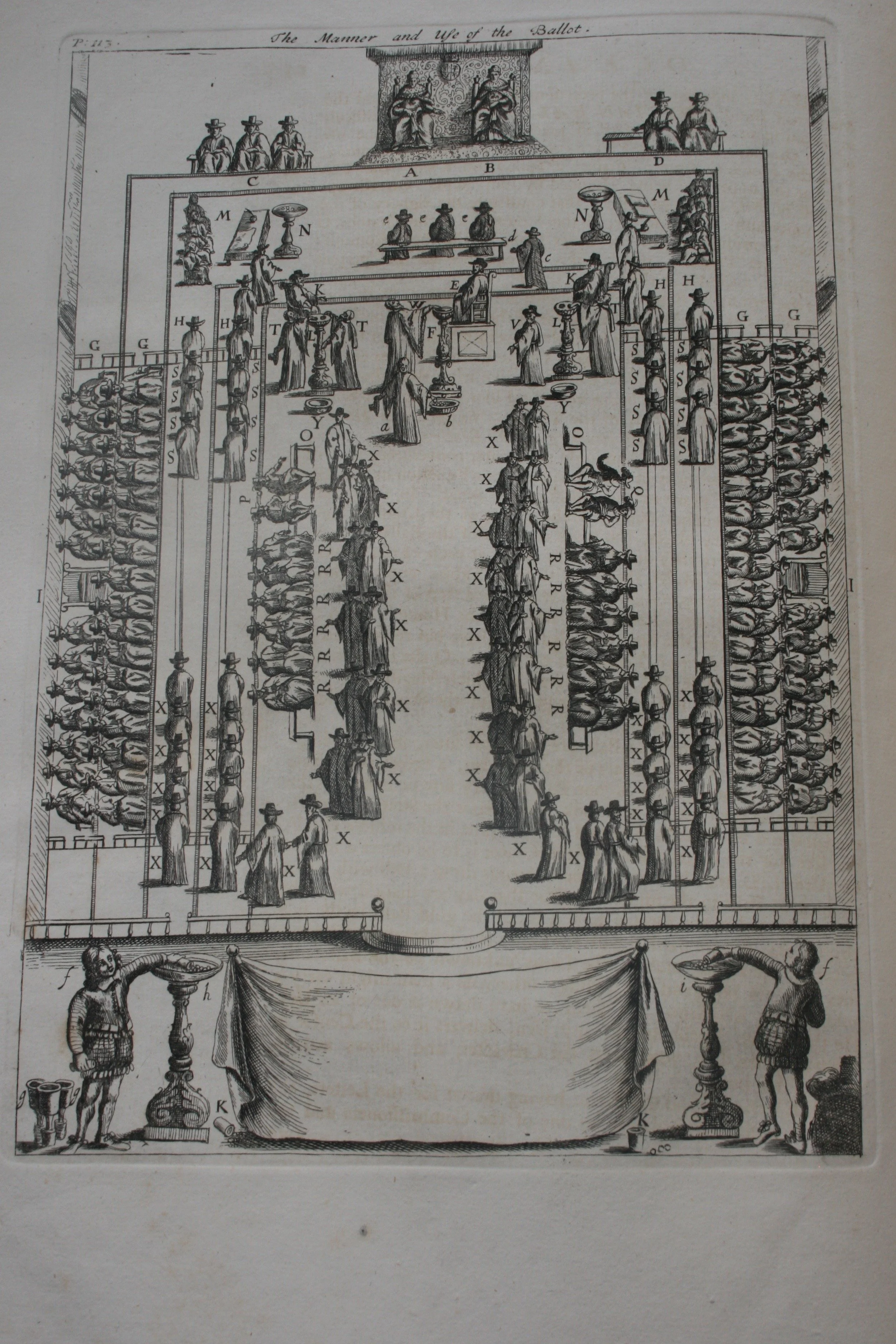
‘The Manner and Life of the Ballot’ from John Toland’s edition of The Oceana and Other Works of James Harrington (London 1737). Volume author’s own. Image by Rachel Hammersley.

Frequent elections were also seen as a means of staving off corruption in the writings of seventeenth-century republicans. Here the emphasis was on avoiding stagnation and decay through constant movement - drawing on the idea of flowing water in a river or blood in the body. Both Harrington and Nedham insisted that there should be constant movement of the people within the body politic through rotation of office, since allowing any individual to remain in power for too long ran the risk of corruption. Becca noted that in eighteenth-century America paper money was viewed in similar terms as a way of ensuring constant movement within the state and thereby staving off degeneration.

A second theme that emerged from our discussions centred on the idea that while bodies epitomise our shared humanity (and therefore our shared membership of the republic) there was also a sense in the past of the need to treat different bodies differently. This problem was introduced in theoretical terms in Borbala's contribution on 'The justice of the body politic' in which she showed how in sixteenth-century England Aristotle's notion of distributive justice was applied to both the state and the human body. According to this understanding, each separate part (each organ or each member of the body politic) had to function well in order for the whole to remain healthy. This was, of course, different from saying that all had to be treated the same or to be given the same role, and in this way it allowed for the inclusion of different groups. For example in the publication Here Begynneth the Kalender of Shepardes (London, 1518) which, as Borbala showed, was suffused with the Aristotelian conception of justice, women were included as a category in their own right (not simply as wives or daughters) and their main duty was obedience. Though it is interesting to note that the Kalender also refers to female shepherds who serve the same function - and are therefore to be treated the same - as their male counterparts.

Leila Marhamati gave a striking example of an unconventional female bodily metaphor for the body politic taken from Machiavelli's Discourses that was originally highlighted by John Freccero. Alongside the conventional allegory of the passive female body politic that was subject to violation by invaders, Machiavelli offered the example of Caterina Sforza. When her fortress was under attack, Sforza is said to have responded to the threat that her sons would be killed, by lifting up her skirts and reminding her opponents that if they carried out this threat, she had the power to make more children. As Leila highlighted, this used the generative power of women as the basis for their claim to a more active role within the body politic. Of course, the notion of republican motherhood was an idea that was picked up later on, not least in a colonial context. Yet Leila cited letters sent to John Adams when he was President that demonstrate the complexity of this notion. Some women reported urging their sons to fight for the defence of their country, clearly accepting the sacrifice they may have to endure as a result. Others appealed to Adams as a parent himself, insisting that his focus should be on striving for a more secure and prosperous future for their children and grandchildren.

In practical terms there was a recognition that male and female bodies were different and needed to be treated differently. Amanda explained that eighteenth-century spas were open to men and women but that women tended to go with different ailments from men; and there was also a sense that women might need a gentler regime to avoid being overwhelmed. By contrast, black male bodies, which were also treated at colonial spas, would often be subjected to particularly harsh regimes on the grounds that it would make them more productive labourers.
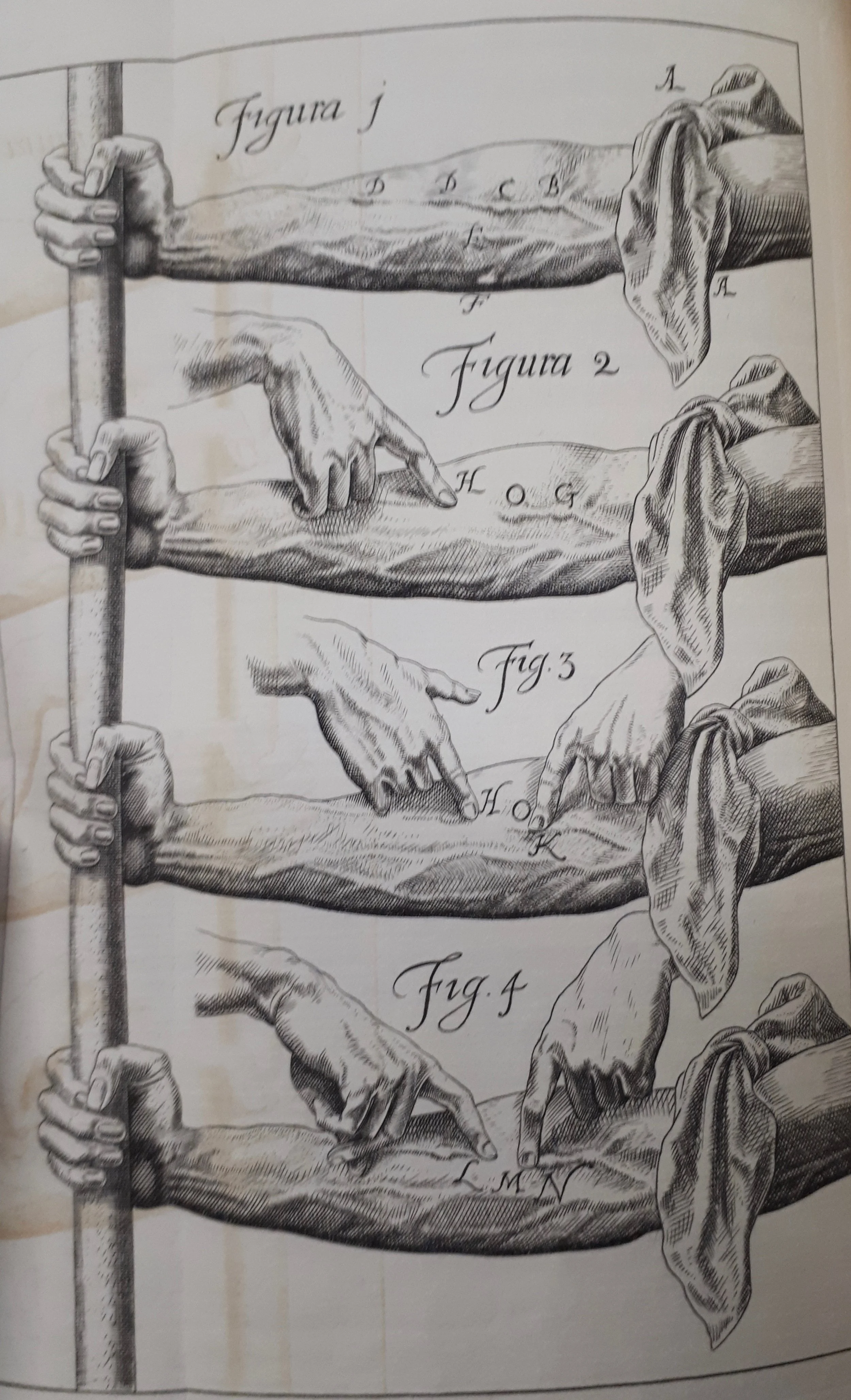
Image from William Harvey’s Exercitatio Anatomica de moto cords et sanguines in animali (1628). Reproduced with permission from the Philip Robinson Library. Special Collections. Pybus Collection Pyb. C. v.9.

Finally, our discussions prompted some methodological reflections on approaching a topic like this from a modern perspective. The disciplinary boundaries that we take for granted did not exist before the nineteenth century, so a thinker like Nedham would probably not have seen his medical work as divorced from his political thinking as we do today. Moreover, in the case of those (like Nedham, Harrington, and Streater) who were influenced by Helmontian thought, there is the difficulty of trying to make sense of their understanding of ideas that we now know to be false. As Gio Maria noted when thinking about Harrington's debt to the scientific theories of Francis Bacon and William Harvey, we need to remember that these figures too were influenced by alchemical, magical and theological approaches to the study of nature. Gio Maria reminded us that the seventeenth century was a transitional period, one in which thinkers were deliberately seeking to adapt older ideas to the new republican cause.

Samantha Wesner's talk on the application of theories about electricity to politics during the French Revolution suggested that something very similar was going on at that transitional moment. She showed that electricity became an important metaphor for republican politics at the time. This was in part because it helped to make sense of the difficult - but crucial - republican concept of the general will. French republicans in the early 1790s were grappling with just how a republican nation could be made to cohere and move as one. At that time electricity was a new scientific discovery and, like the general will, it was invisible and therefore difficult to comprehend. Yet, in the demonstrations that were common at the time, groups of people could be made to feel the power of electricity as a small shock was passed around the group. Electricity then was a helpful metaphor as republicans reached towards new political ideas that they did not fully comprehend.

So, while it may have started out as a metaphor for monarchical politics, the body politic - and the application of scientific theories to politics that was associated with it - proved useful to the articulation, and even understanding, of new republican ways of thinking about politics.

Corruption

There has been much talk in recent weeks of the presence of corruption in British politics. The Prime Minister and members of the Cabinet appear to be relaxed about accepting gifts from wealthy donors. Keir Starmar is said to have accepted £76,000 worth of gifts since 2019 including £16,200 of work clothing from the Labour peer Waheed Alli, as well as corporate hospitality at Arsenal and Taylor Swift concert tickets. (For an in-depth assessment see Peter Geoghegan, 'Labour and the Lobbyists', London Review of Books, 15 August 2024, pp. 10-12).

Image of the Prime Minister’s official residence at 10 Downing Street, taken from Wikimedia Commons.

Of course, such gifts are nothing new, and the perks Labour ministers have accepted pale into insignificance alongside Boris Johnson's Caribbean holiday on the island of Mustique, courtesy of the co-founder of Carphone Warehouse David Ross, and the refurbishment of his Downing Street flat that was paid for by Lord Brownlow. The idea that being in government brings perks way beyond the imagination of most working people seems to be widely accepted, at least among politicians themselves.

However, there is an issue about the gap that this creates between the Government and those it governs and represents. Another concern is the fact that the gift-givers might expect something in return - such as a blue light escort through the capital or favourable deals and contracts.

Corruption is not a new problem in Britain. As long ago as 1701, a pamphlet was published entitled: The Corruption and Impiety of the Common Members of the Late House of Commons. Its author claimed that the government had fallen into decay and observed that even those candidates who before being elected had insisted that they would be 'True-Representatives of the People' - once in office 'have done nothing worthy of the Name of Englishmen' (The Corruption and Impiety of the Common Members of the Late House of Commons. London, 1701).

While what was meant by corruption in the eighteenth century was not necessarily the same as what is meant by it now, understanding how the term was used then and why it was a cause for concern, might illuminate the issues under debate today.

Image depicting Aristotle. Taken from Wikimedia Commons.

In the late seventeenth and early eighteenth centuries, concern about the problem of corruption was grounded in the understanding that the British constitution required that the three elements of the system - Crown, Lords, and Commons - needed to be balanced with and against each other, so as to ensure that the whole would operate in the interests of the public good. The notion of balance in government was based on ancient ideas: Aristotle's assessment of the advantages and disadvantages of the rule of the one, the few, and the many; and Polybius's suggestion that a mixed government comprising all three could secure the advantages of each without their disadvantages. This understanding of mixed or balanced government - and of the English parliamentary system as an embodiment of it - was voiced by many on the parliamentarian side during the mid-seventeenth-century Civil Wars. More interesting is the fact that in 1642 it was used by the writers of His Majesties Answer to the Nineteen Proposition to counter the demands made of the King in those Propositions:

There being three kinds of government among men (absolute monarchy, aristocracy,

and democracy), and all these having their particular conveniences and

inconveniences, the experience and wisdom of your ancestors has so moulded this

out of a mixture of these as to give this kingdom (as far as human prudence can

provide) the conveniences of all three, without the inconveniences of any one, as

long as the balance hangs even between the three states (His Majesties Answer to the

Nineteen Proposition, London, 1642).

The pamphlet went on to argue that the demands being made by Parliament in The Nineteen Propositions - such as the requirement that all officers and counsellors be approved by Parliament - if adopted, would disrupt the balance by shifting power from the King to the Commons.

For opposition writers in the late seventeenth and eighteenth centuries it was not the Crown that was at risk from the Commons, but rather the Commons that was at risk from the Crown. As the author of The Corruption and Impiety of the Common Members of the Late House of Commons noted:

It hath been a common and known Practice for this Forty Years last past; for Men of

Confidence and ready Elocution, if they could but procure an Election in some little

Mercenary Burrough, and so get into the House, presently to set themselves to

oppose the King and the Court, that they might be bought off by some good

Gratuity; Pension, or Place (The Corruption and Impiety, p. 2).

‘James Murray’, by Pollard, 1770s. National Portrait Gallery, NPG D32123. Reproduced under a Creative Commons Licence.

In order to control Parliament, the monarch and ministers would offer money, pensions or positions to elected MPs. From 1706 the term 'placemen' began to be used to denote those implicated in this practice. According to the Oxford English Dictionary a 'placeman' is: 'A person who is appointed (or aspires) to a position, esp. in government service, for personal profit and as a reward for political support; a yes-man.' Placemen remained an issue throughout the eighteenth century. In 1774 the Newcastle minister and political activist James Murray spoke, via a thinly veiled reference to the Biblical state of Moab, of representatives selling out to the crown for 'places, pensions, and perquisites' so that the institution that was supposed to represent and protect the people's interests and liberties became a means of enslaving them. The system of places introduced was 'only to be enjoyed by the friends of the court, or such as wished well to its interests'. By this means, those appointed by the nation 'to guard their liberties in parliament, were corrupted, and sold their constituents for a place under, or a pension from the government.' (James Murray, New Sermons to Asses. Philadelphia, 1774, p. 9).

Not long after, the newly established 'Society for Constitutional Information' noted that the public had been repeatedly warned about the venality of their representatives and called for various changes aimed at expelling 'minions of a court from the temple of public freedom' and restoring 'parliaments to their original purity and people to their rights'. (A Second Address to the Public from the Society for Constitutional Information. London, 1782, pp. 9-10). The arguments of the Society on this point were again grounded in their understanding of the balance of the constitution and the importance of the three elements - King, Lords and Commons - remaining independent of each other: 'The moment that either the Crown, the Lords, or the Commons lose their independence, in that moment our Constitution is violated, our Government is overturned, and our Liberty is endangered.' (An Address to the public, from the Society for Constitutional Information. London, 1780, p. 1).

The kind of corruption at issue today is, of course, different from that condemned by James Murray and the Society for Constitutional Information. For those interested in the complexity and history of the concept I recommend Mark Knights’s book Trust and Distrust: Corruption in office in Britain and its Empire (Oxford, 2021). Today there are many sources of corruption, but the bottom line is the dominance of private interests, including those of the rich and the powerful, over the public interest or the common good.

British Republicans 2: Richard Carlile

The first volume of Richard Carlile’s periodical The Republican. Bodleian Library: Johnson e.3662 Photograph by Alex Plane, courtesy of the Bodleian Libraries.

On Friday 27 August, 1819, there appeared the first issue of a journal entitled The Republican edited by Richard Carlile. Its publication was a direct response to the Peterloo Massacre that had occurred just under two weeks before. Despite the header declaring it to be 'No. 1. Vol. I.', this was not, in fact, an entirely new journal but, as the editorial explained, the continuation of Sherwin's Weekly Political Register, which had been appearing for several years.

The change of title was, however, deliberate. Carlile was publicly identifying as a 'republican'. In his address to readers that prefaced the first volume he took pains to explain his understanding of the term. Noting that 'it has been the practice of ignorant or evil-minded persons' to associate republicanism purely with 'the horrors of the French Revolution' he urged his readers to look more closely at the etymology of the word. A republican government, he explained, is one 'which consults the public interest - the interest of the whole people' (The Republican, I, 'To the Readers of the Republican'). This, as I have argued in a previous blogpost, accorded with the traditional understanding of the term dating right back to ancient times. Yet, because Carlile was writing in the early nineteenth century, he was well aware of the additional connection that had been forged between republicanism and anti-monarchism. He engaged directly with this point, arguing rather cleverly that: 'Although in almost all instances where governments have been denominated Republican, monarchy has been practically abolished; yet it does not argue the necessity of abolishing monarchy to establish a Republican government.' In truth, Carlile believed that securing government in the public interest required a proper system of representation and that if this were to be introduced the abolition of monarchy was likely to follow. Nevertheless, his understanding of the double meaning of 'republican', and his emphasis on establishing government in the public interest rather than simply abolishing the monarchy, indicates continuity with the longer history of English republican thought.

Thomas Paine by Laurent Dubos, c. 1791. National Portrait Gallery. NPG 6805. Reproduced under a Creative Commons Licence.

Carlile also associated his ideas more directly with those of earlier English republicans. He was a committed disciple of Thomas Paine and was responsible for printing and disseminating Paine's works. He was also an admirer of Thomas Spence, declaring that Spence's Land Plan was 'the most simple and most equitable system of society and government that can be imagined' and that it was 'a subject' about which it was 'worth thinking, worth talking, worth writing, worth printing' (Richard Carlile, Operative, 3 March 1839 as cited in Malcolm Chase, '"The Real Rights of Man": Thomas Spence, Paine and Chartism', in Rogers and Sippel (eds), Thomas Spence and His Legacy: Bicentennial Perspectives, special issue of Miranda 13 2016, pp. 3-4). Spence was himself a disciple of the seventeenth-century English republican James Harrington, and Carlile too made frequent reference in his writings back to the period of the Stuarts. He implied that the tyranny enacted by his own government at Peterloo and in its aftermath was similar to that performed by Charles I and his sons. In an open letter to the Prince Regent, which appeared in the second issue of The Republican, he warned the Prince that if he failed to deal justly with the perpetrators of the Peterloo massacre then 'the fate of Charles or James, is inevitably yours. And justly so.' (The Republican, No. 2 Vol. 1. 3 September 1819). Carlile also celebrated the heroic martyrs of the period, including John Hampden and Algernon Sidney.

Carlile repeatedly demonstrated his willingness to act as a martyr to liberty and to sacrifice his own personal freedom in the greater cause by stoically enduring repeated prison sentences. He was imprisoned for his role in publishing Paine’s works in 1819 soon after launching The Republican. This image was produced to celebrate his release six years later. ‘On his liberation after six years of imprisonment’ (Richard Carlile) by an unknown artist, 1825. National Portrait Gallery. NPG D8083. Reproduced under a Creative Commons Licence.

More substantively, The Republican echoed earlier English republican works in celebrating both civil and religious liberty, and in emphasising the interrelationship between the two. In the very first issue, Carlile explicitly declared his willingness to submit to martyrdom 'in the cause of liberty' and in the second issue he accused the despots of Europe of seeking to: 'abridge and destroy the liberties of their subjects, and to make their own authority absolute' (The Republican, No. 1 Vol. 1, 27 August 1819 and No. 2 Vol 1, 3 September 1819). Of particular importance to Carlile were the liberties of free speech and freedom of association. What was particularly galling about the Peterloo Massacre was that the individuals who had been killed had simply been enacting their right, under the British constitution, 'to assemble together for the purpose of deliberating upon public grievances as well as on the legal and constitutional means of obtaining redress' (The Republican, No. 5 Vol. 1, 24 September 1819). Such actions were necessary in Carlile's eyes because, like earlier British commonwealthmen, he believed that the British constitution had become corrupt and its balance disturbed. Echoing the late seventeenth-century thinker Henry Neville, Carlile argued that the balance of the constitution lay too much with the monarch and that too little power was wielded by the House of Commons. It had once dominated the other branches 'but that controul is quite destroyed, and through the influence of Boroughmongering, they are become the base and contemptible tools of every vicious faction that can get into power' (The Republican, No. 4 Vol. 1, 17 September 1819).

Richard Carlile, by an unknown artist. National Portrait Gallery, NPG 1435. Reproduced under a Creative Commons Licence.

Again like earlier English republican authors, Carlile was adamant that citizens should enjoy religious as well as political liberty. Echoing John Milton and other so-called 'godly republicans' of the mid-seventeenth century, he insisted on a clear and complete separation between church and state: 'I maintain on this head, that no government should legislate as to what shall or shall not be the religion of its subjects; or what differences should exist in their creeds' 'an established priesthood, of whatever tenets, is incompatible with civil liberty' (The Republican, I 'To the Readers of the Republican'). Yet in terms of his own personal religious convictions, Carlile had less in common with the 'godly republicans', instead taking the path previously developed by John Toland and his associates at the turn of the eighteenth century, whereby rabid anti-clericalism morphed into deism and even atheism. All forms of religion, Carlile declared, are 'an imposture and fraud practised by base and designing men on the credulous part of mankind' (The Republican, No. 2 Vol. 1, 3 September 1819). By publishing the controversial theological works of Paine, Carlile hoped to be able to emancipate minds from the slavish fears associated with Christianity (The Republican, No. 6 Vol. 1, 1 October 1819). Carlile's readers expressed similar views. In a letter that appeared in the second issue, Joseph Fitch of Old Road Academy, Stepney, praised Carlile for the patriotic firmness with which he faced tyranny after being charged with sedition for publishing the theological works of Paine. He urged those who saw the views voiced by Carlile as a threat to the state to stop being 'the voluntary dupes of priestcraft and corruption' and he ended by urging support for the cause of 'civil and religious liberty' (The Republican, No. 2 Vol. 1, 3 September 1819).

While the continuities between Carlile's understanding of republicanism and that of his predecessors are striking, he also introduced new elements. He was more critical than most earlier English republicans (with the exception of Spence) of the unjust inequalities between rich and poor. In issue six he attacked the 'Prince and Ministers, Sinecurists and Pensioners, Borough-mongers and Fundholders, Bishops and Parsons, Judges and Lawyers' for attacking the lower orders and seeking to keep them down (The Republican, No. 6, Vol. 1, 1 October 1819). He also championed the rights of other marginal groups within society, even asserting that women ought to be accorded political rights (The Republican, No. 5. Vol. 1, 24 September 1819).

Carlile's writings, and the continuity of his arguments with earlier English republicans, challenge the common assumption that the English have no sustained republican tradition. In fact, there is a rich and vibrant vein of republican thinking in this country, one that has been flexible enough to adapt to a variety of different circumstances and issues. The optimism and energy of Carlile's writings stemmed from his firm conviction that the unjust political system of his own day could be completely overturned if only the franchise were extended and the poor were given the vote. On this point history has proved Carlile wrong, which poses challenging questions for democratic republicans today. 

Parliamentary Corruption

The present House of Commons in session. Image from Wikimedia Commons.

During the last month there has been much talk in the UK news about sleaze or political corruption. On 3 November MPs voted by a narrow majority to reform the rules on parliamentary lobbying. This was widely seen as a means of saving Owen Paterson, the Tory MP for North Shropshire, from a 30-day suspension from Parliament after he had been accused of using his position as an MP to benefit two companies for which he worked. It was only the furore this provoked among the press and the public that led Boris Johnson to execute a U-turn, announcing a fresh debate on Paterson's suspension and a willingness to gain cross-party support for the reform of the disciplinary procedure for MPs. While Paterson has subsequently resigned as an MP, this case brought to the surface questionable behaviour by other members of the House of Commons. On 10 November Sir Geoffrey Cox came under scrutiny for the legal work that he carries out alongside his parliamentary responsibilities - including for the British Virgin Islands. Not only had Cox made an agreement to vote by proxy while carrying out work in the Caribbean, but it was also alleged that he had held meetings relating to his legal role from his office in Parliament. The former was within the rules, the latter was not. In response the health secretary Sajid Javid defended the right of MPs to have second jobs, but also made clear that they should not be using Commons' facilities for extra-parliamentary work and insisted that they ought to be devoting the vast majority of their time to their constituents.

Of course parliamentary corruption is nothing new. In the eighteenth century there was concern, particularly among those who called themselves commonwealthmen, about the dangers posed by corrupt MPs, those whose commitment to the public good was called into question because they were subject to other influences. Then, however, the main source of this corruption was not second jobs (most MPs were 'gentlemen' who did not 'work') but rather the monarch and his or her ministers who sought to influence the decisions of the House by putting their own creatures (known as placemen) into the Commons or by offering pensions to those who held office. Yet, despite the difference in the source of the corruption, its significance remains the same.

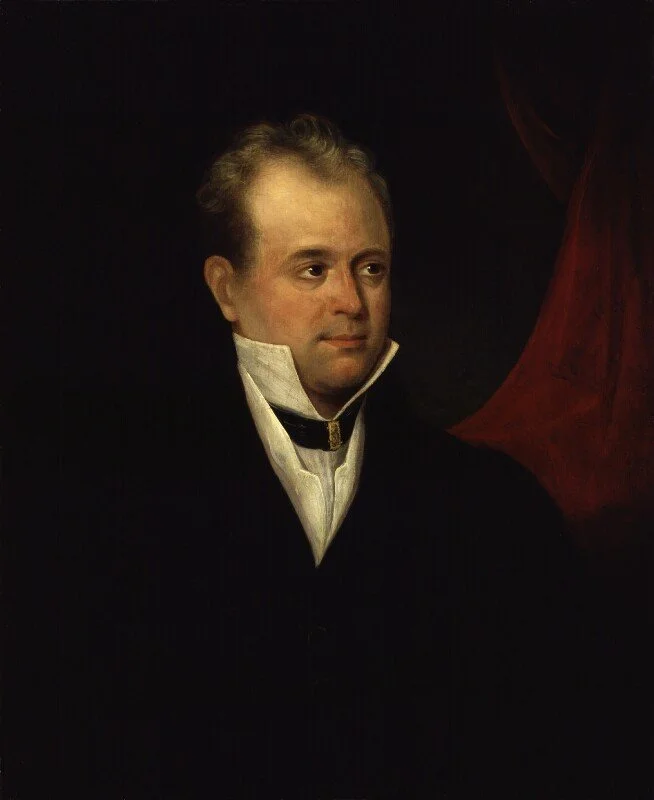
Portrait of John Toland. Taken from Wikimedia Commons.

In the context of the 1698 election campaign, the commonwealthman John Toland produced a short pamphlet entitled The Danger of Mercenary Parliaments. There he argued that a House of Commons filled with officers and court pensioners was a threat to English liberties, pointing out that such a House could not fulfil its role within the constitution. Is it possible, he asked, that 'our Grievances can be redrest, that are committed by Persons from whom there is no higher Power to appeal?' Can there be 'any hope of Justice where the Malefactors are the Judges?' Will the public accounts be 'faithfully inspected by those who embezzle our mony to their own use?' (John Toland, The Danger of Mercenary Parliaments. London, 1698, p. 2). The answers, Toland insisted, were obvious. Indeed he went so far as to suggest that 'all the Calamities and Distractions under which the whole Nation at present groans' were due to 'that bare-fac'd and openly avow'd Corruption, which, like a universal Leprosy, has so notoriously infected and overspread both our Court and Parliament.' (Toland, Danger of Mercenary Parliaments, p. 3).

The only solution, Toland insisted, was to choose MPs who would act according to 'no other motives but the real and true Interest of his Majesty and his Dominions; a Parliament that will fall unanimously upon publick Business, and be free from those petty Factions and personal Piques which in the late Session so shamefully obstructed and delay'd the most importance Service of the Commonwealth.' This required all MPs to be 'subject to the Laws, and to some Power on Earth that may call them to account for their misbehaviours, that they may not be their own judges' (Toland, Danger of Mercenary Parliaments, p. 6). It was, therefore, up to the electors in the forthcoming election to disappoint the 'unreasonable and exorbitant hopes' of those corrupt MPs 'and to spew them out as detestable Members of the Commonwealth; not only as unfit to be trusted with their Liberties, but as unworthy to breath in the air of a Free Government' (Toland, Danger of Mercenary Parliaments, p. 7). Toland was clear that the fact that elections were now held every three years helped in this regard, providing electors with frequent opportunities to hold their MPs to account. Today, of course, general elections are less frequent, meaning that the point made in defence of Geoffrey Cox - that his constituents could vote him out if they were unhappy with his behaviour - does not feel like an adequate solution.

However, Toland's optimism that the problem would be resolved at the forthcoming election was misplaced. More than forty years later, in the context of yet another election campaign, the Scottish writer John Campbell again expressed concern that individual MPs were being diverted by bribes, posts, and pensions and were attached to private interests rather than to the public good. Without banishing corruption, he insisted, 'the Nation never can be out of Trouble, never free from Danger' (John Campbell, Liberty and Right. London, 1747, p. 45).

Campbell recognised that simply relying on electors to make sensible choices was not enough. He therefore proposed two further remedies. First, he called for MPs to be paid a salary (so that they would not be vulnerable to offers of money from elsewhere). Clearly this is no solution to the problems of parliamentary corruption today, since MPs already earn a substantial salary and yet some still have second jobs - though perhaps we should be challenging their right to do so. Surely a job that brings a salary of £81,932 per year (more than 3 times the UK average) is a full-time job that requires the complete attention of the person holding it.

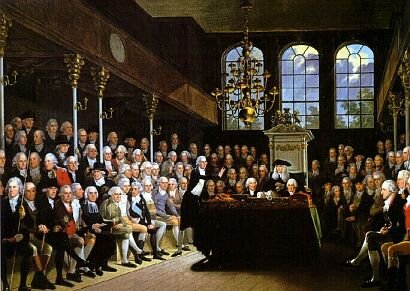
The House of Commons in session in the eighteenth century. Image from Wikimedia Commons

In addition, Campbell linked the corruption of Parliament to the fact that MPs could continue to sit 'one Parliament after another' taking for 'themselves the principal Honours, Places, and Posts of the Country; while Men of Equal, or more extensive Abilities, remain unimploy'd'. (Campbell, Liberty and Right, p. 60). Against this practice he insisted that corruption could only be banished and the public interest secured by frequent and periodic changes to the representative body. In a proposal that clearly owed much to James Harrington's ideas, Campbell insisted that each year one third of the MPs in the House of Commons should be removed and replaced, with those retiring required to spend at least three years out of office before being eligible for re-election.

Not for the first time I am led by current events to think that we have something to learn from the writers of the seventeenth and eighteenth centuries who recognised that in order to secure good government in the public interest it is necessary to have robust systems of accountability. Without these, many will resort to acting in their own rather than the public interest. As Toland and Campbell realised, even those in Parliament must be forced to live under the laws that they make and must not be allowed to act as judges in their own case. How disappointing that, even after three hundred years, we still do not seem to have learned this lesson.

The Inspiration Behind Oceana: 1. Machiavelli: History, Democracy & Human Nature

In January I submitted the final version of my intellectual biography of James Harrington to Oxford University Press. With any luck it will appear before the end of 2019. Consequently, at the start of this new year I have been reflecting on my pursuit of this project and what I have learned from it. One of the particular pleasures of the research has been re-reading not just Harrington's own writings, but also the works of those thinkers who influenced him. This is, then, the first of a series of posts on some of the thinkers who inspired Oceana. Where better to begin than with the great, though controversial, Italian Renaissance political theorist, Niccolò Machiavelli.

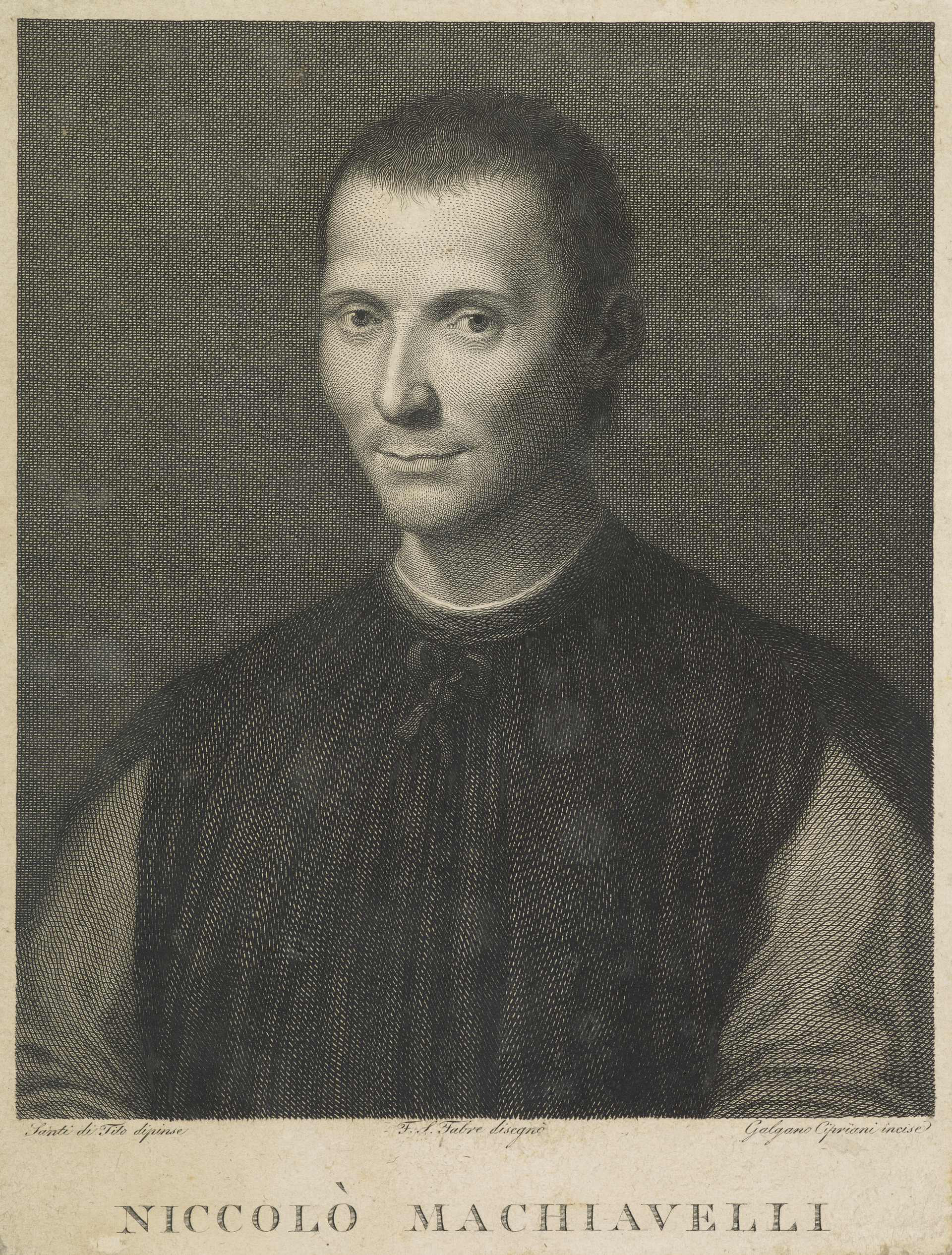
Galgano Cipriani, Niccolo Machiavelli, 1469-1527 Statesman and historiographer, National Galleries Scotland, Accession Number FP I 81.1 https://www.nationalgalleries.org/art-and-artists/34757/niccolo-machiavelli-1469-1527-statesman-and-historiograph…

Galgano Cipriani, Niccolo Machiavelli, 1469-1527 Statesman and historiographer, National Galleries Scotland, Accession Number FP I 81.1 https://www.nationalgalleries.org/art-and-artists/34757/niccolo-machiavelli-1469-1527-statesman-and-historiographer

Various things struck me as I re-read The Discourses after an interval of more than a decade. One of the first was how beautifully Machiavelli wrote. From the dedication I was immediately drawn into the text and looked forward to reading it. Part of the beauty lies in the fact that he is clear about his arguments, stating them openly even when they are controversial. But there is much in the substance, as well as the style, of Machiavelli's works that I found appealing. I want to highlight three aspects of his work here that certainly influenced Harrington and which, I believe, still have relevance today.

In the first place, Machiavelli - like Harrington - is explicit about the benefits of reading history to better understand present politics and make proposals for the future. Machiavelli laments the fact that in his own time people take pleasure in reading about historical events, but do not seem to learn from or imitate them (Niccolò Machiavelli, The Discourses, ed. Bernard Crick, Harmondsworth, Penguin, 1970, p. 98). One purpose of his book is to encourage a new attitude to history, he aims to compare ancient and modern events so as to better understand them 'so that those who read what I have to say may the more easily draw those practical lessons which one should seek to obtain from the study of history' (Machiavelli, The Discourses, p. 99). Machiavelli's historical methodology is vulnerable to criticism on account of his sense that the past and the present are fundamentally the same. It is obviously not appropriate to maintain this view today, and Harrington already went some way beyond Machiavelli in appreciating the nature and importance of change over time. But it would, I think, be wrong to dismiss too quickly Machiavelli's assertion that human nature remains much the same in all times and places: 

If the present be compared with the remote past, it is easily seen that in all cities and in all peoples there are the same desires and the same passions as there always were. So that, if one examines with diligence the past, it is easy to foresee the future of any commonwealth, and to apply those remedies which were used of old; or if one does not find that remedies were used, to devise new ones owing to the similarity between events. (Machiavelli, The Discourses, pp. 207-8). 

It is, Machiavelli concludes, because people do not properly know or understand history that the same problems keep arising.

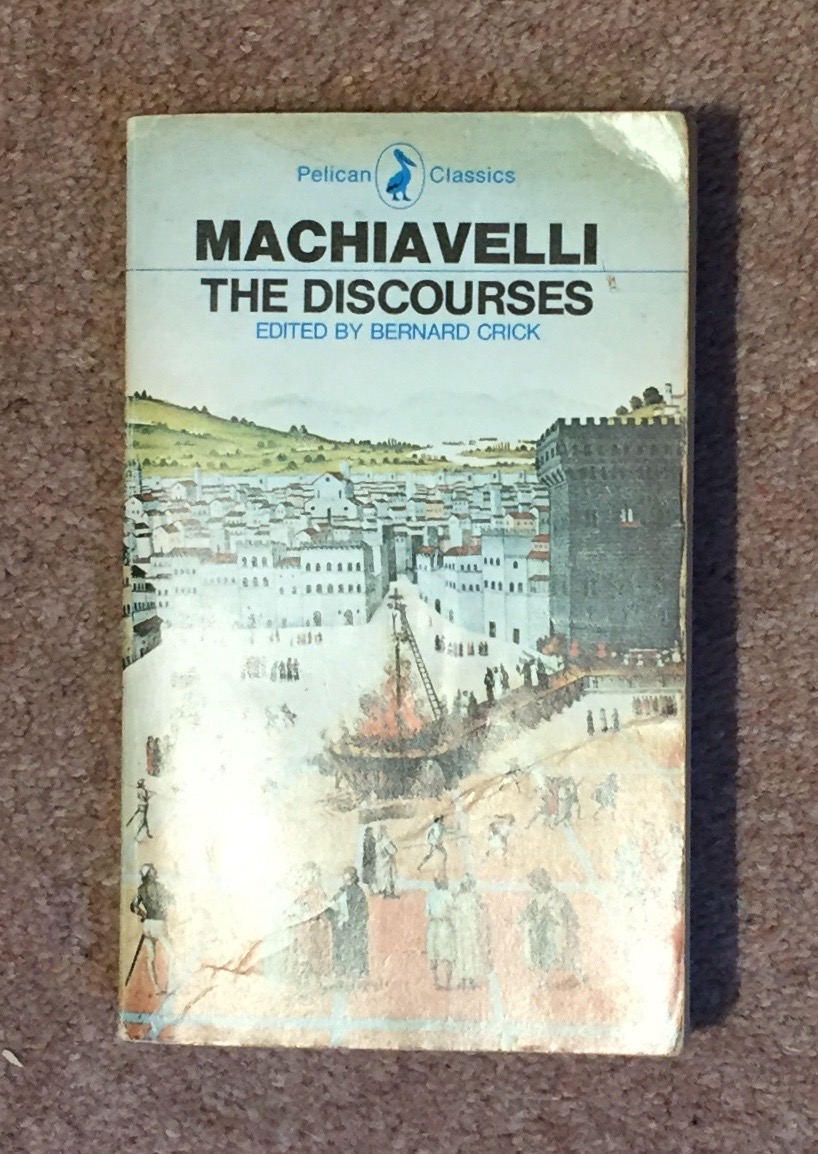
The author’s copy of the penguin edition of Machiavelli’s Discourses.

The author’s copy of the penguin edition of Machiavelli’s Discourses.

One aspect of Machiavelli's understanding of his own past and present which might be of particular interest to us today is what he has to say about popular or democratic politics. As I have pointed out elsewhere, modern democracy is often assumed to be a twentieth-century phenomenon, or at least one that had its origins no earlier than the revolutions of the late eighteenth century. Yet, important discussions on the nature and limitations of democracy took place in seventeenth-century England. Reading Machiavelli reminded me that even seventeenth-century thinkers were by no means the first after the fall of Rome to be interested in the advantages and disadvantages of democratic government. While Machiavelli makes little use of the term 'democracy' he is a strong advocate not just of republican, but of popular, government. As well as claiming that 'it is only in republics that the common good is looked to properly in that all that promotes it is carried out' (Machiavelli, The Discourses, p. 275) he also goes so far as to suggest that 'government by the populace is better than government by princes' (Machiavelli, The Discourses, p. 256). Of course, one has to be careful in interpreting this. The suggestion, put forward by John P. McCormick, that Machiavelli is better described as a democrat than a republican has been challenged on the grounds that he was pessimistic about the capacity of ordinary citizens to govern themselves and consequently insisted on the need for continuous elite intervention in politics (John P. McCormick, 'Machiavelli Against Republicanism On the Cambridge School's "Guicciardinian Moments", Political Theory, 31:5, 2003, pp. 615-43 and Ryan Balot and Stephen Trochimchuk, 'The Many and the Few: On Machiavelli's "Democratic Moment"', The Review of Politics, 74 (2012), pp. 559-88). But, I would argue, what is of most importance is that he engaged with the issues surrounding popular government. Indeed, part of the reason for Machiavelli's preference for popular government was his insistence that the populace can more easily be constrained by laws than a prince, and at the same time if they depart from the law they are less dangerous. Moreover, Machiavelli goes so far as to defend what he admits is an unpopular position. Where most writers at the time dismissed the masses as futile and inconstant, Machiavelli was more cautious: 'The nature of the masses, then, is not more reprehensible than is the nature of princes, for all do wrong and to the same extent when there is nothing to prevent them doing wrong.' (Machiavelli, The Discourses, p. 254).

As this quotation suggests, while Machiavelli was less dismissive of the masses than some of his contemporaries this was based less on an elevated sense of their virtue than on his belief that all human beings are susceptible to corruption and that this must be recognised. He suggested that men cannot restrain their passions for very long and insisted that when constituting a commonwealth it is essential to assume that all men are wicked (Machiavelli, The Discourses, pp. 429 and 111). On this issue Harrington was in agreement with Machiavelli and his political model was grounded in Machiavelli's observation that: 'All legislators, whether in a republic or a kingdom' must be 'ready to restrain human appetites and to deprive them of all hope of doing wrong with impunity' (Machiavelli, The Discourses, p. 217). For both thinkers this included rulers and politicians as much as ordinary citizens. Indeed, Machiavelli had some particularly useful suggestions as to how to treat politicians, and others in positions of authority, emphasising the need to assess them on account of their actions rather than simply their positions: 'For, to judge aright, one should esteem men because they are generous, not because they have the power to be generous; and, in like manner, should admire those who know how to govern a kingdom, not those who, without knowing how, actually govern one.' (Machiavelli, The Discourses, p. 94). Reading statements like this in the midst of the current political chaos over Brexit one cannot help thinking that both understanding historical events and learning from past thinkers could still teach us much about politics that would be of practical value today.