Republican Bodies

Durham on the morning of Thursday 18th September 2025. Image by Rachel Hammersley.

On Thursday 18th September I enjoyed a last fling of summer freedom before term began in earnest. On a bright and sunny morning I took the train to Durham for a workshop I had planned alongside two colleagues, Jamie Gianoutsos and Amanda Herbert. The seed had been sown at a conference almost exactly two years earlier, when I heard Jamie speak about her research on the medical writings of Marchamont Nedham and their relevance for his political ideas. It struck me that there were interesting similarities between Nedham's thought in this area and the ideas of his fellow republican author James Harrington. Both men drew on Helmontian thought, particularly the notion of vital spirits; and in both cases there appeared to be a direct connection between medical theories and republican politics. My intellectual biography of Harrington includes a chapter on his natural philosophy in which I explored his ideas on this topic, but I had always felt that there was more to be said

The plan to pursue our shared interests in this topic was encouraged by two factors. First that Jamie, who is based in Maryland in the US, was going to be in Dublin for the autumn semester of 2025, and secondly that in the intervening period I kept coming across other scholars whose work seemed to touch on similar ideas - including Gio Maria Tesserola on Harrington and John Streater and Tom Ashby on Algernon Sidney. Slowly, the plans for the workshop began to take shape. IMEMS at Durham very kindly agreed to host us. Keen to keep things as informal as possible - and to involve colleagues based abroad who could not travel to Durham for the occasion - we opted for a hybrid format and for sharing and discussing primary sources rather than presenting full papers. By the beginning of September we had nine speakers and several other interested participants. What follows are my reflections on some of the themes that emerged from our discussions.

The metaphor of the body politic was not distinctive to republican thought, it had also been central to traditional monarchical understandings of kingship. James VI and I drew on the idea in The Trew Law of Free Monarchies:

And the proper office of the king towards his subjects agrees very well with the

office of the head towards the body and all members thereof, for from the head,

being the seat of judgement, proceeds the care and foresight of guiding, and 

preventing all evil that may come to the body or any part thereof. The head cares

for the body: so does the king for his people. As the discourse and direction flows

from the head, and the execution according thereunto belongs to the rest of the

members, every one according to their office, so it is betwixt a wise prince and his

people.
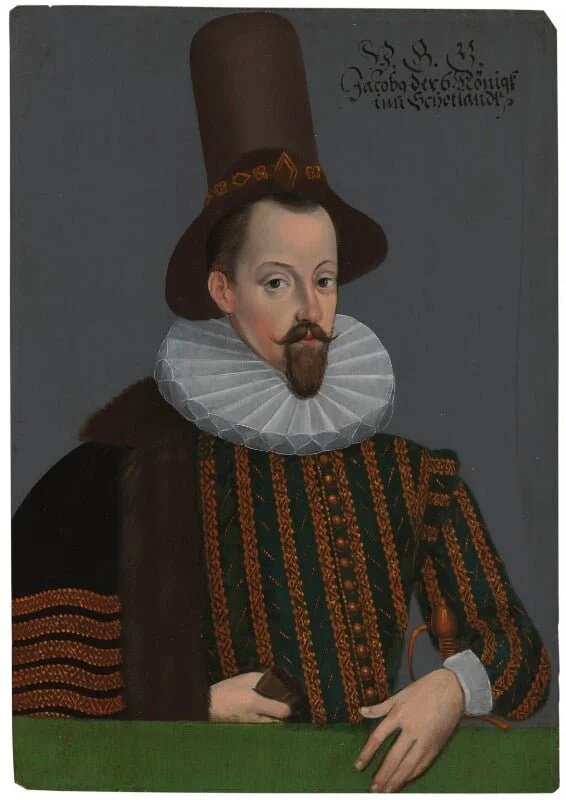
(James VI and I, The Trew Law of Free Monarchies (London, 1598).

The body politic metaphor was also deployed by Thomas Hobbes who described the state as a union understood as a civil person or an artificial man. This raises the question of why republican thinkers of the seventeenth and eighteenth centuries drew on this monarchical commonplace of the body politic to articulate their understanding of politics?

One obvious reason for the widespread deployment of this metaphor is its utility. Like human bodies, bodies politic tend to be subject to periods of health and sickness, and just as doctors seek ways of establishing and prolonging health and preventing illness in their human patients, so those interested in politics and government are keen to promote the well-being of the body politic and stave off corruption and decay.
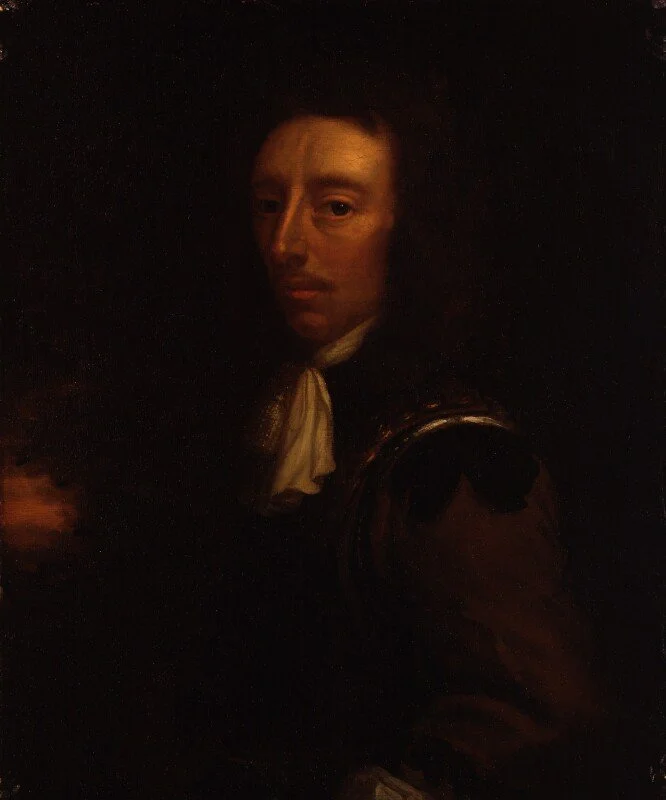
Algernon Sidney, after Justus van Egmont, based on a work of 1663. National Portrait Gallery, NPG 568. Reproduced under a Creative Commons Licence.

In this regard, the experience of ancient Rome was an obvious exemplum for early modern thinkers. Several workshop contributors commented on the fact that the decline and fall of Rome often served as a reference point. For example, Jamie noted that the advanced age (and associated corruption) of the Roman state was said to be reflected in the fact that the men were perfumed and had soft hands. In his paper, Tom Ashby pointed to Algernon Sidney's views on this issue. Sidney insisted, that owing to the Fall, corruption and death (of both the human body and the body politic) were unavoidable and the perfection of virtue impossible. He used analogies with athleticism and physical perfectibility to illustrate this. In the Discourses Sidney described the accumulation of wealth in Rome by the state and by private men as 'a most dangerous disease, like those to which human bodies are subject when they are arrived to that which physicians call the athletick habit, proceeding from the highest perfection of health, activity and strength' (Algernon Sidney, Discourses Concerning Government, Chapter 2, 14). Sidney saw value in striving for perfection (even if it was unattainable), but he cautioned that as the state got close to the peak of perfection greater vigilance was needed to maintain health and stave off corruption.

Other papers, too, emphasised this idea of vigilance. In her discussion of colonial America, Becca Palmer noted the intertwining of the moral and the political in the republican ideal of a watchful citizenry. In this colonial context, the vigilance of citizens was deemed crucial to the preservation of both bodily and state health and the avoidance of decay. Jamie demonstrated that vigilance was also an important concept for Marchamont Nedham, who emphasised the threat of disease and corruption coming not just from outside the body but also from within. He spoke of the craftiness of disease and of the need to be on guard to prevent it from taking hold.

While some early modern writers stressed the need for vigilance, others insisted on the need to purge corrupt elements. Borbala Pigler noted that in the sixteenth century colonisation was seen as a means of purging a diseased and stagnant body politic, by offering an outlet for the excessive or corrupt elements of the population. By the eighteenth century, as Amanda explained, the purging of the body through blood letting was likened to elections - for example by Benjamin Rush. On his account, elections were a means of casting out corrupt members and replacing them with fresh alternatives.
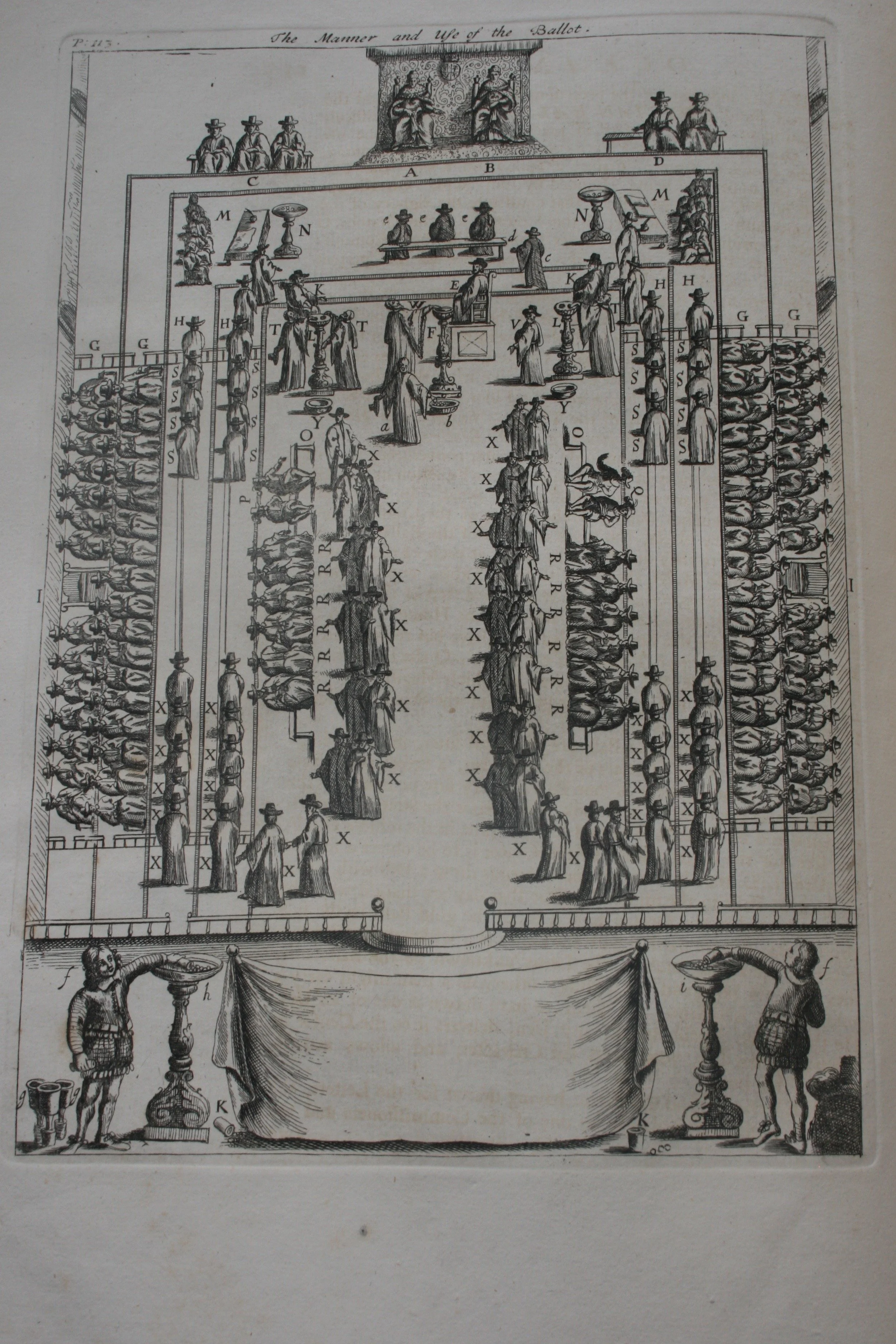
‘The Manner and Life of the Ballot’ from John Toland’s edition of The Oceana and Other Works of James Harrington (London 1737). Volume author’s own. Image by Rachel Hammersley.

Frequent elections were also seen as a means of staving off corruption in the writings of seventeenth-century republicans. Here the emphasis was on avoiding stagnation and decay through constant movement - drawing on the idea of flowing water in a river or blood in the body. Both Harrington and Nedham insisted that there should be constant movement of the people within the body politic through rotation of office, since allowing any individual to remain in power for too long ran the risk of corruption. Becca noted that in eighteenth-century America paper money was viewed in similar terms as a way of ensuring constant movement within the state and thereby staving off degeneration.

A second theme that emerged from our discussions centred on the idea that while bodies epitomise our shared humanity (and therefore our shared membership of the republic) there was also a sense in the past of the need to treat different bodies differently. This problem was introduced in theoretical terms in Borbala's contribution on 'The justice of the body politic' in which she showed how in sixteenth-century England Aristotle's notion of distributive justice was applied to both the state and the human body. According to this understanding, each separate part (each organ or each member of the body politic) had to function well in order for the whole to remain healthy. This was, of course, different from saying that all had to be treated the same or to be given the same role, and in this way it allowed for the inclusion of different groups. For example in the publication Here Begynneth the Kalender of Shepardes (London, 1518) which, as Borbala showed, was suffused with the Aristotelian conception of justice, women were included as a category in their own right (not simply as wives or daughters) and their main duty was obedience. Though it is interesting to note that the Kalender also refers to female shepherds who serve the same function - and are therefore to be treated the same - as their male counterparts.

Leila Marhamati gave a striking example of an unconventional female bodily metaphor for the body politic taken from Machiavelli's Discourses that was originally highlighted by John Freccero. Alongside the conventional allegory of the passive female body politic that was subject to violation by invaders, Machiavelli offered the example of Caterina Sforza. When her fortress was under attack, Sforza is said to have responded to the threat that her sons would be killed, by lifting up her skirts and reminding her opponents that if they carried out this threat, she had the power to make more children. As Leila highlighted, this used the generative power of women as the basis for their claim to a more active role within the body politic. Of course, the notion of republican motherhood was an idea that was picked up later on, not least in a colonial context. Yet Leila cited letters sent to John Adams when he was President that demonstrate the complexity of this notion. Some women reported urging their sons to fight for the defence of their country, clearly accepting the sacrifice they may have to endure as a result. Others appealed to Adams as a parent himself, insisting that his focus should be on striving for a more secure and prosperous future for their children and grandchildren.

In practical terms there was a recognition that male and female bodies were different and needed to be treated differently. Amanda explained that eighteenth-century spas were open to men and women but that women tended to go with different ailments from men; and there was also a sense that women might need a gentler regime to avoid being overwhelmed. By contrast, black male bodies, which were also treated at colonial spas, would often be subjected to particularly harsh regimes on the grounds that it would make them more productive labourers.
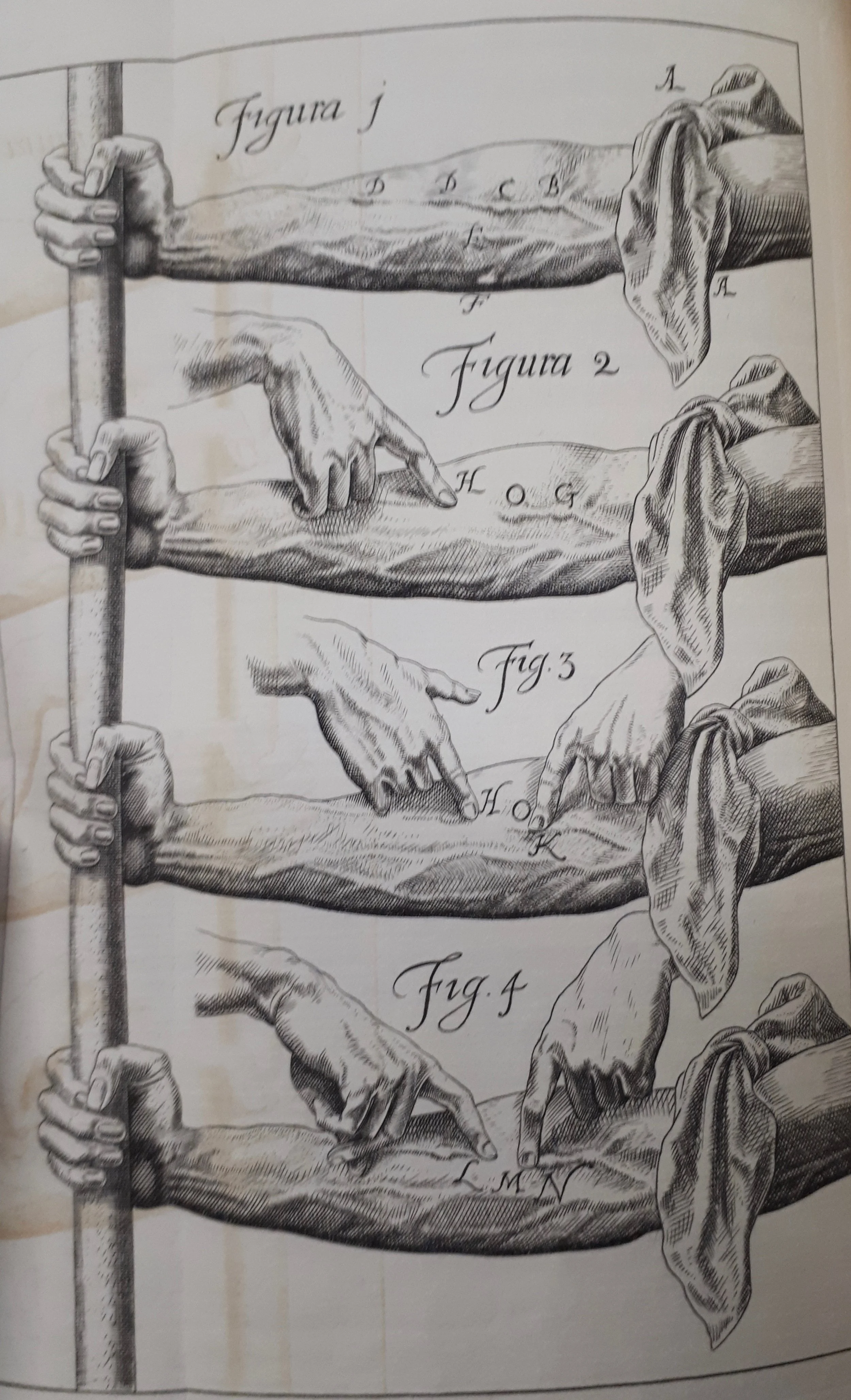
Image from William Harvey’s Exercitatio Anatomica de moto cords et sanguines in animali (1628). Reproduced with permission from the Philip Robinson Library. Special Collections. Pybus Collection Pyb. C. v.9.

Finally, our discussions prompted some methodological reflections on approaching a topic like this from a modern perspective. The disciplinary boundaries that we take for granted did not exist before the nineteenth century, so a thinker like Nedham would probably not have seen his medical work as divorced from his political thinking as we do today. Moreover, in the case of those (like Nedham, Harrington, and Streater) who were influenced by Helmontian thought, there is the difficulty of trying to make sense of their understanding of ideas that we now know to be false. As Gio Maria noted when thinking about Harrington's debt to the scientific theories of Francis Bacon and William Harvey, we need to remember that these figures too were influenced by alchemical, magical and theological approaches to the study of nature. Gio Maria reminded us that the seventeenth century was a transitional period, one in which thinkers were deliberately seeking to adapt older ideas to the new republican cause.

Samantha Wesner's talk on the application of theories about electricity to politics during the French Revolution suggested that something very similar was going on at that transitional moment. She showed that electricity became an important metaphor for republican politics at the time. This was in part because it helped to make sense of the difficult - but crucial - republican concept of the general will. French republicans in the early 1790s were grappling with just how a republican nation could be made to cohere and move as one. At that time electricity was a new scientific discovery and, like the general will, it was invisible and therefore difficult to comprehend. Yet, in the demonstrations that were common at the time, groups of people could be made to feel the power of electricity as a small shock was passed around the group. Electricity then was a helpful metaphor as republicans reached towards new political ideas that they did not fully comprehend.

So, while it may have started out as a metaphor for monarchical politics, the body politic - and the application of scientific theories to politics that was associated with it - proved useful to the articulation, and even understanding, of new republican ways of thinking about politics.

Translating Cultures

Exterior of the Herzog August Bibliothek, Wolfenbüttel. Photograph by Rachel Hammersley.

Exterior of the Herzog August Bibliothek, Wolfenbüttel. Photograph by Rachel Hammersley.

In June 2018 I attended two excellent conferences at which I was able to present some of the findings of the research I have completed during my British Academy fellowship. It seems appropriate, then, to reflect on those conferences and my thoughts about them. I cannot, in two blogposts, do justice to the rich nature of all the papers. Rather I will draw out certain themes that struck me as pertinent to my work and demanding further reflection. This blogpost will deal with the first conference of the week, which took place in Wolfenbüttel, Germany on 26-27 June. In September's blogpost I will deal with the Graduate Conference on the History of Political Thought, which was held in London on 28-29 June.

translatingculturesprogramme.png

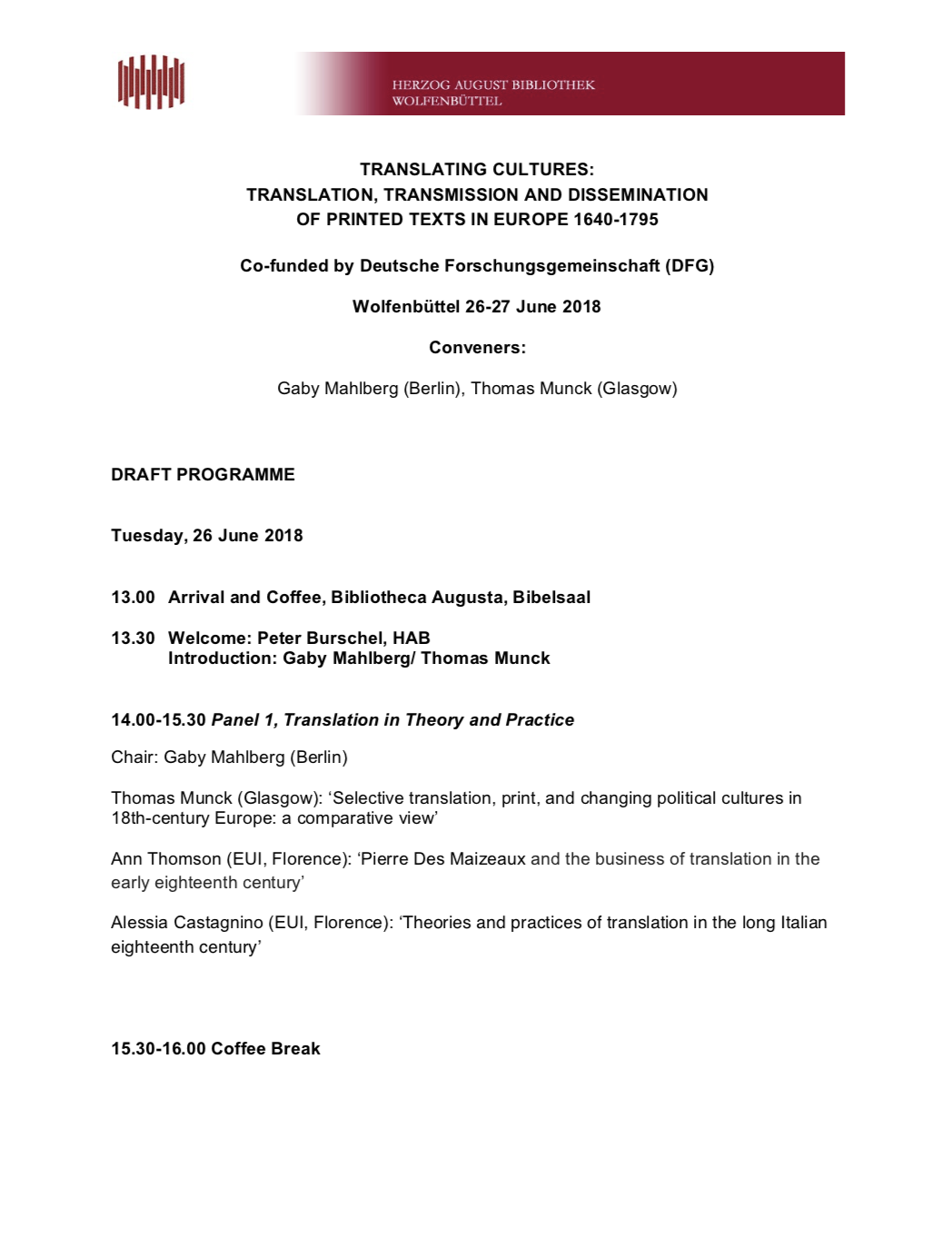
'Translating Cultures: Translation, Transmission and Dissemination of Printed Texts in Europe, 1640-1795' was held at the Herzog August Bibliothek in Wolfenbüttel and organised by Thomas Munck from the University of Glasgow and Gaby Mahlberg, an independent historian who now also works as a journalist in Berlin. Fittingly, the idea for a workshop on translation arose when these two academics met at the Herzog August Bibliothek when they were both carrying out research there, thanks to the institution's generous research fellowship programme. This setting was the perfect place in which to hold such a workshop since it is Germany's national library for the seventeenth century. It owes this distinction to the fact that it houses one of the few intact seventeenth-century libraries still in existence, much of which was collected by Duke August (1579-1666) after whom the library is named.

Interior of the Herzog August Bibliothek, Wolfenbüttel. Photograph by Rachel Hammersley

Interior of the Herzog August Bibliothek, Wolfenbüttel. Photograph by Rachel Hammersley

During the course of the workshop, we took time out to be given a tour of the library. We were shown the books, many still bound in their original white coverings, which are organised according to eight themes and placed on the shelves by theme and in height order. We were also shown the catalogue that Duke August produced himself and the wonderful seventeenth-century book wheel which was made to hold it. We learnt that, in its original location, the library was housed immediately above the stables. It struck me that Harrington would have appreciated this arrangement, given his notion that the foundation of power is grounded in land (and in the military force - including horses - needed to protect it), but that at the level of the superstructure, power also comprises authority and that this requires reason - including the knowledge found in books.

Duke August's catalogue. Photograph by Rachel Hammersley.

Duke August's catalogue. Photograph by Rachel Hammersley.

In his opening paper, Thomas Munck introduced several important themes. One of these was the idea of tracing when key works in the history of political thought were translated into particular European languages, in order to uncover the motivations behind those translations. I was already aware that a number of English republican works were translated into French during the French Revolution. I included a list of the seventeenth and eighteenth-century French translations of English republican writings in an appendix to my last monograph, which shows that at least ten such works were published  between 1789 and 1801. Munck's research identifies at least another five English political works that also appeared during that period. More precise research is also revealing. As noted in the papers that Miriam-Isabelle Ducroq and I gave at the workshop, the two French translations of Harrington's works that were published during 1795 were directly relevant to the very particular circumstances of that year - and especially the debates over the introduction of a bicameral legislature and the form it ought to take.

As well as translations being inspired by particular circumstances, works also sometimes had to be adapted to fit new contexts. In the case of scientific translations this could involve having to make careful choices regarding vocabulary, or even updating the original text to reflect advances in scientific knowledge since the original work had appeared. Sietske Fransen described examples of the former in German translations of the works of Jan Baptist van Helmont, where the lack of an established German vocabulary for the new science forced translators to give new meanings to words. Similarly, Lázló Kontler found that German translations of Bernard Le Bovier de Fontenelle's Entretiens sur la pluralité des mondes were adapted in order to reflect subsequent advances in the discipline.

Books from Duke August's library. Photograph by Rachel Hammersley

Books from Duke August's library. Photograph by Rachel Hammersley

In a parallel way, translations of political works sometimes distorted the meaning of the original text in order to better fit new circumstances or the concerns of the author.  Munck addressed this in relation to André Morellet's translation of Cesare Beccaria's work on crime and punishment, raising the question of at what point translations become completely distinct works. Gaby Mahlberg demonstrated that the German translations of Algernon Sidney's Discourses produced in 1793 and 1795 were quite different from the seventeenth-century original. Those texts were edited, cut and moderated, so as to turn Sidney from a defender of rebellion into a proponent of good citizenship. The text became a defence of moderate constitutional monarchy against the radical forces of the French Revolution (ironically at exactly the time when the French were using him and his associates to endorse their revolution). In a similar way, Wyger Velema showed how Dutch translations of the classics were employed on both sides of the patriot debate in The Netherlands in the late eighteenth century. 

Distortions could also arise and be perpetuated through the common practice of one translation being used, in place of the original, as the base text for later translations. Asaph Ben-Tov explored an extreme example of this in his discussion of early modern translations of the Koran into European languages - many of which were produced by scholars who knew little or no Arabic.

Distortion is also linked to another theme that loomed large in our discussions: audience. Both Alessia Castagnino, in her consideration of the theory and practice of translation in eighteenth-century Italy, and Luc Borot, in his comparison of two translations of Thomas Hobbes's De Cive, commented on this issue. Castagnino emphasised the fact that one common justification for producing a translation is to make a book that is deemed useful available to a wider public - including those whose linguistic skills may be limited. Borot noted that different translators may aim at different audiences such as those with greater technical knowledge and experience as compared with the general public; and that these decisions impact directly on the translation itself. 

Yet the relationship between translator and audience can be complex. Both Helmer Helmers and Rachel Foxley cited examples in their papers of works which might be read differently depending on the linguistic skills of the reader. In the case of the diplomatic translations examined by Helmers, some of the jokes presented in those works would only be fully understood by multilingual readers. Similarly, Foxley noted that readers of Marchamont Nedham's The Case of the Commonwealth would have a different experience of the text depending on whether or not they understood Latin. Nedham's translation of Juvenal's famous tag 'Panem & Circenses' as 'Bread and Quietnesse', rather than the more commonly used 'bread and circuses', will have produced a rather different understanding without knowledge of the original Latin.

Finally, several papers reminded us of the importance of paying attention not just to the words, but also to translation as a business and books as material objects. Ann Thomson's study of Pierre Desmaizeaux offered insight into some of the causes of translators distorting original texts, by reminding us that the extent of their freedom could be seriously limited by agents and publishers. Mark Somos's fascinating paper on census bibliographies, which trace and describe all extant copies of a particular work, revealed the insights that can be drawn from such research. This led me back to thinking about Harrington and to wonder what a census bibliography of his works might reveal.

Republics v Monarchies

The Scottish National Party recently brought the question of the Monarchy back onto the political agenda by voting at their 2017 party conference in favour of cutting public funding for the Royal Family. Delegates supported overwhelmingly a motion calling for the repeal of the Sovereign Grant Act of 2011. While the vote will not bring immediate political change, since Westminster retains control of the Sovereign Grant, the vote has drawn attention once again to the alleged republicanism at the heart of the SNP and the idea that an independent Scotland might choose to replace the Queen as head of state. Such suggestions always produce strong views on both sides, usually labelled 'republican' and 'monarchist'.

On the surface, at least, the distinction between republics and monarchies is a crucial feature of our modern political landscape. Yet the history of these two constitutional forms is far more complex than this simple dichotomy would suggest. Indeed, according to one historical definition, Britain is and has long been a republic, whereas on the basis of another neither France nor the United States of America is worthy of that term. Monarchists and republicans alike might, therefore, benefit from a deeper understanding of the history of these political concepts.

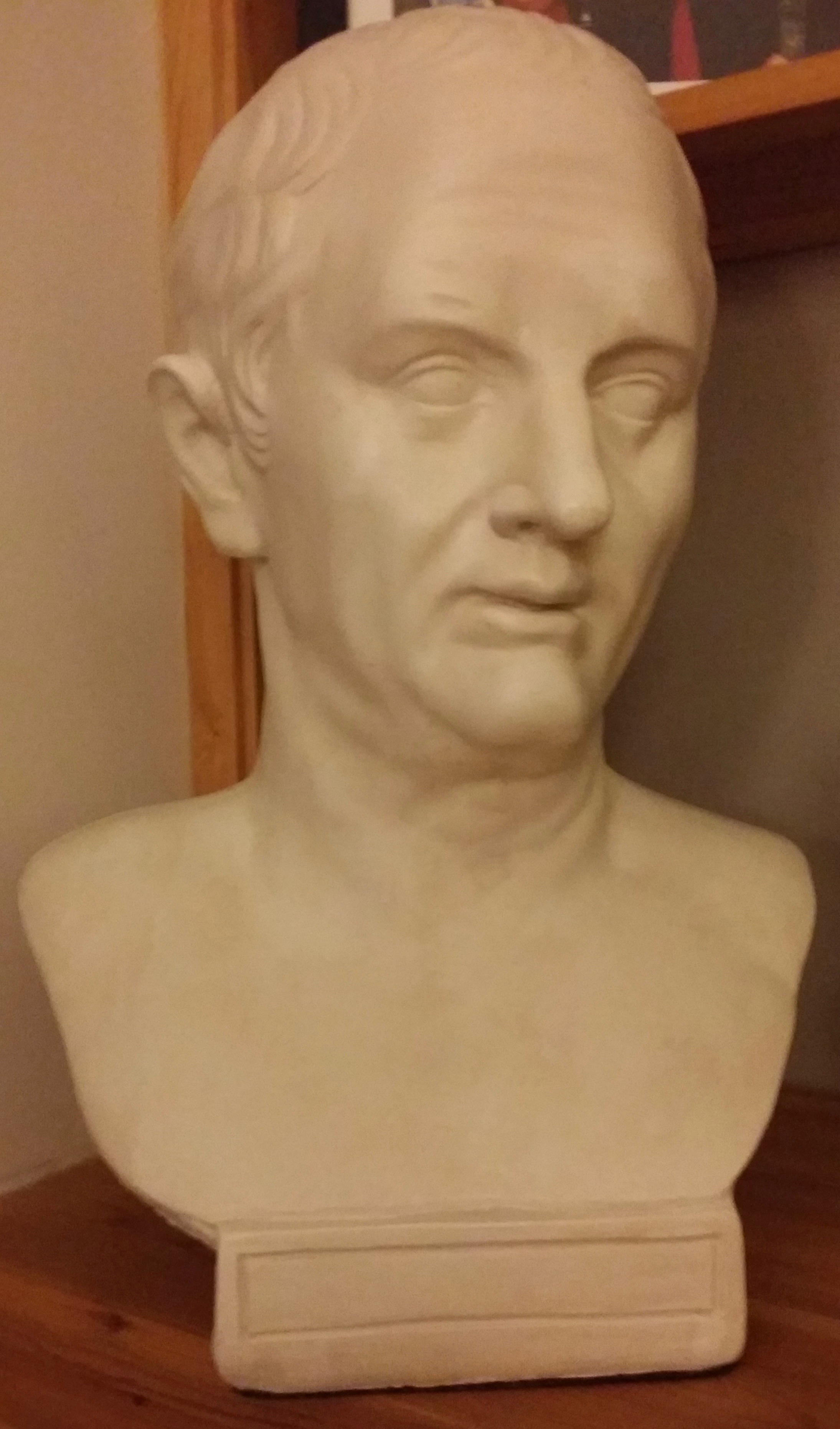
Bust of Cicero. I am grateful to Katie East for providing the image.

Bust of Cicero. I am grateful to Katie East for providing the image.

The concept of republican government, in both theory and practice, dates back at least to ancient Rome. It was explored in a number of Roman texts, not least those of Marcus Tullius Cicero who was both a politician and a political thinker. In his De re publica Cicero did not define a republic or commonwealth in opposition to kingship, but instead argued 'that a commonwealth (that is the concern of the people) then truly exists when its affairs are conducted well and justly, whether by a single king, or by a few aristocrats, or by the people as a whole'. (Cicero, On the Commonwealth, ed. James. E. G. Zetzel Cambridge, 1999,  p. 59). The key distinction here, then, is between rule that serves the public interest and that which serves private interests. So, on Cicero's account, a monarchy, if properly organised and directed towards the public good, could be a kind of republic. That same idea was still being voiced as late as the mid-eighteenth century, when the Genevan-born political theorist Jean-Jacques Rousseau wrote in his Social Contract:

I therefore call Republic any State ruled by laws, whatever be the form of administration: for then the public interest alone governs, and the public thing counts for something. Every legitimate government is republican.

The accompanying footnote might appear self-contradictory, if Cicero's position is not borne in mind:

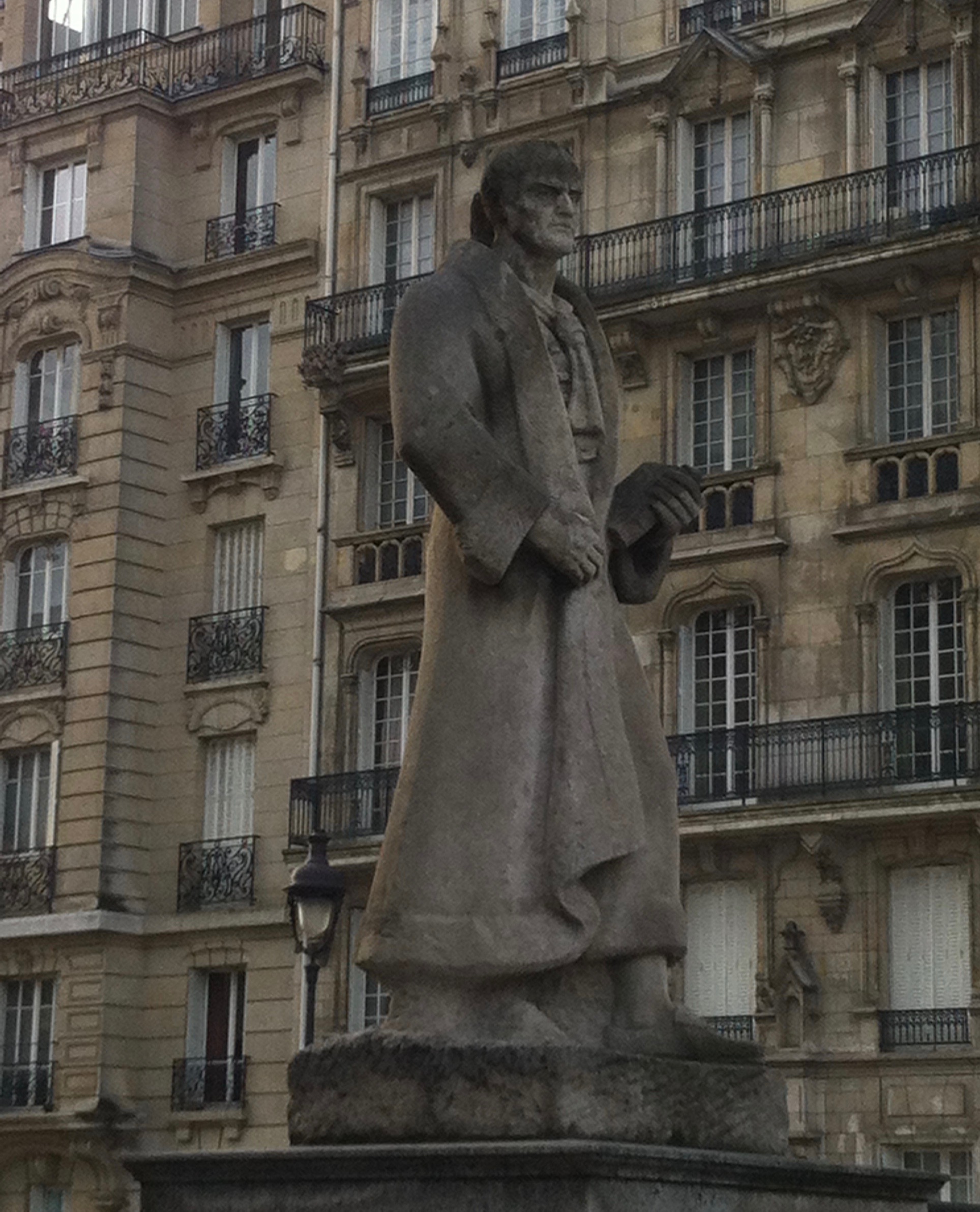
Statue of Jean-Jacques Rousseau outside the Pantheon in Paris. Image by Rachel Hammersley.

Statue of Jean-Jacques Rousseau outside the Pantheon in Paris. Image by Rachel Hammersley.

By this word I understand not only an Aristocracy or a Democracy, but in general any government guided by the general will, which is the law. To be legitimate, the Government must be not confused with the Sovereign, but be its minister. Then monarchy itself is a republic. (Jean-Jacques Rousseau, The Social Contract, ed. Victor Gourevitch, Cambridge, 1997, p. 67)

   But while the Ciceronian understanding of a republic survived well into the eighteenth century, from the late fifteenth century onwards a second understanding was developing. This saw monarchy not as one form of republican government, but as its direct opposite. Several historians have recently traced the development of this tradition of republican thought, emphasising its debt to the writings of Italian Renaissance thinkers as well as to a tradition of Jewish Biblical scholarship that offered a distinctive take on the Israelites' plea to God in I Samuel 8 that they be given a king like other nations.

By the seventeenth and eighteenth centuries there were certainly those who saw republican government as requiring the destruction of monarchy. The English Civil War of the 1640s prompted some parliamentarians to attack not simply Charles I, or even just tyrants, but all kings. Marchamont Nedham was one of several figures who challenged the very distinction between kings and tyrants: 'Had they [the English] but once tasted the sweets of peace and liberty both together, they would soon be of the opinion of Herodotus and Demosthenes that there is no difference between king and tyrant and become as zealous as the ancient Romans were in defence of their freedom.' (Marchamont Nedham, The Case of the Commonwealth of England Stated, ed. Philip A. Knachel, Charlottesville, 1969, pp. 127-8). This view had practical import too. The 'Act Abolishing the Office of King', which was passed on 17 March 1649, declared the office of king to be 'unnecessary, burdensome, and dangerous to the liberty, safety, and public interest of the people' and the ensuing 'Act Declaring England to be a Commonwealth and Free State', which was passed in May 1649, insisted that this government was to be 'without any King or House of Lords'.

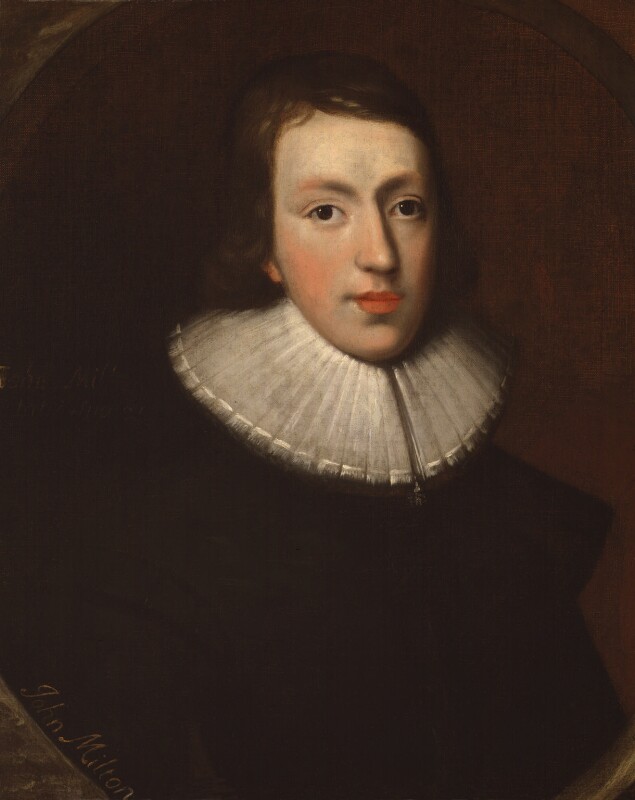
John Milton, by unknown artist, National Portrait Gallery, NPG4222. Reproduced under a creative commons license.

John Milton, by unknown artist, National Portrait Gallery, NPG4222. Reproduced under a creative commons license.

Yet even this does not present the full complexity of the concept, since those who agreed that republicanism was, by definition, anti-monarchical, could nevertheless disagree over precisely what institutional form should replace the office of king. Most significant was the distinction between those who insisted merely on the absence of a monarch, and those who outlawed any form of single-person rule. Thus a third definition of republic required that the government was not headed by a single figure, but by a group or council. As John Milton asserted in The Readie and Easy Way to Establish a Free Commonwealth: 'I doubt not but all ingenuous and knowing men will easily agree with me, that a free Commonwealth without single person or house of lords, is by far the best government, if it can be had.' (John Milton, The Readie and Easy Way, in Selected Prose, ed. C. A. Parties, Harmondsworth, p. 338). Milton's formulation ruled out both monarchy (as in the reign of Charles I) and a Protectorate (as under Oliver Cromwell).

Moreover, the English revolutionaries had attempted to institute such a form a decade earlier. When Charles I was executed on 30 January 1649 he was replaced not by another single person, but rather by the Rump Parliament, which ruled together with its Council of State, until April 1653. Yet as its short life - and the rise of Oliver Cromwell - would suggest, experiments involving a purely conciliar government have often proved unsuccessful in practice. The experiments in France in the 1790s with the Committee of Public Safety, and later the Directory, further confirmed this conclusion.

Evidently, it is the second definition of a republic outlined above that is most common today, so that a republican wishes to abolish the Monarchy. According to the first definition, that of Cicero, modern Britain could, despite having a Queen as head of state, be counted as a republic so long as government decisions were made in the public interest. Indeed, there were those in the eighteenth century who made precisely that argument. In 1700, the controversial political thinker and activist John Toland declared that 'if a Commonwealth be a Government of Laws enacted for the Common good of all the People' and if they had some means to consent to those laws 'Then it is undeniably manifest that the English Government is already a Commonwealth, the most free and best constituted in all the world.' (John Toland, The Oceana and Other Works of James Harrington, London, 1737, p. vii-viii). According to the third definition, by contrast, which requires that a single person must not be given considerable power, neither France nor the United States of America (both of which have a President), would be deemed worthy of that label.

Viewed historically, 'monarchy', is no easier to define than 'republic'. We can see this if we consider precisely what features make a monarch. Hereditary rule might be thought of as one key element, but this does not hold in the case of the early-modern Polish monarchy, which was elective. We might, then, say that a monarch generally holds his or her position for life. This would work for the Polish system, but it was also true of the Doge of Venice during the same period, and yet most people would argue that the Doge was the head of a republic rather than being a monarch.  Instead of thinking about the nature of the position, then, we might consider the extent of the power wielded. But this seems no more satisfactory as a basis for distinguishing monarchies from republics, since from the late eighteenth century to the present the President of the United States of America has tended to wield far greater powers than the English monarch. While part of the problem here is that the modern British Monarchy is in some ways a misnomer, since our Queen is a hereditary figurehead rather than a power-wielding head of government, even in the late eighteenth century George Washington already enjoyed greater powers in certain respects than George III. (For an interesting exploration of the royal tendencies in the American system see Eric Nelson, The Royalist Revolution, Cambridge Massachusetts, 2014).

John Lilburne, England's New Chains Discovered, London, 1649. http://oll.libertyfund.org/pages/leveller-tracts-6. 18.10.17. Taken from the Online Library of Liberty [http://oll.liberty.org] hosted by Liberty Fund, Inc.

John Lilburne, England's New Chains Discovered, London, 1649. http://oll.libertyfund.org/pages/leveller-tracts-6. 18.10.17. Taken from the Online Library of Liberty [http://oll.liberty.org] hosted by Liberty Fund, Inc.

This is not to say that important differences between what are conventionally labelled as monarchies and republics do not exist. The expenditure of public money on the Royal Family and the upkeep of royal palaces has always been one of the stronger arguments in the British republican arsenal (though of course presidential systems and legislative assemblies also incur costs). But we must also be careful not to assume that all our political problems can be solved by establishing a republic. It did not take long even for those seventeenth-century English revolutionaries who had called for an end to the monarchy to realise that many problems remained in its wake. Perhaps the best illustration of this is the fact that, less than a month after the regicide, the Leveller leader John Lilburne published a pamphlet which he entitled England's New Chains Discovered.