
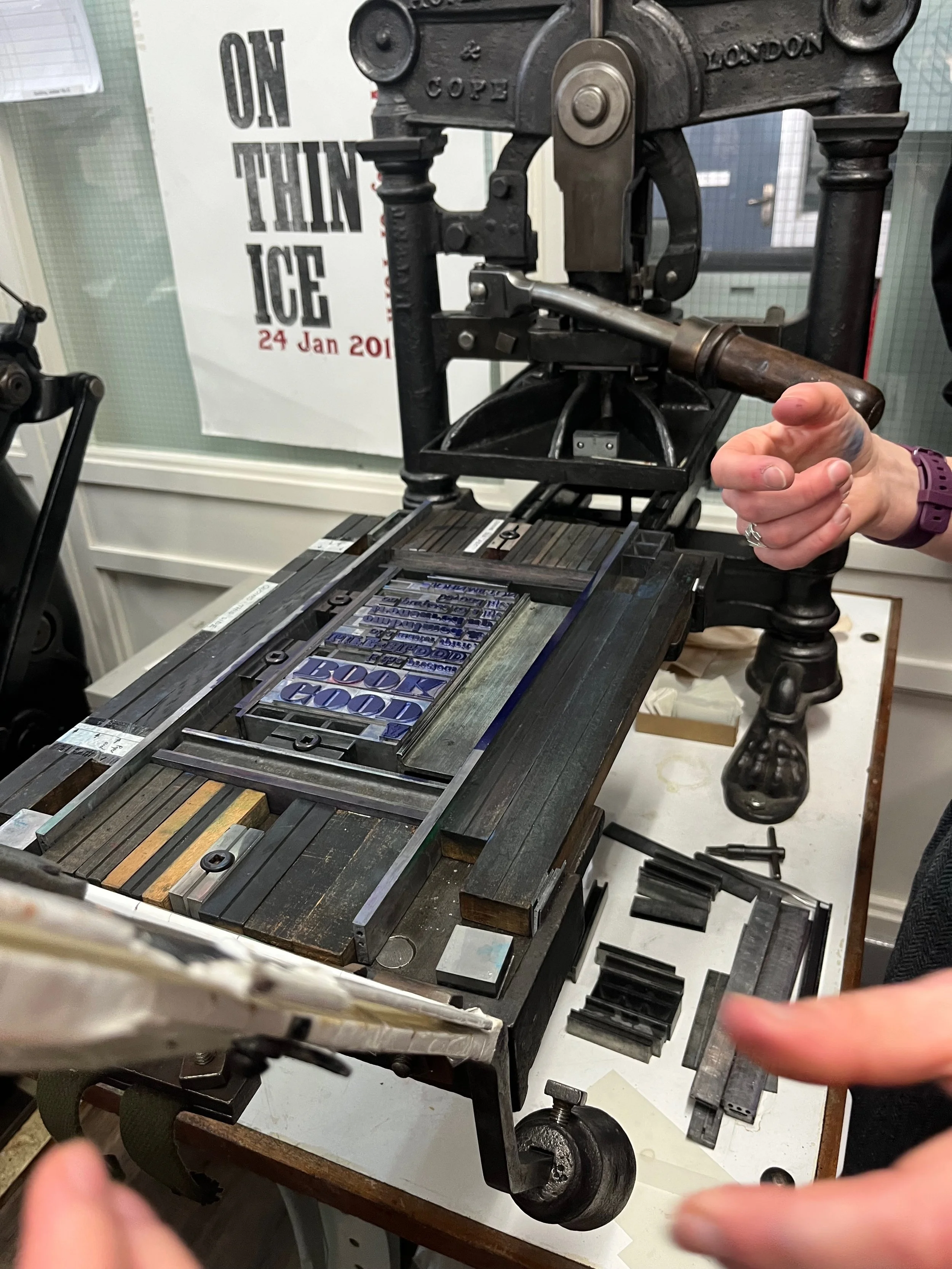
Printing press in the collection of Thin Ice Press at the University of York. Image by Rachel Hammersley, 2023.
Our second semester started at the very end of January and this year we have embarked on a new early modern MA module 'The First Information Revolution? Print Culture and the Public Sphere in Early Modern Europe'. The title deliberately signals potential parallels with today, and it has felt like a particularly auspicious time to be discussing the impact of the invention of the printing press on life in the early modern period. The news this month has been full of issues relating to our current information revolution: should teenagers have access to their smart phones while in school? Should under sixteens be prevented from accessing social media? How is AI going to impact on our lives, and should we be moving cautiously or seizing the initiative? Looking around us we can see the impact that the digital revolution is having on all aspects of life and society, and we hear daily the worries and portents this generates. Perhaps this makes us better able to imagine how it felt for those who were alive in the immediate aftermath of Gutenberg's invention, and to understand their excitement at the new development, as well as their concerns about its potentially dangerous consequences.
In teaching the module I have been particularly struck by three parallels. First, the expansion of the opportunities for people to communicate with one another that both information revolutions delivered. Secondly the huge increase in the sheer amount of information circulating, which, in both cases, could lead to people feeling swamped or overwhelmed. Thirdly, the fact that changes to the form in which information is conveyed prompts questions about what counts as trustworthy information.
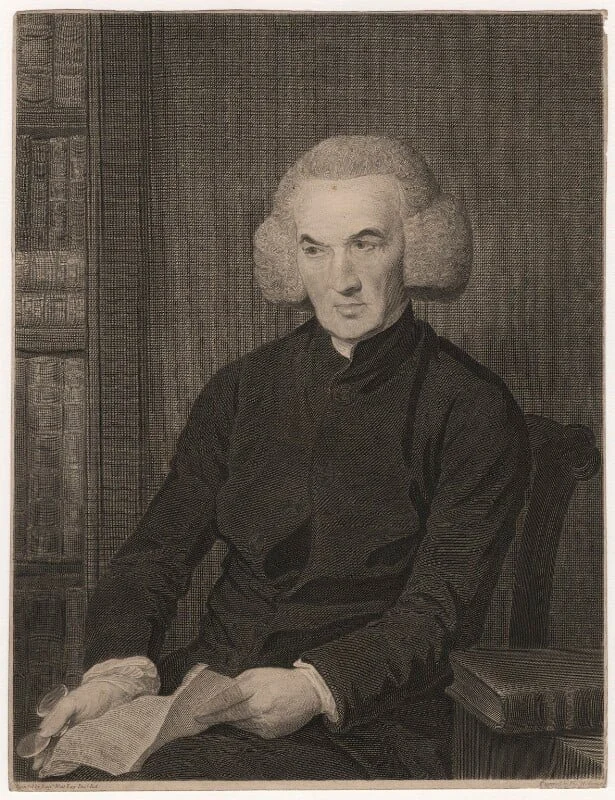
Richard Price depicted with his books behind him. By Thomas Holloway, after Benjamin West. National Portrait Gallery. NPG D5557. Reproduced under a Creative Commons Licence.
Initially the invention of the printing press, and the explosion of print it brought in its wake, generated new possibilities for communication and engagement among those who were already literate, and in particular scholars and the members of the so-called republic of letters. The historian Ann Blair has observed that whereas medieval readers were generally shown reading a single text, early moderns were often presented consulting several at once, and we can think too of the wealth of images from the seventeenth and eighteenth centuries depicting scholars surrounded by their books (Ann Blair, 'Reading Strategies for Coping with Information Overload', Journal of the History of Ideas 64:1 (2003): 15-16). Moreover, Elizabeth Eisenstein, whose book The Printing Revolution initiated the debate on this topic, made the point that the shift to a world in which there were multiple copies of the same work, each bearing the same pagination, facilitated scholarly discussion even over great distances. Scholars living and working in different parts of the world could refer to the same text and correspond about the ideas presented on the same page, confident that they were discussing the same thing (Elizabeth Eisenstein, The Printing Revolution in Early Modern Europe, second edition. Cambridge: Cambridge University Press, 2012, p. 348)
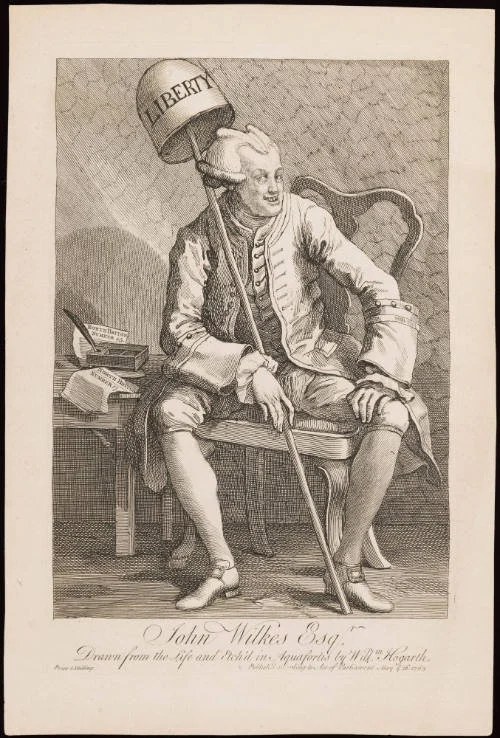
Satirical print of John Wilkes by William Hogarth. Image from the author’s collection. Rachel Hammersley, 2025.
Of particular importance was that, as time went on, the print revolution also began to open opportunities to new individuals and groups. Eisenstein makes the point that whereas previously those wanting to exercise political influence had to be capable of eloquent speech, by the eighteenth century we see the rise of figures who were better with the pen than the tongue, including Thomas Paine, John Wilkes, Camille Desmoulins, and Jacques-Pierre Brissot (Eisenstein, The Printing Revolution, p. 331. By chance I also came across a modern parallel of this idea this month when I read John McMillian's article, on the role of print culture in the 1960s organisation Students for a Democratic Society (SDS), for a reading group with colleagues. McMillian emphasised the importance of the written word for this society and observed that the organisation's emphasis on print opened opportunities for participation to those who did not just 'talk the loudest at meetings' - including some of the female participants. This indicates that print could provide platforms for marginalised groups.
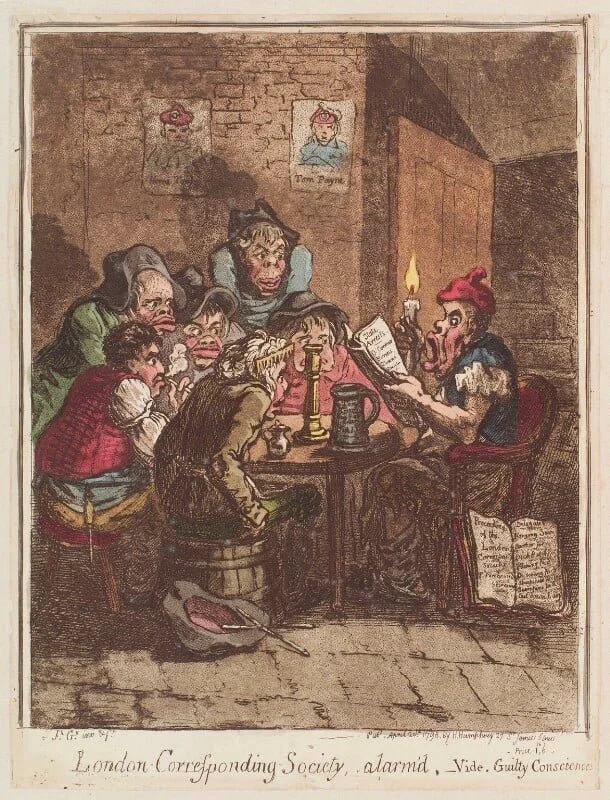
‘London Corresponding Society, alarm’d’ by James Gillray, published by Hannah Humphrey. National Portrait Gallery. NPG D12634. Reproduced under a Creative Commons Licence. Though satirical, this image gives a sense of the role of print for the LCS.
Print was crucial to the activities of the London Corresponding Society, which was established in 1792. While it was not the first reform society in Britain, it was distinctive in that its members were primarily un-enfranchised artisans and workers who campaigned directly for parliamentary reform. Improvements in literacy levels - especially in London - meant that print could be crucial to its activities. Information about meetings was conveyed via printed posters and leaflets, minutes of meetings were carefully taken, and members were encouraged to read and discuss key political texts
While the expansion of opportunities for communication and the opening up of the scholarly and political worlds to new groups as a result of print could bring positive benefits, the experience of information overload was a genuine phenomenon. The historian Paul M. Dover has demonstrated that the volume and variety of things that were written down in the early modern period was much greater than it had ever been before, and Eisenstein too commented on the marked shift from the scarcity of manuscripts to the abundance of printed material (Paul M. Dover, The Information Revolution in Early Modern Europe. Cambridge: Cambridge University Press, 2021, p. 14; Eisenstein, The Printing Revolution, p. 342). As a result, early modern people had to grapple with far more information than their predecessors. Ann Blair argues, that they quickly developed strategies for doing so. They adjusted their reading methods depending on their purpose and what they were seeking to get from the material. They also developed new techniques and resources to help them to cope. Moreover, then, as now, the increasing reliance on shortcuts and reference tools was bemoaned by some. (Blair, 'Reading Strategies', p. 16).
Perhaps not surprisingly the increase in information coupled with the change in the form in which it was conveyed, prompted questions to be raised regarding trustworthiness and reliability. Dover observes that in the Middle Ages information that was presented in written form was viewed as less reliable than oral accounts due to the fact that the source was not always immediately evident. Previously the veracity of the information being conveyed was partly dependent on the reputation of the person uttering it. Writing broke the direct connection back to the source, and so the reliability of the information was tainted as a result. Consequently, Dover notes, print sources were not immediately seen as trustworthy, and this was only heightened by the awareness of errors and irregularities in early print. Gradually, though, attitudes shifted, with print growing in trustworthiness on account of it being verifiable. By the late eighteenth century the Marquis de Condorcet was arguing that print shifted the balance between mere eloquence and solid reason - reducing the power of the former and increasing the role of the latter as the criterion by which information should be judged. Of course, we might observe that it is just as possible to deceive through eloquent writing as through eloquent speech.

Title page from Thomas Spence’s Pigs’ Meat (London, 1793-1795). One of the original early modern texts examined in our Library Workshop. Philip Robinson Library, Newcastle University. Special Collections: RB 331.04 PIG. Reproduced with kind permission.
Yet, I have been heartened by our students' response to the module and the issues it raises. While they are a self-selecting group, they were thoughtful about the issues discussed and well aware of the need to think about the sources and reliability of the information presented to them, both when working as historians and in their everyday lives. Moreover, despite being digital natives, their excitement at being able to handle original copies of early modern books at our library workshop was palpable and they were thoughtful and perceptive about what is gained by handling the physical book rather than simply reading it on a screen. As rumours circulate that we are not far from a time in which AI tools could be used to set, produce, and mark student assignments without any human involvement in the process at all, it has been reassuring to spend time with students who are keen to engage with early modern printed material, to analyse it carefully, and to offer their own views and interpretations of it. Perhaps there is hope that just as the invention of print did not bring about 'the downfall of civilisation' in the way that some feared, our own digital revolution need not do so either.