
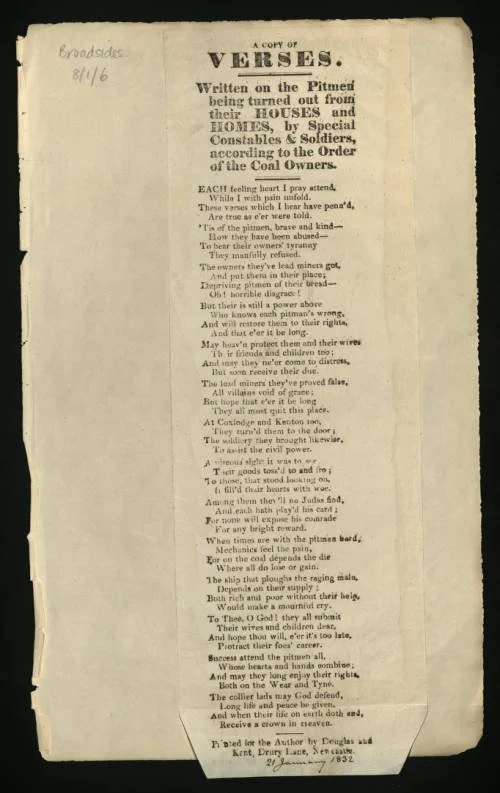
A Copy of Verses… Philip Robinson Library, Newcastle University, UK. Special Collections. Broadsides: 8/1/6. Reproduced with kind permission.
This year I have been involved with a group of colleagues at Newcastle University who are interested in the theme of ‘Networks of Resistance in European Print Culture’. From our very first meeting back in September, I was struck by the parallels across time and space, with similar themes and issues emerging in very different contexts. Since then we have established a reading group, which devoted its first meeting to John McMillian's article '"Our Founder, the Mimeograph Machine": Participatory Democracy in Students for a Democratic Society's Print Culture', and held a session in the Philip Robinson Library at which several of us presented an item or items from Special Collections as a way of introducing our own research in the area. Across these sessions, several themes have emerged.
The first is the value of ephemera. All of the works discussed in the two sessions were ephemeral in one sense or another. In the Library session, Melanie Wood and Rachel Anderson presented a series of miners' songs from the nineteenth century. Not only do they provide an insight into an oral culture that would often be lost to historians, but the songs are rare (they do not appear on the British Folksong Index) and the broadsides fragile. Yet they offer an important insight into the miners' strikes that took place in Northumberland and Durham in the early 1830s and 1840s, the issues surrounding those strikes, and the culture of solidarity among the miners.
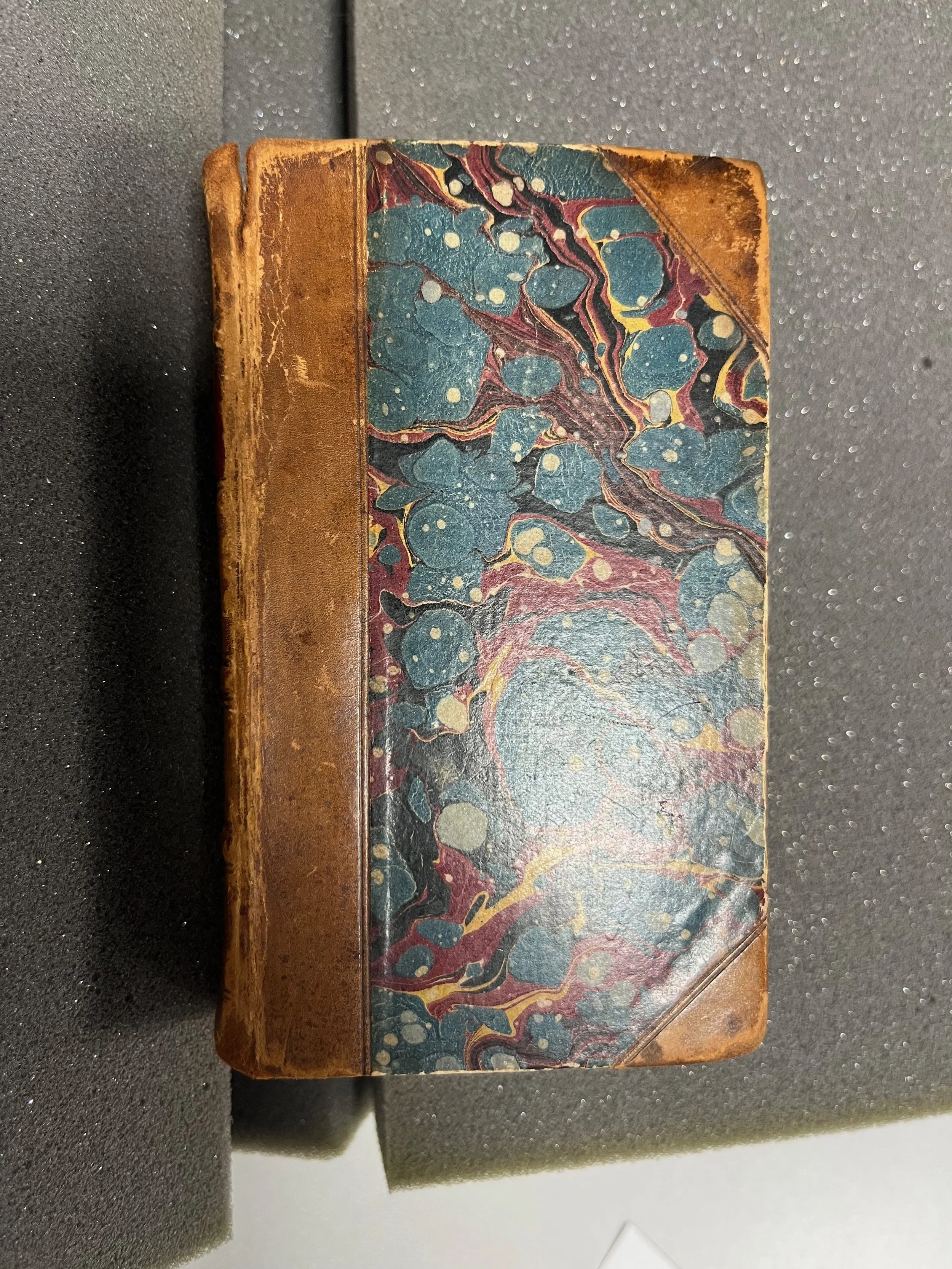
Roger de Rabutin, comte d Bussy, Histoire amoureuse des Gaules (1708). Philip Robinson Library, Newcastle University, UK. Special Collections. Bradshaw 848.4.BUS. Reproduced with kind permission.
The item presented by Joseph Hone, while less obviously ephemeral in its material form, fits the model described by Robert Darnton of works that were very popular in their own time, but have been largely forgotten today (Robert Darnton, The Forbidden Best-Sellers of Pre-Revolutionary France. London, 1996). Histoire Amoureuse des Gaules by Roger de Rabutin, Comte de Bussy, was, as Joe explained, a scandalous presentation of the sex lives of the French King and royal family that Rabutin wrote to entertain his mistress. Originally produced as a manuscript for private circulation, the work was leaked and quickly became a best seller. While intended for titillation and entertainment, like eighteenth-century works of political pornography described by Darnton, it had political resonance and impact by undermining respect for royalty
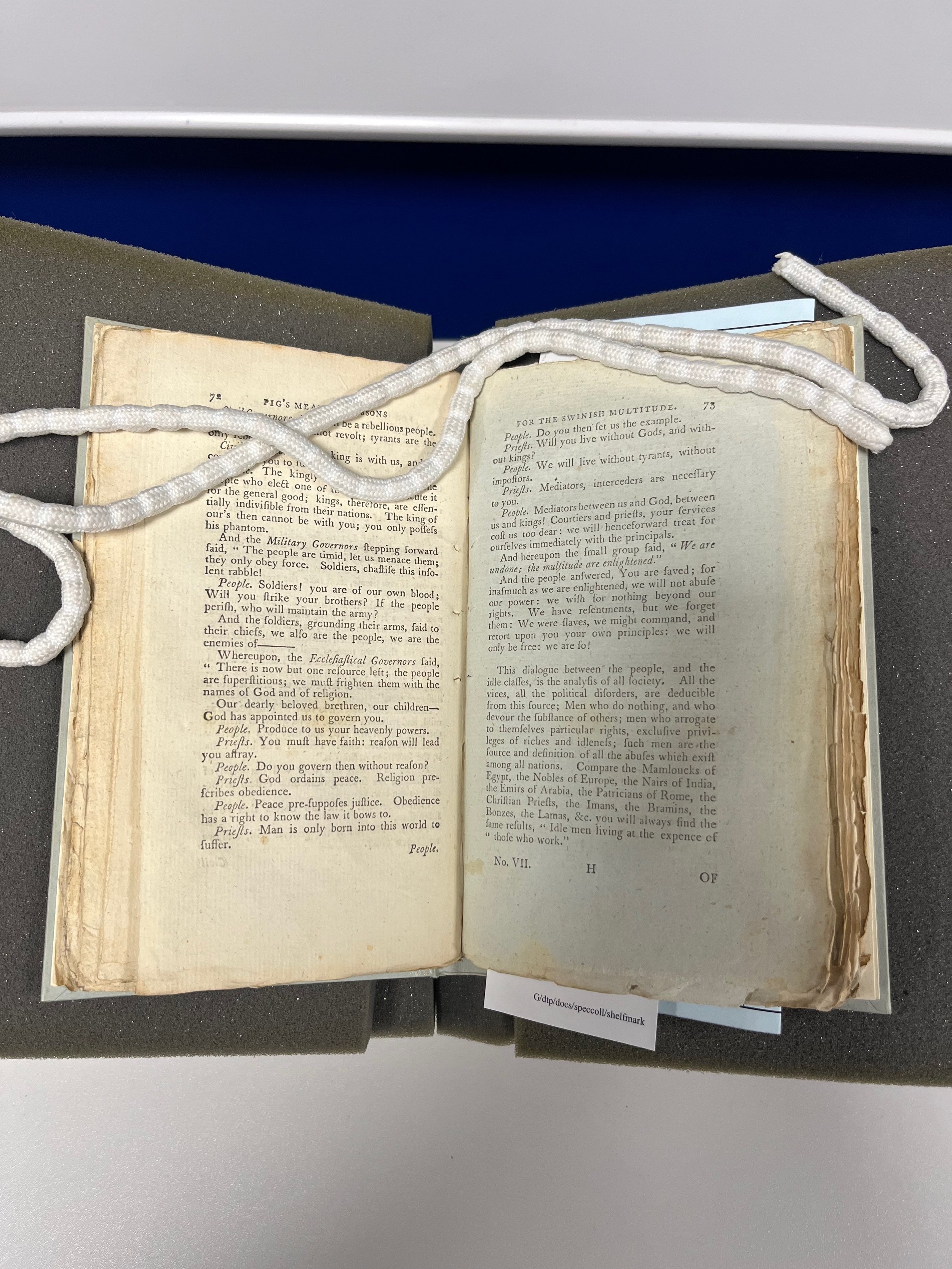
Thomas Spence, Pigs’ Meat, or, lessons for the swinish multitude, second edition (London, 1795). Philip Robinson Library, Newcastle University UK. Special Collections. Rare Books: RB 331.04 PIG. In this image it is possible to see the different types of paper used in this volume.
Thomas Spence's Pigs' Meat, which was the focus of my short presentation, was also a deliberately ephemeral work. Its cheap format made it affordable for ordinary working people who were Spence's target audience. By selling the periodical for just 1d per weekly issue, and by filling it with short extracts from a range of contemporary and historic political works, Spence was making political ideas accessible to those who might not normally come into contact with them. As he examined the physical copy, Joe Hone discovered that the work was actually even more ephemeral than we had realised. He noticed that the format was unusual. Not only are the sheets folded into three rather than the more usual four or eight, but the paper used to make the pages is not uniform. It would appear that this second edition of the first volume was produced from off-cuts that were perhaps lying around in Spence's shop. In this sense the miscellany format of the content of the work - composed of a series of extracts from different authors - is matched by the miscellaneous nature of the physical object itself.
If Spence had been a student in 1960s America he would no doubt have been a member of the organisation Students for a Democratic Society (SDS) and a keen user of their mimeograph machine. This early form of photocopier was used by SDS members to produce their own materials - including a regular newsletter (initially called Discussion Bulletin) and to copy correspondence written by members of the group. The nature of the bulletin was simultaneously ephemeral - in that it was cheaply produced - and a way of sharing ideas beyond the organisation's leadership.
This hints at an answer to the second theme prompted by these discussions: why works of this nature were printed at all. This is a particularly pertinent question in the case of the miners' songs, given that many of the miners themselves were illiterate and the songs would have been shared orally rather than relying on printed dissemination
The first, and most obvious, answer is that putting ephemera into print was a means of communication; of spreading ideas beyond face-to-face meetings and in doing so building a wider network or community. In the case of the miners we can perhaps see one consequence of this in the visit by William Roberts, a leading Bristol Chartist, to the miners in the North East to offer them his support. We cannot know for sure, but perhaps Roberts heard about the situation in Northumberland and Durham via the printed songs. They would certainly have been a good means of spreading news of the strikes to miners and political campaigners elsewhere in the country to encourage solidarity.
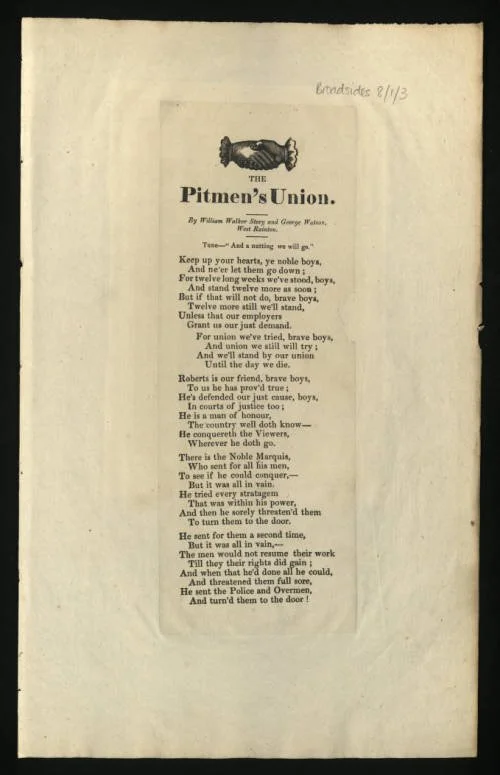
William Walker Story and George Watson, The Pitmen’s Union. Philip Robinson Library, Newcastle University, UK. Special Collections. Broadsides 8/1/3. Reproduced with kind permission. This song includes reference to the Chartist William Roberts and his support for the north east miners.
Spence was also a keen writer and disseminator of songs. Several appear in Pigs' Meat itself, but there are also three collections of Spencean songs that were printed separately in the early nineteenth century. Spence had been writing songs since he was in Newcastle in the 1770s, and intended them to be sung at meetings of likeminded people. In the 1790s Spence was involved with the London Corresponding Society (LCS), a vehicle through which un-enfranchised artisans and workers campaigned for parliamentary reform. There is some evidence that songs were sung at LCS meetings and the society made great use of print more generally as a means of creating and expanding its community.
The SDS reminded me in various ways of the LCS and here too, as McMillian argued, print culture was key. He suggested that it was a good means of eliciting support for the organisation and building a sense of community - particularly over wider distances. Moreover in sharing ideas in print, and even reproducing private correspondence by members, the SDS leaders were modelling the kind of open democratic society they wanted to see on a national level.
McMillian also suggested a second reason why members of the SDS were keen to deploy print, one that I touched on in last month's blogpost. As some members acknowledged, the SDS's use of print opened opportunities for less socially confident members. Some who remained quiet in face-to-face meetings were much more articulate in print. In this sense print could be a more accessible medium for marginalised groups, including women and ethnic minorities. In the same way, the use of print by the LCS perhaps offered a route into political discussions (and perhaps even a voice) to labouring people who had not previously had the opportunity to express their political views.
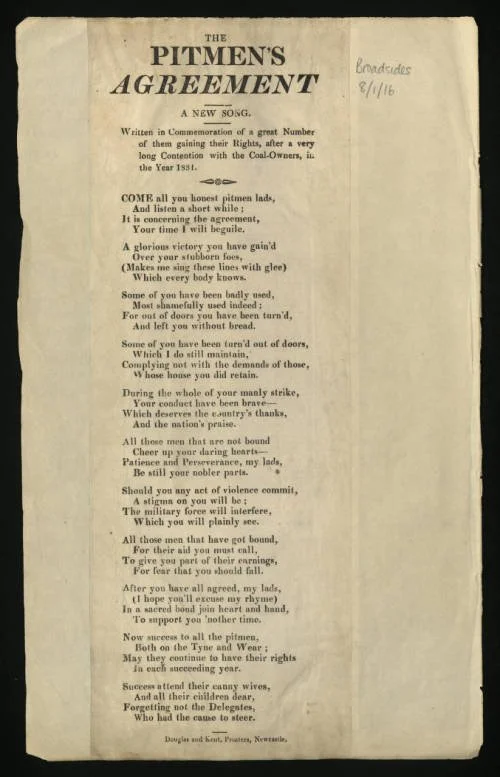
The Pitmen’s Agreement. A New Song… Philip Robinson Library, Newcastle University, UK. Special Collections: Broadsides 8/1/16. Reproduced with kind permission.
A third reason for putting words into print is that it can be seen as giving legitimacy to the claims made, or ensuring a lasting record of those claims. This is perhaps most resonant in the case of the miners' protest songs. As noted above, many miners would not have been able to read the broadsides, but also would not have needed to since they knew the songs by heart and were familiar with the events they were describing. The broadsides were perhaps useful, though, in legitimising the miners' cause not just to others at the time but also to posterity. Melanie and Rachel noted that the local Newcastle newspapers had tended to be neutral on the events described in the songs. Perhaps printing the songs was a means for the miners to put their side of the case to a wider public.
Spence did something similar when he found himself on the wrong side of the authorities. In The Case of Thomas Spence he offered an account of the circumstances of his arrest and subsequent release for selling seditious books in 1792. In The Important Trial of Thomas Spence he offered a full account of his 1803 trial, presented from his own perspective, perhaps to counter the official newspaper reports. The same might also be true of an organisation like the SDS - particularly in its early years when it was seeking to establish itself - with print being used as a way to gain status and legitimacy.
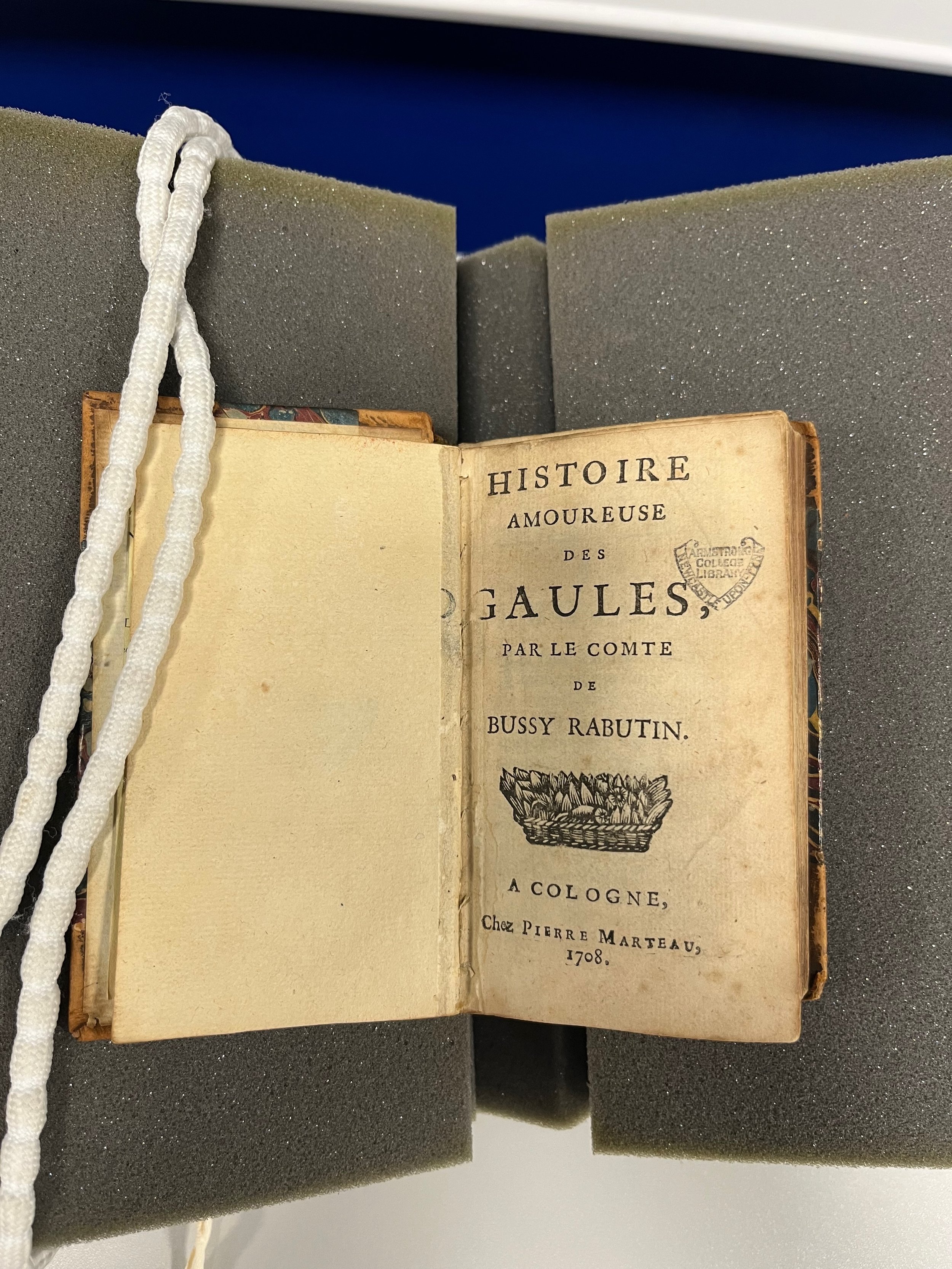
Here we see the title page of the Comte de Bussy’s work with its false imprint.
One final theme that was prompted by the workshop was the value and reliability - or unreliability - of imprints. In my work on Spence I have been using the information given on the title pages of his pamphlets to build a chronology of his bookselling businesses - identifying which premises he operated from and when he moved from one to another. As Joe pointed out in his talk, not all imprints can be used in this way. The title page of Histoire Amoureuse des Gaules gives the printer as Pierre Marteau of Cologne. As Joe noted, very few books were printed in Cologne at this time, since the city probably only had two presses. The use of a false imprint was particularly common in the case of scandalous or seditious books, and 'Pierre Marteau, Cologne' was a very common example of this which was used across Europe in the early modern period. We explored whether false imprints were genuinely intended to hide, and therefore protect, the printer (given that other elements of the copies such as the wood cut ornaments could have been used for identification) or whether the false imprint was a signal to readers interested in scandalous material. In the late seventeenth century 'Amsterdam' was often used as a false imprint for English books that showed some sympathy for republican government. Of course, as the Library staff observed, the use of false imprints presents problems for those involved in cataloguing works. The convention when cataloguing is to transcribe the information on the title page. If some of that information is false, then the catalogue itself is corrupted as a result. As this would suggest, there is much to learn from paying careful attention to the material form and paratextual elements of ephemeral material.