Reflections on the BIAPT Annual Conference

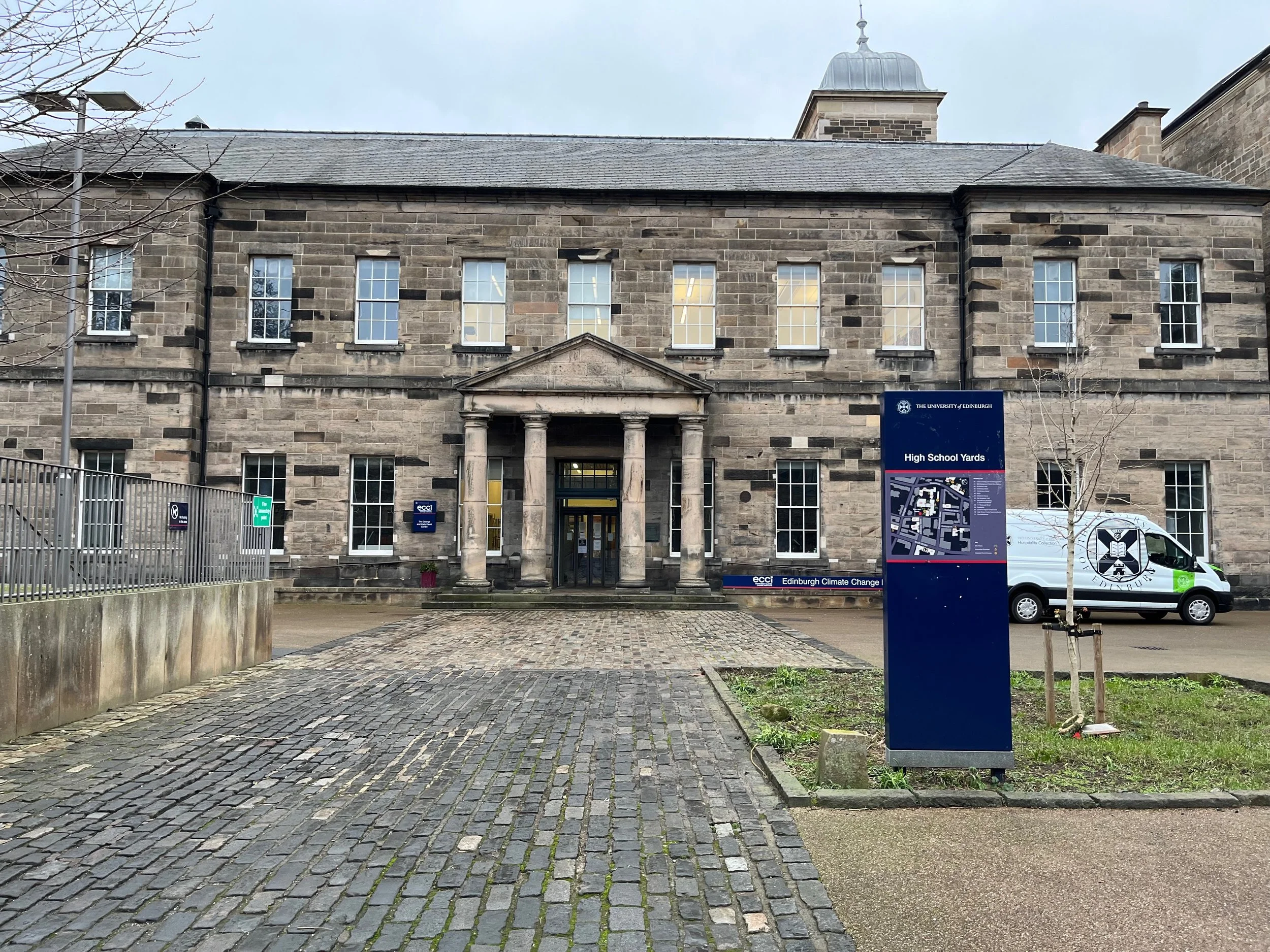
Edinburgh Climate Change Institute. Image Rachel Hammersley

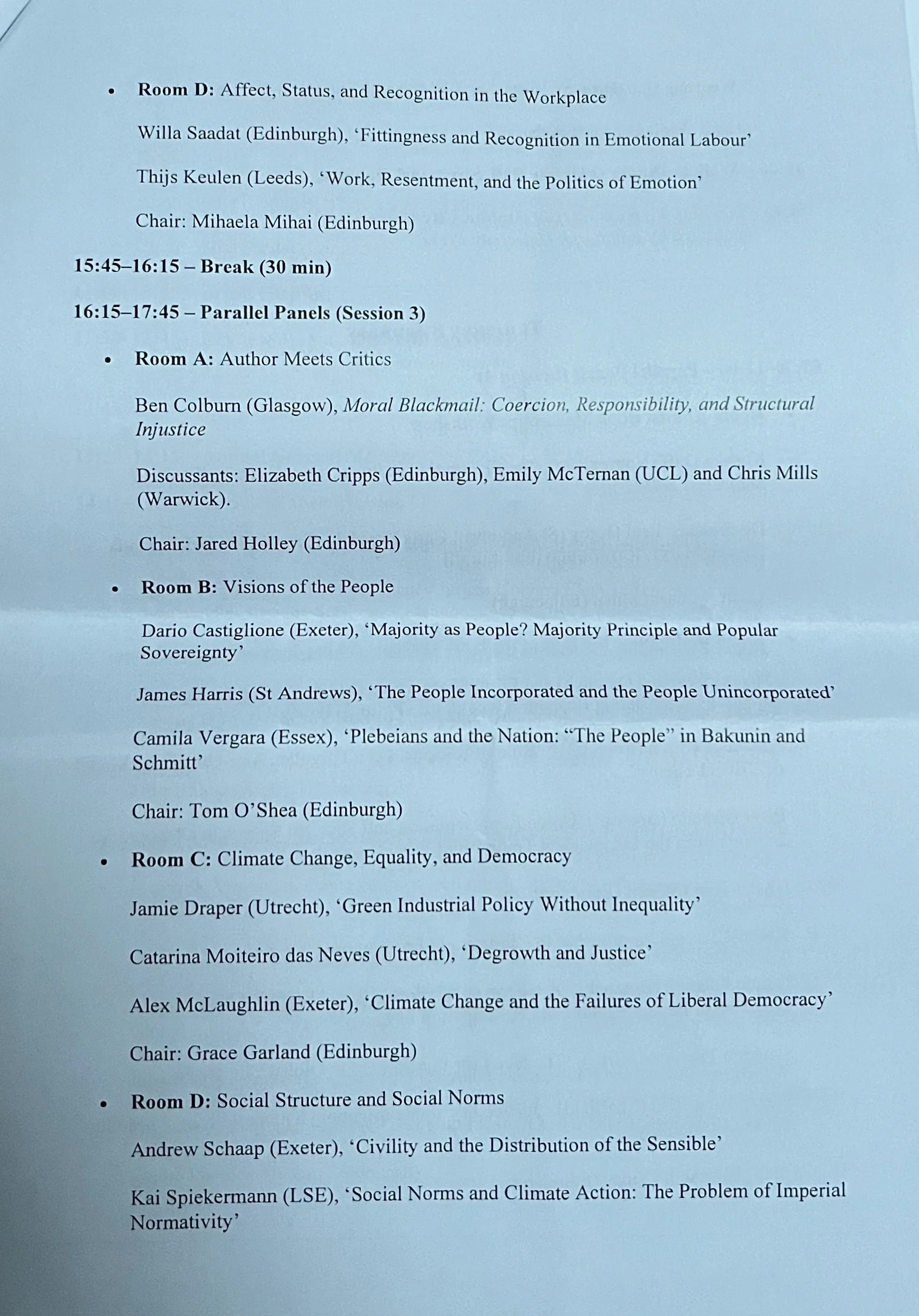
On a dark and bitterly cold morning in January I literally slipped and skidded down my street in order to catch a train to Edinburgh for the British and Irish Association of Political Thought conference. Despite BIAPT holding an annual conference since 2008 - and its forerunner the Political Thought Conference dating back to the early 1970s - I am ashamed to say it was the first I have attended. Given how interesting and thought-provoking the papers were, I hope it will not be my last.

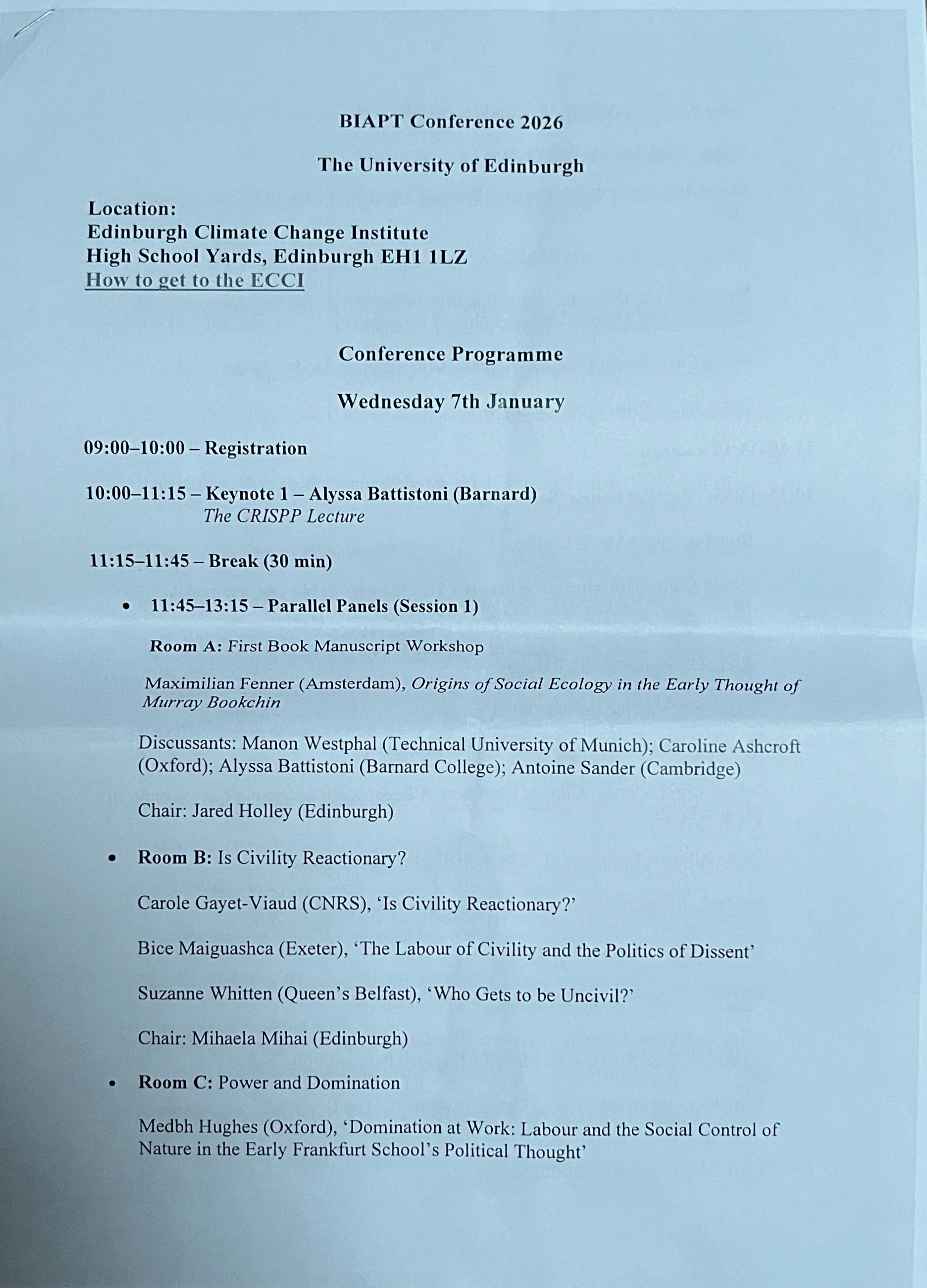
Unfortunately the demands of work and home meant that I was only able to attend the first day of this three-day event. I was sorry to miss what looked like some excellent papers on the Thursday and Friday. This means that the comments below focus only on those papers I attended on Wednesday 7th January. The conference was held at the Edinburgh Climate Change Institute and topics such as climate change, environmental political theory and ecology featured prominently in the programme, but my only engagement with that topic came via the first keynote.
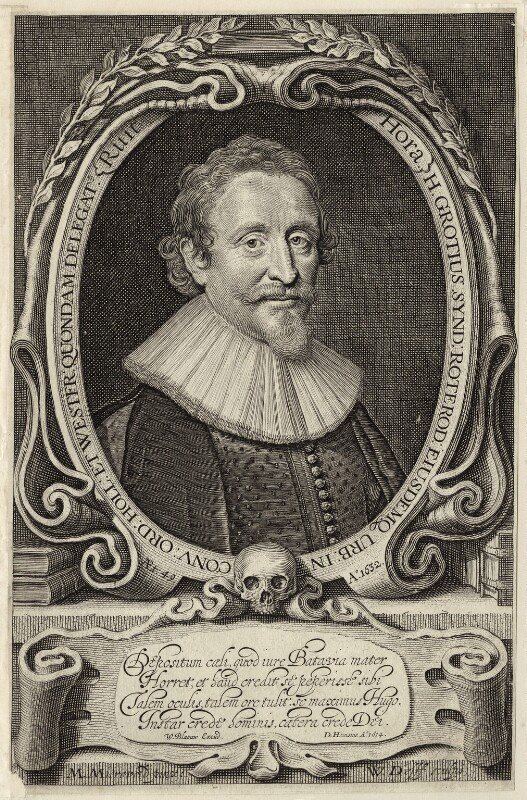
Hugo Grotius, by Willem Jacobsz Delff, after Michiel Jansz. van Mierevelt. National Portrait Gallery. NPG 26250. Reproduced under a Creative Commons Licence.

One of the recurring themes that spoke to my interests was popular sovereignty. It was explored in detail in the panel entitled 'Visions of the People'. Dario Castiglione explored the majority principle and its relationship to democracy and popular sovereignty. He emphasised the historical importance of majority rule in non-democratic - and even non-political - contexts, noting that many of those discussing the topic today forget this history, tending to see majority rule as specific to democratic government. He explained that in the sixteenth and seventeenth centuries majority rule was often used for collective decision-making in private contexts, for example in legal or business settings. He also helpfully highlighted some of the issues with majority rule explored by early modern thinkers. These included: the epistemic problem of whether majority rule produces the best result for the community; why and how the majority comes to represent all voters; and on what grounds minorities are obliged to obey the majority. Castiglione noted that in Roman Law the sense that the majority represented the whole group was a legal fiction. For some it can be justified simply on the grounds of numbers or force, but seventeenth-century natural law theorists sought a more robust justification. For Hugo Grotius and John Locke while majority rule was not natural, it was rational. For Locke, it was also moral, since it encompassed both respect for all - in allowing all to contribute to the collective decision - and the opportunity for agency (which the use of sortition would not). By contrast Samuel Pufendorf and Jean-Jacques Rousseau offered a different account, suggesting that majority rule was not rational but rather a matter of convention. Castiglione's argument was that there is a missing element to these discussions, derived from the notion of fraternity or solidarity, which can help to show how and why the minority remains part of the community despite their will not becoming law.
James Harris took as his starting point Philip Pettit's recent book The State, and the argument Pettit develops there about how and why the people as a body can have collective powers (both constitutional and extra-constitutional) against the state. In challenging Thomas Hobbes's view that it is incoherent to imagine the people as a body acting against the state, Pettit distinguishes between three understandings of 'the people': the unincorporated people ('the multiple citizens considered independently of the polity they form' (Philip Pettit, The State. Princeton University Press. 2023, p. 212)); the incorporated people (the people as a corporate body - effectively the state itself); and his own third conception which he calls 'the people incorporating' or the people in a properly political guise - embodying their potential for joint action (Pettit, The State, p. 212). James was unconvinced by this move, but it did generate interesting discussion on the relationship between the people and the state and just how popular sovereignty can be exercised.

The final paper on the panel, by Camila Vergara, approached popular sovereignty and the people from yet another direction, in examining the origins and development of two distinct versions of modern populism. The first, which she traces back to Mikhail Bakunin, reflects plebeian resistance to oligarchic domination. The second, which has its roots in the ideas of Carl Schmitt, is characterised by ethno-nationalism. Whereas for Bakunin, nationality was irrelevant, with the people's interests and their experience of exclusion and oppression transcending national boundaries, Schmitt saw the nation as key, with citizens sharing a common cultural identity. The consequences of these different visions, Camilla argued, are stark, where Bakunin's model is the basis for popular revolution and emancipation through the establishment of bottom-up federative networks, that of Schmitt is used to legitimise state power and disable any exercise of power from below.
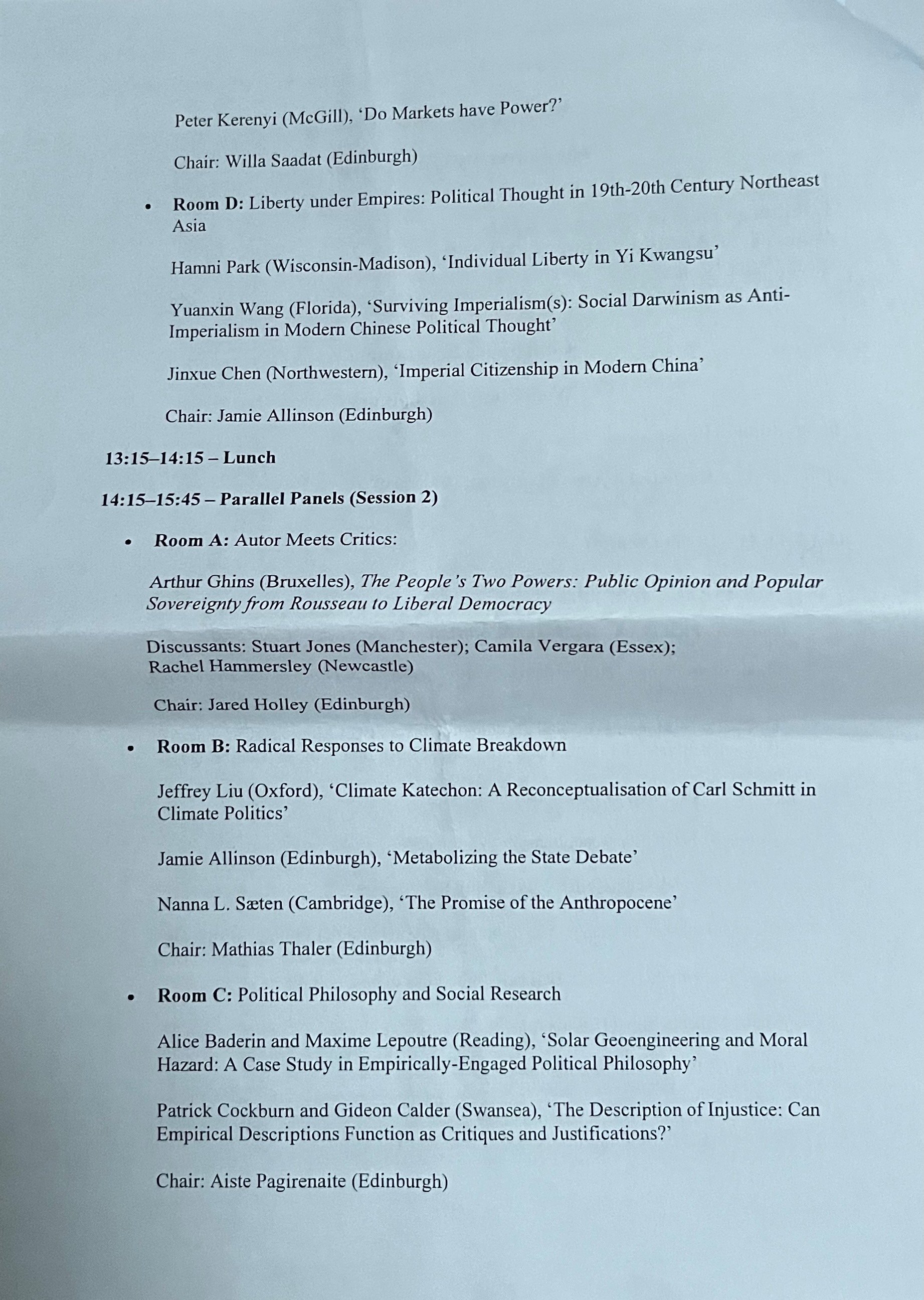
Camilla and I had also discussed popular sovereignty on an earlier panel that focused on Arthur Ghins's forthcoming book The People's Two Powers. Here the emphasis was on the relationship between popular sovereignty and public opinion. As Arthur explained, these concepts have conventionally been studied separately but the relationship between them is itself important. Where popular sovereignty is a means by which the people engages in decision-making, generally via voting, public opinion provides an opportunity for the people to express influence via media such as clubs, newspapers and petitions. Arthur's book traces the different understanding of the relationship between these two concepts offered by various thinkers in late eighteenth- and early nineteenth-century France. He demonstrates that as the century progressed there was a general move towards a position in which popular sovereignty was limited to the election of representatives, with public opinion providing the main opportunity for the people to influence politics between elections. Tracing the relationship between these two concepts across one hundred years of French thought he came to the striking conclusion that while we see public opinion as intrinsically democratic (and as a key component of 'Liberal Democracy') it was originally deployed in the 1790s and early nineteenth century against a version of representative democracy which emphasised popular sovereignty.

This aspect of Arthur's book points towards a second general theme that was explored in a number of the papers I heard - the problem of baked-in principles or assumptions stymying the efficacy of particular concepts. Arthur showed the extent to which modern liberal democracy is inherently anti-plebeian by exploring its origins. Public opinion is emphasised over popular sovereignty and the latter is understood as involving nothing more than the periodic election of representatives. At the same time for many of the thinkers he has studied public opinion was subject to elite control and even manipulation.

The Panel entitled 'Is Civility Reactionary' looked at a different 'baked-in assumption' namely the notion that civility is inherently conservative. As all three speakers noted, the literature on civility and incivility tends to be sharply divided, with formalists praising civility as a social lubricant while critics view civility as an instrument of social control and a means of preventing dissent. All three panellists challenged this view, arguing that there is a role for civility, as Carole Gayet-Viaud put it, as a living part of democratic culture. While the three speakers had the same overall aim and understood the existing literature in similar ways, the research and observations behind each paper were distinct. Gayet-Viaud is motivated by her ethnographic work on urban public life and especially the experiences of women in these settings. Bice Maiguashaca grounded her case in the experience of feminist movements and their use of techniques of solidarity and prefiguration both of which present an alternative to the eruptive and insurrectionary model of incivility emphasised in the literature. Suzanne Whitten's work on Northern Ireland has highlighted to her the importance of civility in building and sustaining a shared life for communities living in post-conflict societies. She explored the idea of plural civilities - of the need for a common set of civility norms in addition to (rather than instead of) the in-group civility norms of different communities, and she explored the ways in which these have to be carefully developed in order to build trust.
In her opening keynote address, Alyssa Battistoni explored another example of baked-in assumptions stymying progress - the commonplace that capitalism, and therefore our current political economy and political theory, are inherently antithetical to environmental perspectives. She began by setting out the view, expressed by many in the field, that climate change presents a challenge to political theory as a discipline; that the terms and categories are not adequate to address the problems it poses and that what is, therefore, required is its fundamental rethinking. While not entirely unsympathetic to this view, Battistoni mounted a strong response to it. She argued that we do not have time for a complete rethinking of political theory, the pressing nature of climate change is simply not compatible with an overhaul of our terms, concepts, and ideologies. Rather we need to do what is possible with what we have to hand. Moreover, she insisted that the history of political thought actually offers rich resources to help us deal with those issues. This is reflected in Battistoni's own recent book Free Gifts: Capitalism and the Politics of Nature, which draws on the history of political economy, and especially Karl Marx's analysis of capitalism, to understand the relationship between nature and the human world. The book offers a diagnosis of why capitalism fails to address ecological matters, because of the capitalist understanding of natural resources as free gifts.

Of course offering diagnoses is one thing, taking action is another. This question of the practical relevance of political thinking was a third theme I identified across the papers I attended. Battistoni addressed this directly, acknowledging that the relationship between understanding and practical transformation is complex. There are limits to what academic political theory can do, and academic research rarely does the work of politics. Moreover, academic work and activism are directed at different audiences and have different underlying aims. Writing a book will achieve some things, she argued, but it does not and cannot achieve others. Nonetheless Battistoni was clear that the two can and do inform each other. This sense of there being a symbiotic relationship between academic work and activism was reflected in several other papers. The papers on civility offered a model in which practice informs thinking (challenging the very notion of civility as inherently reactionary) and the resulting theorising then helps to shape future practice. Similarly Camila Vergara's paper demonstrated how understanding the origins and development of different versions of populism has relevance for how we deal with those movements today. Despite the current state of the world, I left the conference reassured that political theory remains vibrant and convinced that, while it cannot offer simple solutions to today's pressing problems, it can help us to understand them more clearly.

Experiences of Urban Green Spaces 2: Present uses of urban commons

Having explored historical perspectives on urban commons in our first webinar, our second - held on 29th April 2021 - turned to ‘Present Uses of Urban Commons’. The webinar opened with a talk by Professor Chris Rodgers (PI on the Wastes and Strays project) entitled ‘Forever Green? Nourishing our urban commons in a post-pandemic context’. After the talk and a brief Q&A session, we divided into break-out groups for discussion around four themes: defining urban commons, tradition, identity, and environmentalism.

John Singer Sargent, Octavia Hill, oil on canvas, 1898. NPG 1746. Reproduced with thanks to the National Portrait Gallery under a creative commons license.

John Singer Sargent, Octavia Hill, oil on canvas, 1898. NPG 1746. Reproduced with thanks to the National Portrait Gallery under a creative commons license.

Professor Rodgers began his talk by noting that while the current global pandemic has highlighted the urgent need to protect green space, that imperative has been around for many years, citing the warning given in 1877 by Octavia Hill (one of the founders of both the National Trust and the Commons Preservation Society) that people should not allow any of their open space to be lost. Yet, urban commons remain under threat today, not least as a result of austerity and the selling off of open spaces by local councils desperate to maintain essential services. Moreover, preservation has been hampered by confusion and misunderstanding regarding the legal designation of urban commons and their protected status (or lack of it). The legislative framework varies from one urban common to the next. Moreover, legal definitions are not good at capturing the variety of uses to which green spaces are put, and can end up restricting rights to certain groups. Furthermore, legislation and judicial decisions have limited the ability of communities to acquire communal use rights and create new commons. Rather than relying on existing legal definitions, then, Professor Rodgers suggested that it would be better to think in terms of key characteristics shared by all urban commons. While they may have different origins, resulting in different legal protection, and are subject to multiple uses, all provide vital ecosystem services from which we benefit. Given this, Professor Rodger argued, it is ecosystem services that should provide the key to protecting these important spaces in the future.

So what do we mean by ecosystem services? They include a range of uses or benefits of the land, including resources for industry and/or agriculture, recreational access, spaces for social and political gatherings and protest, and sites of cultural heritage. One of the advantages of focusing on ecosystem services is that it allows for a dynamic assessment of the value of the space rather than one that is static and fixed on use at a particular point in time.

Nomansland Common, Hertfordshire. Wastes and Strays 20th April 2019. Image by Rachel Hammersley.

Nomansland Common, Hertfordshire. Wastes and Strays 20th April 2019. Image by Rachel Hammersley.

Professor Rodgers ended his talk by arguing for a new Community Charter for green space. At the heart of the Charter would be a new ecosystem services appraisal system. By embedding such an appraisal into the planning process it would be possible to prioritise and promote the provision of community green spaces, offering proper protection (on the basis of their use and value) to those that currently exist and facilitating the creation of new urban commons where they are not currently available. By this means, Professor Rodgers argued, we can perhaps ensure that Octavia Hill’s vision for the protection (and expansion) of green space can become a reality in post-pandemic times.

The entrance to Leazes Park, Newcastle. Wastes and Strays 1 September 2020. Image by Rachel Hammersley.

The entrance to Leazes Park, Newcastle. Wastes and Strays 1 September 2020. Image by Rachel Hammersley.

Professor Rodgers' reconsideration of how we define urban commons was explored in greater detail by one of our break-out groups. The group felt that the first question to ask was what purpose the definition was designed to serve. Whatever the purpose, group members were adamant that a single, fixed definition was unhelpful, and they called instead for a higher level, multi-faceted definition inclusive of different uses. They suggested that rather than speaking of urban commons it might be more helpful to refer to 'commons in urban areas' which would allow for the possible inclusion of both former rural commons now situated within city boundaries thanks to urban expansion, and even virtual commons. The group spent some time discussing the different connotations of the terms 'public good' and 'common good'. While the two are often used synonymously, there is more of a sense of coming together, reciprocity, and shared effort implied by the notion of the common good. Another issue that was explored was the fact that commons tend to be wilder than other public spaces such as parks. But it was noted that the fluid nature of commons can blur this distinction. Do public parks that lose their funding and become neglected automatically become commons? What is the status of wild spaces that are tidied up by the local authorities or by communities themselves, do they cease to be commons as a result? Finally, the group reflected on how Covid-19 has impacted on our understanding of commons. It was noted that, due to social distancing, people's experiences of urban commons over the last year have been more individualised and that this may have diluted the sense of the common ownership and shared use of these spaces.

While the events of the last year have impacted on how we think about urban commons, our understanding of them is grounded in a much longer history. The group focusing on tradition was asked to think about whether city residents are aware of the history of their local urban commons; if so, how they gain knowledge of them; and whether that history matters to them. Group members involved with the management and maintenance of Mousehold Heath noted that volunteers on that common vary as to how much historical knowledge of the area they have when they first arrive, but even those who come with little awareness often find that it becomes important to them as they become invested in the area. Particularly for those volunteering on a regular basis, there is a sense of being part of a tradition that stretches back over many generations and this creates a sense of belonging and adds significance to the work they do. The group reflected on contrasts in this regard between urban commons in cities of different sizes. Whereas Mousehold Heath and Newcastle's Town Moor are very closely identified respectively with Norwich and Newcastle and their inhabitants, there is not the same sense of communal ownership for a common like Epping Forest, which lies on the eastern edge of London and is unknown to many Londoners. The group also discussed the way in which the history of a common can play into current issues, noting that in recent campaigns on several commons reference was made back to the historic use and also to earlier opposition to encroachment. This can be seen historically too, with those involved in conflict in the mid-nineteenth century between the Freemen and the Town Council over Newcastle's Town Moor often invoking the controversies of the late eighteenth century. Finally, the group thought about how best to reflect and transmit the history of urban commons to visitors today. Some use is made of interpretation boards, leaflets, and history walks or school visits, but it was suggested that new digital technologies perhaps present possibilities that have not yet been fully exploited.

Long Valley, Mousehold Heath. Wastes and Strays. Image by Sarah Collins. This valley is thought by some to have been the site of the final battle during Kett’s Rebellion of 1549 an event still closely connected to Mousehold Heath in the popular imagination.

Long Valley, Mousehold Heath. Wastes and Strays. Image by Sarah Collins. This valley is thought by some to have been the site of the final battle during Kett’s Rebellion of 1549 an event still closely connected to Mousehold Heath in the popular imagination.

Perhaps not surprisingly, there was some cross-over between discussions in the group focusing on tradition and that exploring the theme of identity. Here too it was noted that it is often through engagement that people come to identify with a particular space and its history. The example of a neglected riverside area in Gateshead was given. It had been all but forgotten, but once members of the community were involved in renovating it, the direct engagement of individuals with the landscape helped to create a sense of identity. It was suggested that there is a distinction between rural and urban areas in this regard. In a region like the Cotswolds there is lots of open space, but that very abundance can mean that people do not identify with a particular common or area; and, of course, much of the land in those areas is privately owned. By contrast, in cities there are generally fewer green spaces, making them more precious but also potentially more fragile. Together these qualities can create a stronger sense of identification. Just as in the discussions at our previous webinar, it was observed that social class plays a role here, with a stronger sense of identification between locals and urban commons often evident in middle-class areas or among middle-class residents of an area. Furthermore it was noted that it is easier for those already in a position of influence within the community to engage productively with local authorities. In this regard, the impact of Covid-19 was deemed to be positive. Not only have urban commons been used more extensively during the pandemic, but they have also been used by a wider range of locals resulting in the creation of new identities and relationships to those spaces.

Wildflowers in Valley Gardens, Brighton. Wastes and Strays, 20 August 2020. Image by Siobhan O’Neil.

Wildflowers in Valley Gardens, Brighton. Wastes and Strays, 20 August 2020. Image by Siobhan O’Neil.

The importance of urban commons has not just been brought into focus by the pandemic, the protection of open green spaces was already rising up the political agenda prior to the emergence of Covid-19, thanks to the growth in environmental concerns. Urban commons are, of course, crucial tools in combatting climate change but, as the group focusing on this topic acknowledged, the issues are complex. Decisions about commons are not necessarily taken communally, but depend on the views of the landowner or those involved in the management of the space. Even among those who are committed to combatting climate change, there are debates around the best policies to pursue. Tree planting is seen by some to be key, but it may not always be the most effective option, with biodiversity regarded by some as a better strategy. Yet this in turn can raise problems, since, particularly in the early stages, biodiversity may interfere with the access of local communities to the space. The group had a lively discussion about rewilding, the extent to which that actually takes land back to an 'original' state, and the question of exactly what the 'original' state of the British countryside was. The group concluded that while sustainability is certainly to be encouraged, it is necessary to take ecological specificity into account.

In the final discussion it was noted that there is a need for communication and collaboration: between the authorities responsible for managing the commons and the communities in which they lie; and also between researchers and activists. It is our hope that through this project we can encourage, facilitate, and sustain those relationships so as to secure the valuable urban commons of this country for future generations.