Brinkburn Priory: Connections over Space and Time

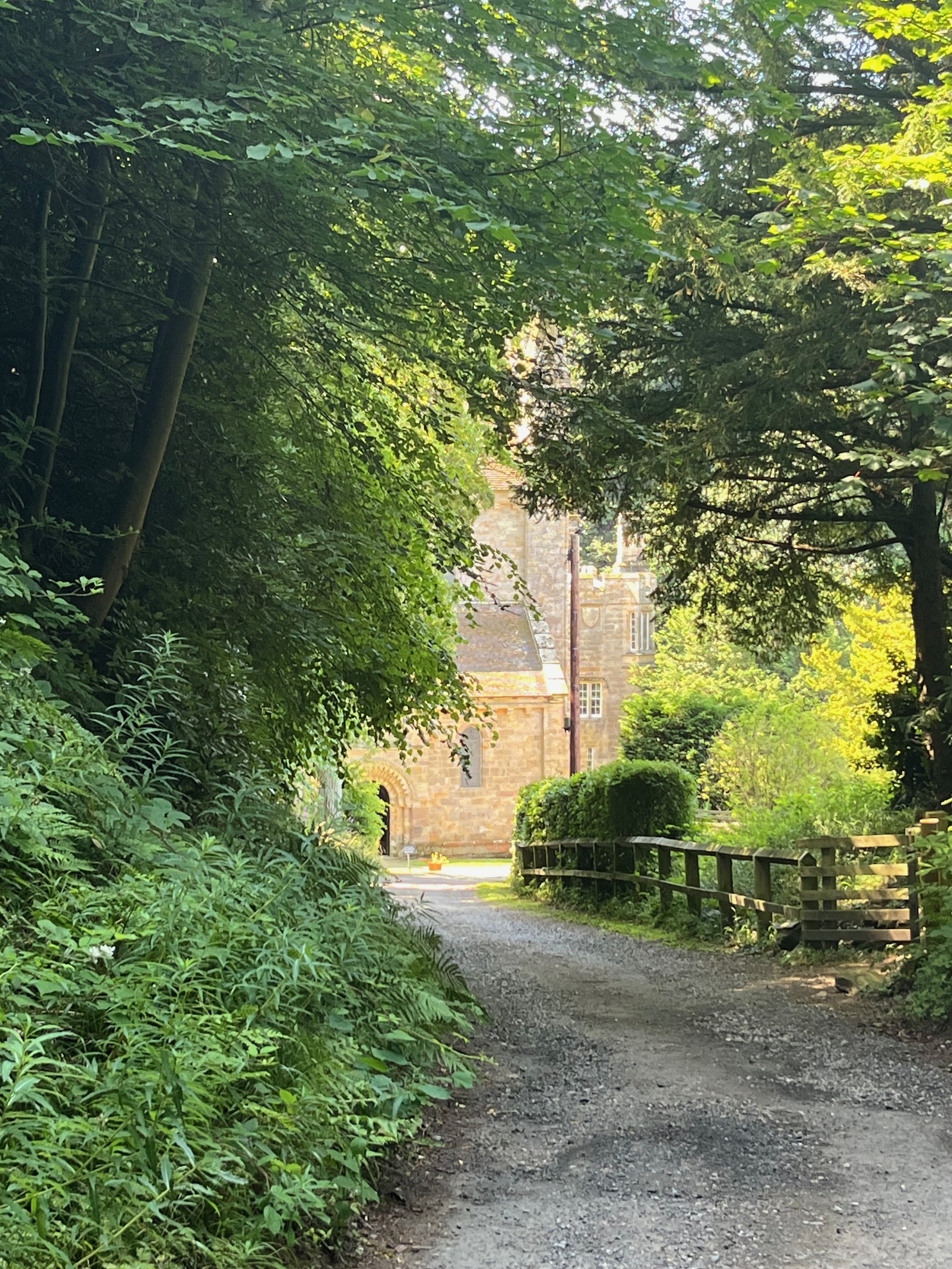
The approach to the Brinkburn site. Image by Rachel Hammersley, 2026.

As I start writing this post, the 2026 Mouth of the Tyne Festival has just come to an end. Once again our local area was busy with incomers and our evening activities were accompanied by a soundtrack of thudding bass carried on the wind. This time last year the Festival prompted me to write about the layering of history evident in the landscape and remains at Pen Bal Crag, the headland on which Tynemouth Priory sits, where the Festival takes place. This month I visited another English Heritage site - Brinkburn Priory - where a similar layering is evident. Like Tynemouth, Brinkburn was originally the site of a priory, in this case an Augustinian foundation established in the 1130s. Yet despite this basic similarity, the location of the site could not be more different. Where Pen Bal Crag is an exposed headland clearly visible from both land and sea, Brinkburn is hidden away down a narrow road in a wooded area of the Coquet valley in the depths of rural Northumberland. When we visited, it was even harder to find the priory than usual due to road closures and diversions. It was definitely worth the trouble, though, as I was treated to a personalised tour by Esther who works at the site.

The Augustinian priory at Brinkburn was established by William Betram, lord of Mitford, in the early 1130s. (This section draws on: Martin Roberts, Brinkburn Priory, London: English Heritage, 2024). The secluded nature of the site would have been ideal for this type of small foundation, while its position in a bend of the River Coquet will have ensured a ready supply of water for the inhabitants. The monastery itself lay at the heart of a wider estate that was worked to sustain the community with food, clothing and building materials. The earliest surviving buildings on the site date not from its foundation but from the late twelfth century, previous structures probably having been constructed of timber rather than stone. The location of Brinkburn, just fifteen or so miles from the border, meant that it was frequently subject to attacks by the Scots, including a major plundering of animals and goods in 1484. In the early sixteenth century the monastery was at the centre of a dispute over land, which resulted in the murder of the canon Sir Richard Lighton in 1521.
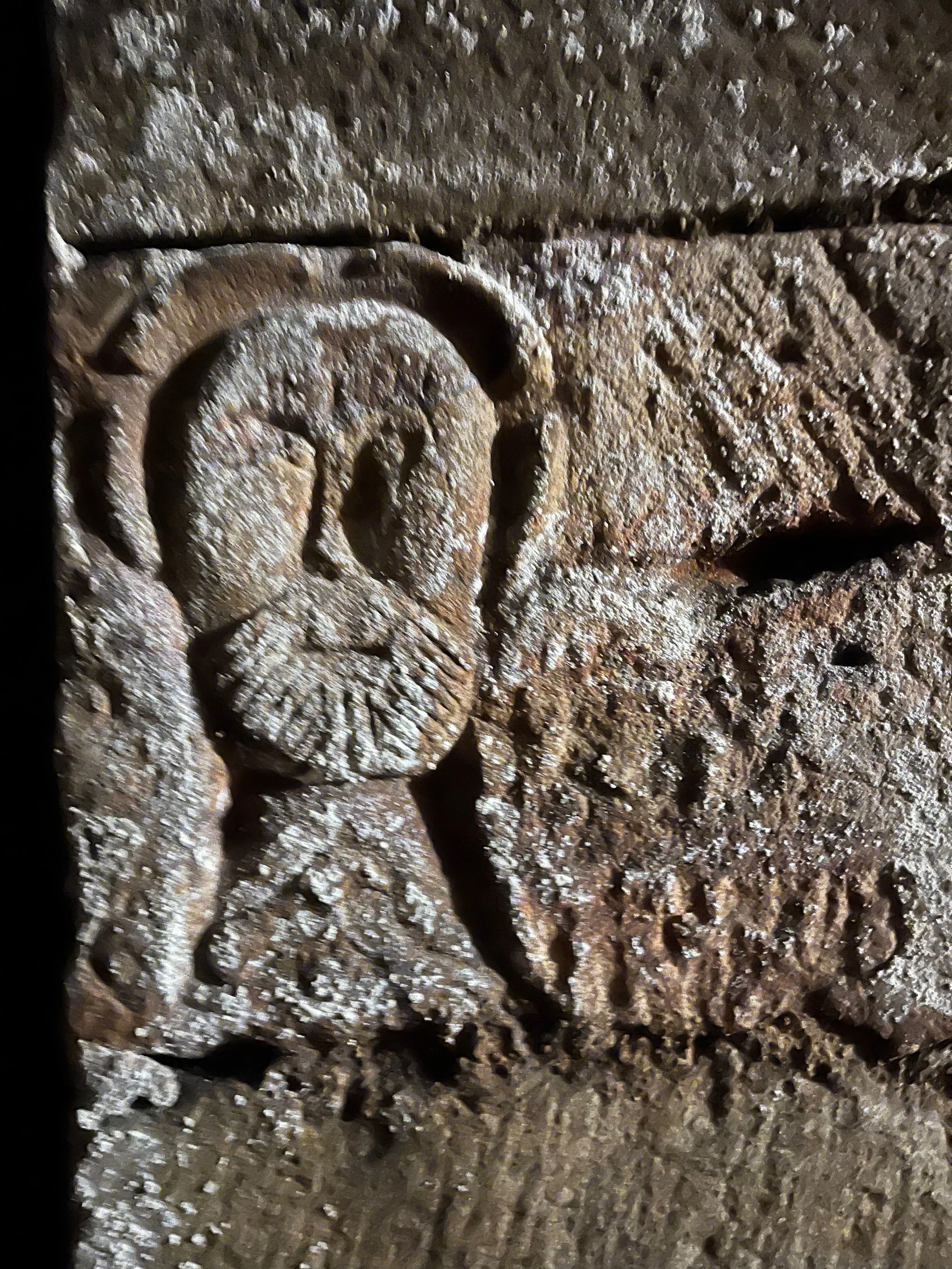
The carving in the basement at Brinkburn that resembles Henry VIII. Image by Rachel Hammersley, 2026.

Brinkburn was one of the first monasteries that was closed following Henry VIII's Dissolution in 1536. After this, the site was leased out, with the tenancy changing hands frequently. The priory church continued to be used as the local parish church for several surrounding villages, but by the early seventeenth century it was in a state of disrepair. By the end of that century the roof had collapsed and services had ceased.

While Henry VIII's influence on the site was largely destructive, what is perhaps a small creative testimony to his impact remains. Down in the basement of what was originally the monastic refectory is a face carved into the wall. The beard and other features look remarkably similar to contemporary portraits of Henry. If it is him, was this carving a symbol of homage to the new king early in his reign, or does it represent an act of defiance by someone who objected to the Dissolution?
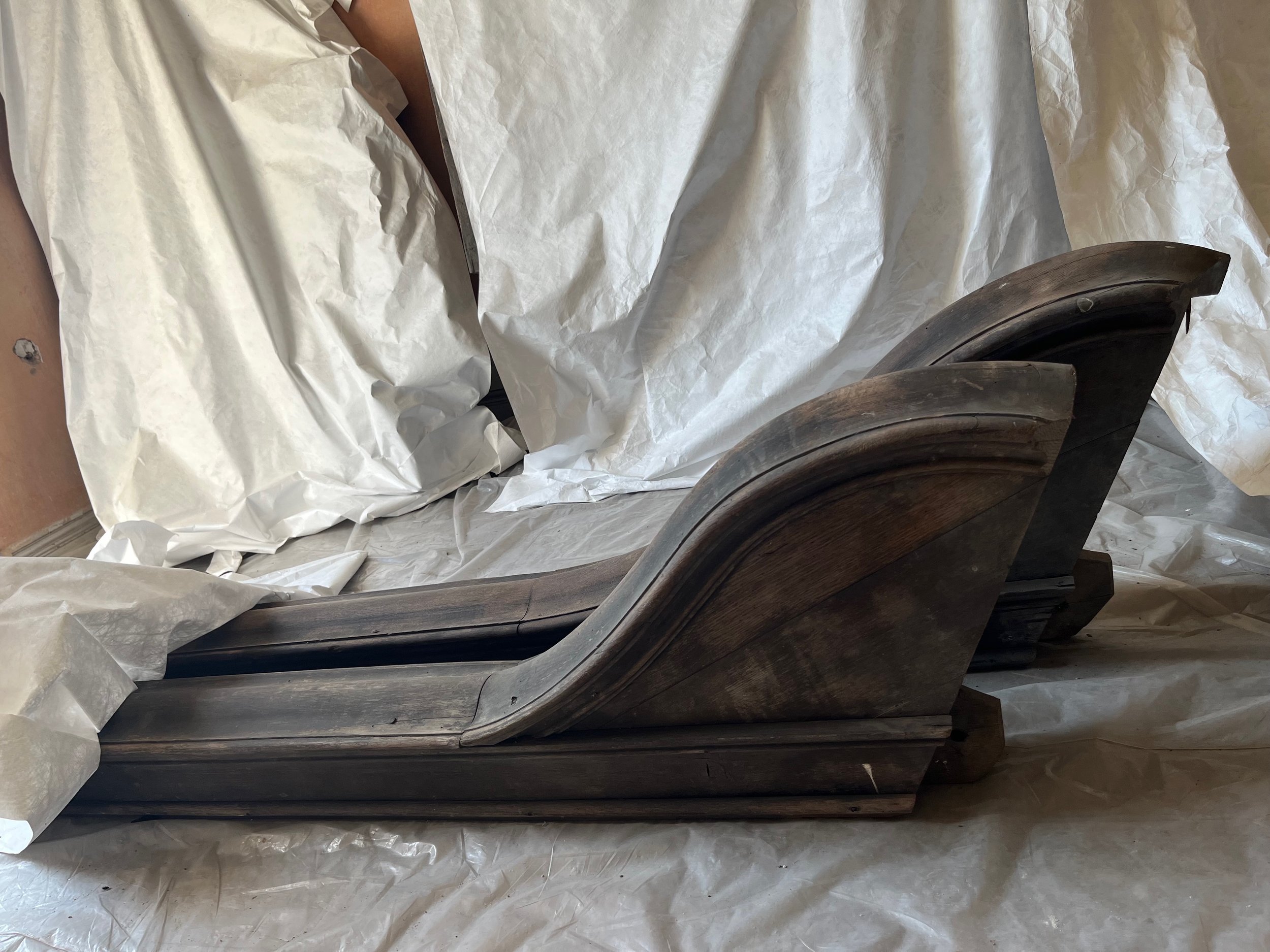
Parts of the bannister from the Anderson Place staircase. Image by Rachel Hammersley, 2026.

The main reason for our visit had nothing to do with the priory or the Reformation. Our interest lay, instead, in the derelict manor house that now stands behind the priory church. It was constructed on the site using some of the remains of the monastic buildings. Between 1626 and 1792 the house was in the possession of the Fenwick family. George Fenwick, the first owner from this family, is interesting in his own right, but our reason for visiting was not specifically to do with him - or even the building itself. We had come to see something that is currently being stored in one of the upstairs rooms. Esther led us through a 'staff only' gate and up the only staircase in the building that is not rotting away. We then proceeded through a series of rooms and corridors to a large room with white plastic sheeting covering various objects leaned against the walls and arranged on the floor. Esther lifted one of the sheets to reveal what was clearly a very old - and once very beautiful - oak bannister. Beneath another sheet were a couple of the steps themselves - treads and risers intact. This staircase is not original to Brinkburn, but comes from Anderson Place in Newcastle.

Anderson Place was constructed in the late sixteenth century by Robert Anderson on the site of the old Grey Friars monastery in the centre of Newcastle. By the mid-seventeenth century 'Newe House', as it was then known, was the largest private residence within the walls of a town anywhere in England. In the Civil War it was used by the Scottish general, Alexander Leven, as his headquarters during the Scottish occupation of the town. In 1646, when the defeated King, Charles Stuart, surrendered to the Scots and was brought by them to Newcastle (which was still under Scottish control), it became his official residence-cum-prison.
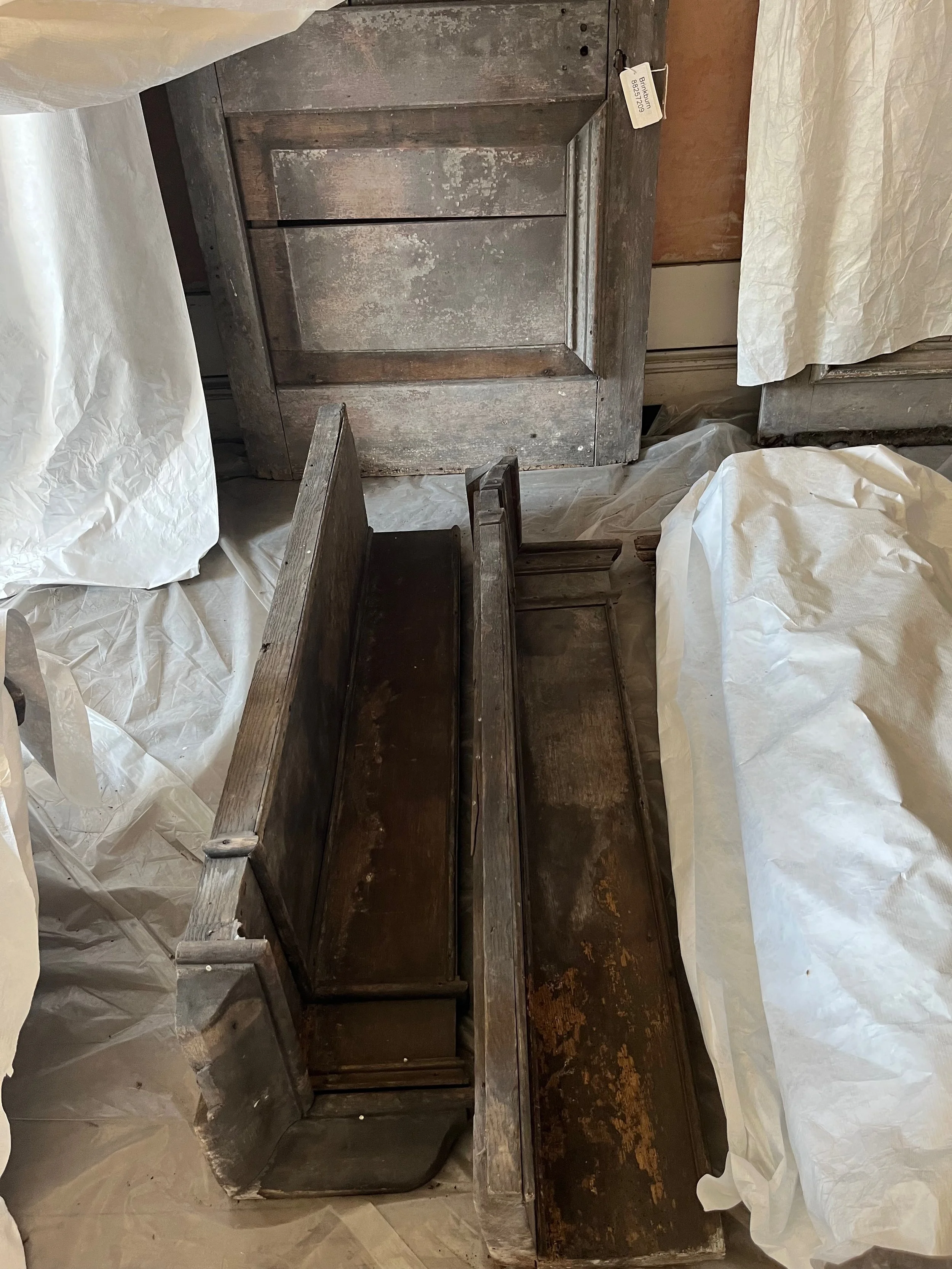
The treads and risers. Image by Rachel Hammersley, 2026.

To understand why the Anderson Place staircase ended up thirty miles away at Brinkburn we have to move forward in time again to the early nineteenth century. This was the period when the centre of Newcastle was being remodelled by the architect Richard Grainger and others. Anderson Place fell victim to their ambitious enterprise, being demolished in 1834. One of the architects assisting Grainger was John Dobson who was also working at that time on the restoration of Brinkburn manor house for the Hodgson family. The eastern portion of the manor house had already been redesigned in the 1810s, so Dobson was working on the central and western end. His plan was to replace the existing sections with a new west wing in a style popular at the time. Dobson will have been aware, from his work with Grainger, that Anderson Place was being demolished and he perhaps decided that the staircase would make a striking central feature for his new west wing. Whoever came up with the idea, Dobson certainly incorporated the Anderson Place staircase into a design for the remodelling of Brinkburn manor house, making it part of a grand entrance. Grainger was apparently keen to oblige because he was struggling financially at this time and the sale of the staircase would help him to pay off his debts. The staircase was transported to Brinkburn, but for whatever reason it was not incorporated into the final design. Instead it was placed in a barn on the estate where it remained for more than a hundred years before being catalogued by Historic England and moved to its current location.
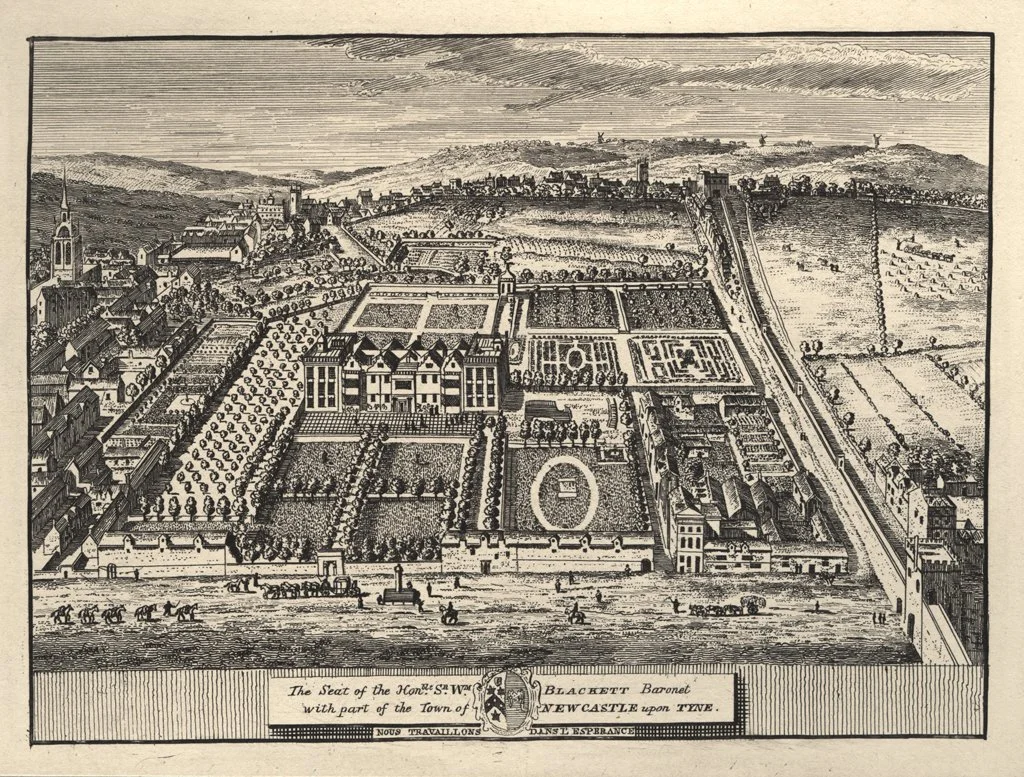
An eighteenth-century print showing Anderson Place in Newcastle. Newcastle Libraries 003390: Anderson Place Newcastle upon Tyne (1702). https://flikr.com/photos/newcastlelibraries/4076330220/

At Brinkburn, as at Tynemouth, we can see how events and decisions at different moments of history have contributed to the current appearance of the site, influencing both what has been lost and what remains. In addition, this site also reveals the curious interconnections across space as well as time, with the history of Brinkburn being bound up not only with the surrounding land and villages but also with the lost architecture of Newcastle city centre.

Memories of the British Revolutions

One of the frescoes from the Peers’ Corridor in the Palace of Westminster. Reproduced from Wikimedia Commons.

In the Peers' Corridor of the Houses of Parliament, which leads from the central gallery to the House of Lords, eight frescoes by the Victorian artist Charles West Cope are mounted on the walls. On one side of the corridor are four pictures that depict events from the mid-seventeenth-century Civil Wars from the Parliamentarian perspective, on the other are four paintings that offer a Royalist account. They were commissioned as part of the refurbishment of the Palace of Westminster following a devastating fire in 1834. The idea behind the paintings, and the way in which they are hung, was to represent the fact that the two sides had fought each other during those wars, but that they were now unified once again and working together for the good of the nation. This scheme, and the careful consideration that went into it, reflects the difficulties involved in commemorating the events of the mid-seventeenth century.

Reconciling ourselves to the history of the British Revolutions (1640-1660 and 1688-1689) is perhaps less of a problem today, since those events are no longer central to British public consciousness or the understanding of our own history. In part this reflects the fact that the mid-seventeenth century features only fleetingly in the school history curriculum. Yet the events of those years still resonate in the way in which we conduct parliamentary politics. The adversarial model of parliamentary debate, the fact that the monarch cannot enter the House of Commons without permission, and the exclusion of Roman Catholics from the line of succession to the throne, all date from the seventeenth-century conflicts.

On 3rd September we held a workshop at Newcastle University on 'Memory of the British Revolutions in the 17th, 18th, and 19th Centuries'. Organised in collaboration with colleagues at the Université de Rouen in France, this was a second workshop aimed at building towards a big grant application 'Memories of the English Revolutions: Sources, Transmissions, Uses (17th-19th centuries)' (MEMOREV). This workshop brought together a number of British and French scholars from different disciplines and career stages to consider how the 1640-1660 and 1688-1689 revolutions were remembered, forgotten, contested and reinvented across the British Isles, Europe, and North America between the mid-seventeenth and the early twentieth century. The aims of the wider project (as set out in the workshop by Claire Gheeraert-Graffeuille) involve several elements:

Linking the conflicts of the 1640s and 1650s with those of the late 1680s and early 1690s. These were often linked retrospectively and, as Jonathan Scott has shown, many of the issues that were fought over in the 1640s were unresolved in 1660 and surfaced again at the time of the Glorious Revolution

Taking a broad geographical approach encompassing not just the British Isles but also continental Europe and North America so as to re-examine the impact of these revolutions on European and transatlantic cultures

Exploring the tension between memory and history and the way in which the two impact each other, including the importance of remembering and forgetting in the fashioning of historiography.

In what remains of this blogpost I will explore my own reflections on this stimulating workshop.

While the British Revolutions may no longer hold the place in the public consciousness they once did, episodes from that era still create tensions or problems for those engaged in remembrance, memorialisation, and even historical interpretation. As an historian who regularly teaches the British Revolutions I am acutely aware of this. I know the horrifying fact that the proportion of the population that died in the civil wars was greater than in World War One, and despite my republican sympathies I am uncomfortable discussing - let alone celebrating - the details of the execution of the King.

As several speakers from our workshop highlighted, the violence and the regicide have created difficulties for those remembering the events ever since the seventeenth century. Isabelle Baudino's paper was particularly strong on this. While early visual narratives of the period, such as A True Information of the beginning and cause of all our troubles and John Lockman's New History of England, did present the violence - the latter including an image of the execution of Charles I by Bernard Picart - later versions replaced these images with tableaus that encapsulated the event without actually depicting the brutality. Isabelle focused on two scenes that proved particularly popular as means of presenting the regicide and Cromwell's reign respectively in ways that were not too shocking or distasteful.

‘Charles the First after parting with his children’ by Samuel Bellin, published by Mary Parkes, after John Bridges. 1841 (1838). National Portrait Gallery NPG D32079. Reproduced under a creative commons licence.

Rather than depicting the regicide itself, the authors of narrative histories began alluding to that event by recreating the king's final farewell to his children. As Isabelle noted, the regicide was effectively present in this scene, since the reason Charles was having to take leave of his family was because he had been condemned to death, but the act itself was not shown. That farewell scene became ubiquitous not just in narrative histories but also in other forms, right up to Ken Hughes's 1970 film Cromwell.

The other scene Isabelle discussed also features in that film. It was Oliver Cromwell dissolving the Rump Parliament in April 1653, which became a symbol or shorthand for Cromwell's authoritarian rule. As Myriam-Isabelle Ducrocq noted in her paper, Cromwell as a character has also been problematic for those remembering or offering an historical account of the British Revolutions. This is especially true with regard to his activities in Ireland, but Myriam-Isabelle showed that Cromwell was also a difficult figure for historians such as Frances Wright, whose grand narrative England, the Civilizer appeared in 1848. On the one hand Wright was critical of Cromwell's actions and yet she also sought to exonerate and redeem him, describing him as a wonderful man and a guardian of civilisation.

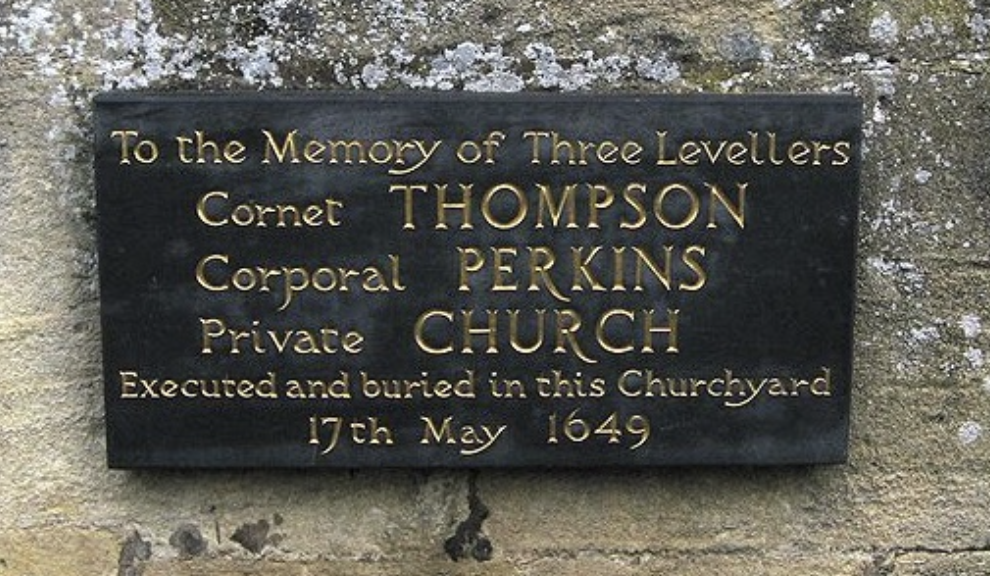
Plaque at Burford Church. Reproduced from Wikimedia Commons.

Wright saw the Revolution of 1640-1660 as a positive event, advancing the civilising process, yet for her - and for later parliamentarian sympathisers - it could be difficult to identify moments or characters worthy of celebration. Waseem Ahmed's paper addressed this issue from the perspective of the Left in examining 'Levellers Day', a commemoration of the Leveller mutiny which resulted in the execution of three men - Cornet Thompson, Corporal Perkins, and Private Church - at Burford in Oxfordshire in May 1649. Despite the violence of this event, and the fact that it marked the end of the main active phase of the Leveller movement, it is the date that Left-wing activists have chosen as a focus for celebration since the 1970s. In his talk, Waseem provided detail on the background to the annual Levellers Day celebration and drew out some of the complexities and tensions inherent in it. Though effectively a celebration of a moment of defeat it celebrates the bravery of these men who sacrificed their lives for a cause they believed in. Moreover, the event is important in offering an alternative history of the British Revolutions distinct from that offered by the establishment, and is part of a wider argument (encouraged by the Communist Party Historians’ group in the 1950s and 1960s) that England does have a revolutionary tradition.

A second theme that cropped up in several of the papers was the importance of networks - both familial and political - to the preservation of memories (especially more hidden or controversial memories). Cheryl Kerry's paper highlighted this in relation to the 'regicides' who had signed the death warrant for Charles I. She showed both that there was a great deal of intermarrying among regicide families and that a number of descendants of the regicides were involved or implicated in later plots and were prominent among the supporters of William III in 1688-89.

Interestingly, Stéphane Jettot demonstrated that the situation was very similar for a group on the other side of the political divide - the descendants of Jacobites. Again there is evidence of intermarriage and Stéphane particularly highlighted the role played by female family members in maintaining memories through the preservation of documents and artefacts.

Lucy Hutchinson by Samuel Freeman, C. 1825-1850. National Portrait Gallery NPG D19953. Reproduced under a creative commons licence.

Returning to the civil wars, Lucy Hutchinson, who was the focus of David Norbrook's paper, played a crucial role in preserving the memory of her husband, the parliamentarian Colonel John Hutchinson. David demonstrated how important members of her family then were in controlling the publication of the manuscript of her Memoirs and the format in which it appeared.

Gaby Mahlberg also touched on the importance of networks, this time of those with similar political views, in her paper on the dissemination of texts and images relating to the regicide Algernon Sidney in seventeenth- and eighteenth-century Germany. Gaby noted the important role played by Thomas Hollis and his circle in the creation and circulation of key images. Members of that circle included the Italian painter and engraver Giovanni Battista Cipriani, the German engraver Johann Lorenz Natter, and the Baron Stolzh.

Giovanni Battista Cipriani’s engraving of Algernon Sidney for the 1763 edition of Sidney’s works commissioned by Thomas Hollis. National Portrait Gallery NPG D28941. Reproduced under a creative commons licence.

Hollis and his circle worked hard to keep the memory of the British Revolutions alive in Britain and abroad in the late eighteenth century and saw connections between the events of the mid-seventeenth century and their own times. The third theme that stood out to me from the workshop papers was the importance of reverberations and feedback loops both in preserving memories (by ensuring that events remained relevant) but also in distorting the way in which particular events were remembered.

Several participants highlighted the fact that in nineteenth-century France, discussing the English Revolutions was a subtle way of commenting on the French Revolution and contemporary events in France. In his paper on nineteenth-century French school textbooks, Pascal Dupuy explained that parallels between the Stuarts and the Bourbons were especially common in the Restoration period and that discussions of the Stuarts could be read as comments on the contemporary French monarchy.

Another obvious parallel for the French was that between Napoleon Bonaparte and Oliver Cromwell. As Isabelle Baudino explained, Bonaparte's coup added a new urgency and relevance to the image of Cromwell dissolving the Rump Parliament. It was not only for the French that Cromwell was a striking character. As Maxim Boyko demonstrated in his paper, Cromwell was interpreted by some Italians through a Machiavellian lens. Maxim noted that the Italians also tended to understand the period of the commonwealth and free state between 1649 and 1653 through the lens of the Italian city states, not least Venice.

These ideas have been very much in my mind as I returned to teaching. In my first week back I encouraged undergraduate students on my special subject 'The British Revolutions, 1640-1660' to think about some of the resonances of that period today. I also engaged in a lively discussion with MA students on British values and citizenship and the extent to which these are rooted in history. I hope the MEMOREV project will offer further opportunities to explore the symbiotic relationship between the past and the present, memory and history.

The Memoirs of Edmund Ludlow

In the vast manuscript 'A Voyce from the Watch Tower', the former regicide Edmund Ludlow left advice about what should happen to it after his death:

If the Lord please to put a period to my pilgrimage, before I have brought this

narrative to its perfection, it's my desier, that my deare wife, if liveing, if not, those

of my deare friends, and relations, into whose hands by providence it shall fall, will

take care that if it, or any part of it, bee thought of use unto others, it may not bee

made publique, before it hath ben perused, rectifyed, and amended by some one, or

more judicious friends, who have a fluent style, and of the same principle with

mee, as to civill, and spirituall governement, the liberty of men, and Christians, and

well acquainted with the transactions of the late times, to whome I give full power

to deface what hee, or they conceive to be superfluous, or impertinent, or what they

know to bee false, to change and alter what they find misplaced in respect of time,

or other circumstances, to adde what they conceive to bee deficient, or may conduce

to render it more usefull, and agreable, and to that end to cloth it with a more full,

and liquid stile, and to illustrate what is therein asserted with such reasons,

similes, examples, and testimonys, as they shall thinke fit. Provided that in the

maine, they make it speake noe other then my principle (which as I judge is

according to the minde of the Lord) in relation to the gouvernement of church, and

state, and Christ's ruleing... (Edmund Ludlow: A Voyce from the Watch Tower, ed. Blair

Worden. London, 1978, pp. 54-5).

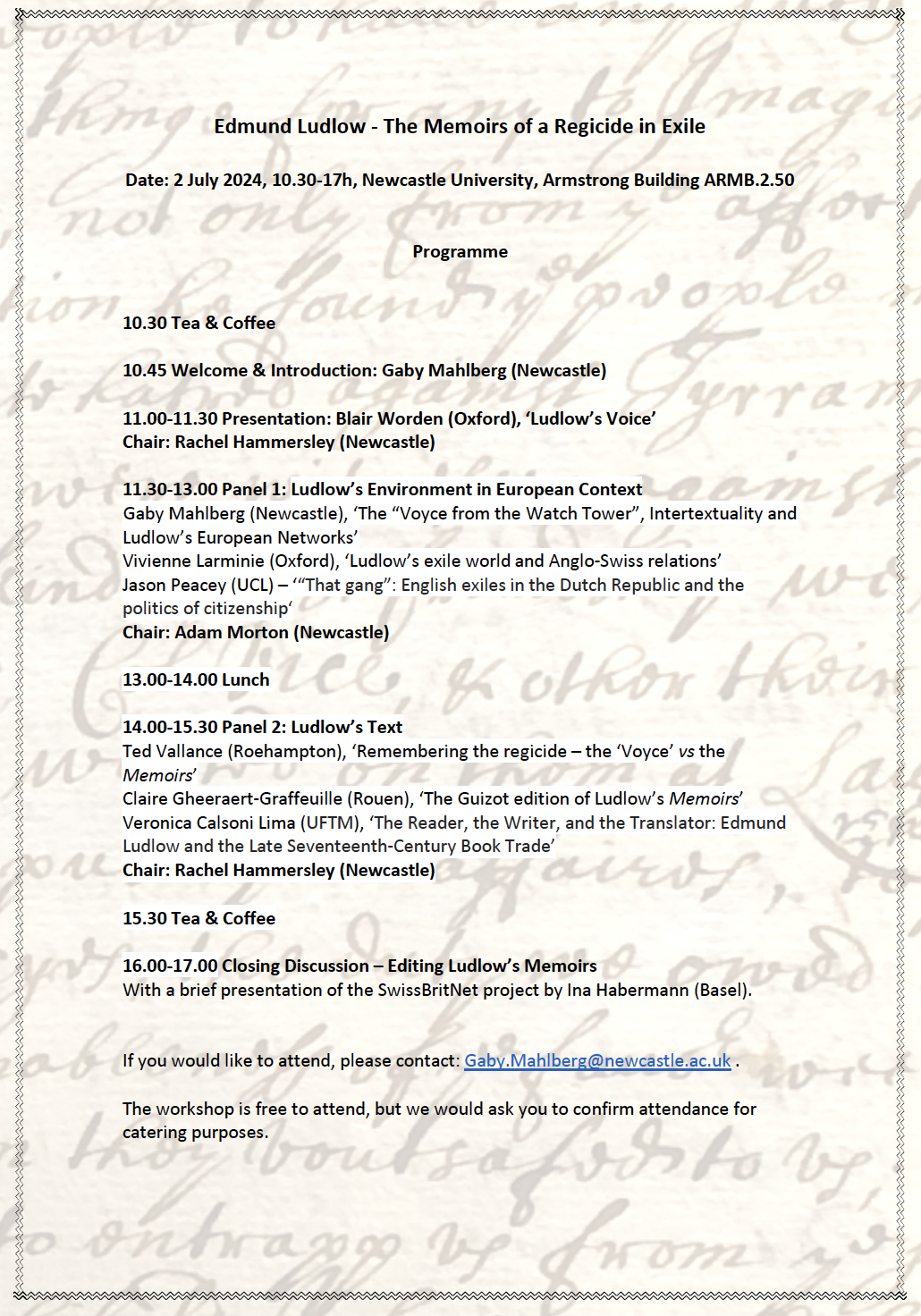
Ludlow's request that something be done with his manuscript was soon fulfilled. An edition, entitled The Memoirs of Edmund Ludlow, was published in 1698, one of several civil war-related tracts to be produced by John Toland and John Darby. It proved popular, going through at least four editions by the end of the eighteenth century and being translated into French and Dutch. Moreover, as Professor Blair Worden reminded us in his opening presentation at our workshop on 'Edmund Ludlow - The Memoirs of a Regicide in Exile', the text was used to teach generations of history undergraduates and future historians.

Yet Ludlow's other stipulations were ignored. This was revealed by Blair himself after he analysed the Ludlow manuscript, which was discovered at Warwick Castle in the 1970s, and compared it to the published version of the Memoirs. In the latter, Ludlow was, as Blair put it, 'taken to a literary barber'. The alterations changed the text from the work of a deeply committed protestant to that of an admirer of ancient republicanism.

In 1978 Blair produced an edition of the portion of the text covering the period 1660-62, which has remained a crucial source for historians ever since. He is, then, an editor of the text as well as an historian of the period. Given the complex history of the text, the role of editors was one key theme of our discussions.

The various editors of Ludlow's manuscript have exerted control over how Ludlow and his text have been understood by future generations. Yet the situation has been complicated by the fact that we only have the manuscript for the period 1660-77, both the later portion (covering 1677-85) and the earlier part - on the civil wars themselves - have been lost. In his paper, Ted Vallance paid particular attention to one important episode that is treated rather perfunctorily in the Memoirs, but which one might have expected Ludlow to dwell on more deeply - the regicide. The account of the trial and execution of Charles I in the Memoirs is very brief and, as Ted noted, this is at odds with later portions of the manuscript where Ludlow frequently returns to that event and expresses his views on it. Moreover, the account does not follow other known primary sources, raising the possibility that elements of it were invented.

Later editors and translators of the work were equally influential. As Claire Gheeraert-Graffeuille noted in her paper, the 1794 French edition of the Memoirs published as Histoire de la République d'Angleterre d'après les Mémoires d'Edmond Ludlow turned Ludlow into a French republican and his opponents, the Cavaliers, into French-style aristocrats. C. H. Firth, who produced an edition of the Memoirs in 1894, was equally influential in his insistence that the text accurately reflected Ludlow's views.

Edmund Ludlow by Giovanni Battista Cipriani, after Thomas Simon. National Portrait Gallery, NPG D28923. Reproduced under a creative commons licence. This is one of several images of Civil War figures commissioned by Thomas Hollis.

Of course, in some respects, these editors were simply doing their job in framing or shaping the text to suit their audience. This point was brought home to me by our discussions at the end of the day about the possibility of producing a new edition of the Ludlow manuscript. Our colleague (and experienced editor) Ruth Connolly insisted that our first step must be to establish what people currently read Ludlow for and what we think they ought to read him for. Our answers to these questions, she said, would dictate all our editorial decisions. Toland and Darby no doubt began by asking themselves the same questions and acting in the same manner. While we might argue that the invention of key passages took their actions beyond editing to rewriting, the question of exactly where that boundary lies is not clear.

In the past, the mid-century civil wars were generally seen as a purely English affair. When I was an undergraduate in the 1990s, even the notion that they should be understood in a wider British context was novel. Now, thanks to the work of various historians including Jonathan Scott and Gaby Mahlberg, the idea that the British civil wars should be viewed in a European - even a global - context is shaping and directing research. Analysis of the manuscript allows us to see Ludlow as a European - not just an English - figure. Exploring this wider European context constituted a second theme of our workshop.

Geneva in 1630. Image Rachel Hammersley.

Gaby's paper offered a sense of Ludlow's daily life in Switzerland: how he kept in touch with people in England and his knowledge of current affairs. She identified some of his key contacts in Switzerland including the Genevan politician and minister Charles Perrot, the chief minister of Bern, Johann Heinrich Hummel, and the Bernese politician Sigmund von Erlach. She also pointed out that Ludlow had religious contacts that stretched right across Europe. Vivienne Larminie's paper complemented Gaby's in deepening the exploration of the Swiss context and reinforcing the point that contacts between England and Switzerland were complex. For example, she showed that some of Ludlow's ties to Swiss figures came via his neighbours in Wiltshire the Earls of Pembroke and their involvement with the French Church in Westminster. Anglo-Swiss connections are being explored on a larger scale via the SwissBritNet project that Ina Habermann introduced to us at the end of the day.

In his paper, Jason Peacey, broadened our sense of the context beyond Switzerland to the wider Protestant world and, in particular, the Dutch Republic. His account of the experience of English exiles in the Netherlands shed light on the probable experience of those in Switzerland. Jason noted how the complexities of the Dutch system meant that the authorities were often more willing to offer help in capturing the regicides than to take concrete action. His paper also highlighted interesting (and topical) questions around the status of refugees in relation to their home country and country of residence.

Claire's paper addressed the European context from a different perspective in exploring the reception of Ludlow's Memoirs in nineteenth-century France. The historian and politician François Guizot included Ludlow's text in a series entitled Collection des Mémoires relatif à la Révolution d'Angleterre. These effectively acted as sources for his Histoire de la Révolution d'Angleterre (1826-7). Guizot's belief that these were valuable works to publish in French at this time tells us something about the place of the British revolutions within European history.

The third theme that was highlighted for me during the workshop was intertextuality. Gaby drew our attention to the Ludlow manuscript's status as a composite text. While published as a Memoir, it not only drew on Ludlow's own experiences and memories, but also on a range of sources including letters, newsletters (both manuscript and print), official documents (including Acts of Parliament and proclamations), and pamphlets (in English, French and Latin). While not all the sources are acknowledged, many are still visible within the text. This theme was deepened by Verônica Calsoni Lima, who concentrated on a set of pamphlets used not only in the manuscript but also in Ludlow's printed pamphlet on the regicides, Les Juges Jugez. Many of these were produced by a group of radical stationers in London which included Livewell Chapman, Thomas Brewster, and Giles Calvert. In this way the sources out of which the manuscript is woven tell us something not only about Ludlow's reading habits, and the sources of information available to him in Switzerland, but also about his networks and connections.

One of the first decisions we need to make if we are to produce a new edition of the Ludlow manuscript is whether it should be print or digital. Print is more durable as it is not at risk of obsolete technology rendering it inaccessible. Yet the potential offered by the digital is enticing. In a digital edition it would be possible to highlight the intertextuality of the text, perhaps even offering direct links to original sources. Visualisations of Ludlow's networks of European contacts, and the locations of editions and translations of the Memoirs, could be produced to accompany and contextualise the text. Of course, in producing a more interactive edition, and taking advantage of the possibilities provided by the latest digital technology, we would be transforming the text into something way beyond Ludlow's original vision and perhaps highlighting elements of it that he would have preferred to keep hidden. Would this, I wonder, make us as guilty of transgressing Ludlow's wishes as the editor of the Memoirs.

[Gaby Mahlberg has produced her own excellent report on the workshop, which can be read here.]