
I uploaded my first blogpost to this site ten years ago this month. Since then, I have posted every month, accumulating a total of 119 separate posts. On several occasions I have wondered about calling it a day, since coming up with a fresh blogpost every month is a tall order alongside the day job and family responsibilities. Yet every time I have thought about stopping, something has propelled me on - whether an idea for my next post or a comment from a stranger at a conference about how much they enjoy reading my blog. Reaching this milestone has led me to reflect on the road I have travelled over the last ten years - both personally and professionally.
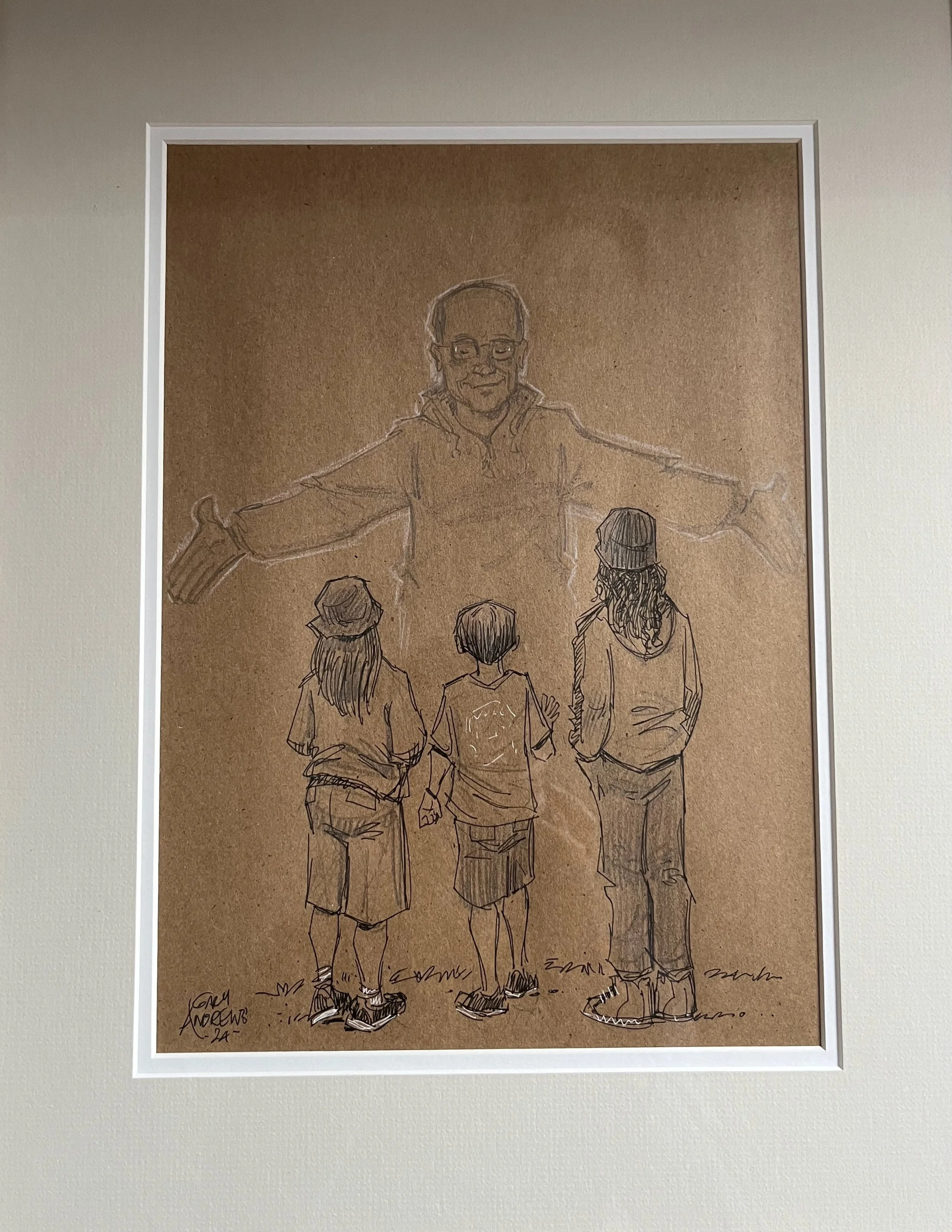
Gary Andrews’s drawing of Team Gurney commissioned to commemorate the tenth anniversary of John’s death. The picture shows how I (in the middle) have been outgrown by my children. I remain grateful to Gary for producing this for us and for sharing his own experience of grief as a widowed single parent in such an articulate and engaging fashion.
In 2016 I was a widowed single Mum with a 10-year-old and a 7-year-old. I now live in a household with two other adults and one almost adult. In many ways, my life is easier than it was ten years ago (though my moonlighting as a taxi driver is still going strong). Yet the last couple of years have also proved to be a difficult moment of transition. Navigating the emptying of the nest is tricky for any parent, but it has a particular poignancy for a widowed single parent. When John died, it was my instinct as a mother to protect and nurture my children that kept me going. They were my reason for getting up each morning and my motivation for carrying on. Those 'children' are now bigger than me. They still need me, of course, but less intensely than they did. I am no longer the centre of their world, and they can no longer be my reason for moving forward. I need to forge new motivations and goals for myself. Acknowledging and adjusting to this is difficult. It feels like a 'loss' all over again but it is also a time for new beginnings and fresh opportunities - not just for them, but for me too.
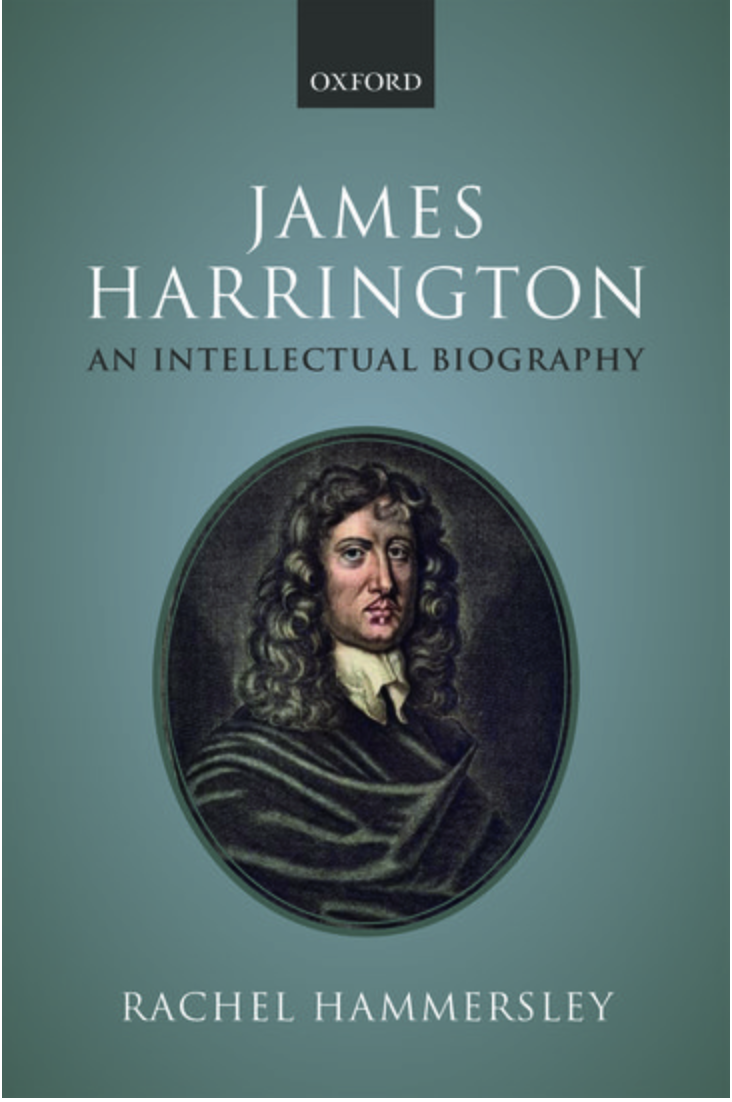
The cover of my book on James Harrington, which drew on my own research as well as on John’s notes.
John was not just central to my personal life, our shared passion for history meant that he was also a huge part of my working life. Here too his death meant having to forge something new. As my early blogposts indicate, in late 2016 I was tentatively exploring the idea of writing a book on James Harrington that would draw on my own research, but also on research notes that John had left behind. I saw that project functioning as a bridge from my past life and work with John to my future without him. Using John's notes alongside my own research to write that book was a way of keeping him at my side as I moved forward into new territory. Looking back, there was probably also something significant about the fact that working on Harrington took me back to my own past (my MA dissertation had focused on him). The need to reconnect with the person I was before I met John was an unexpected aspect of my grieving process.
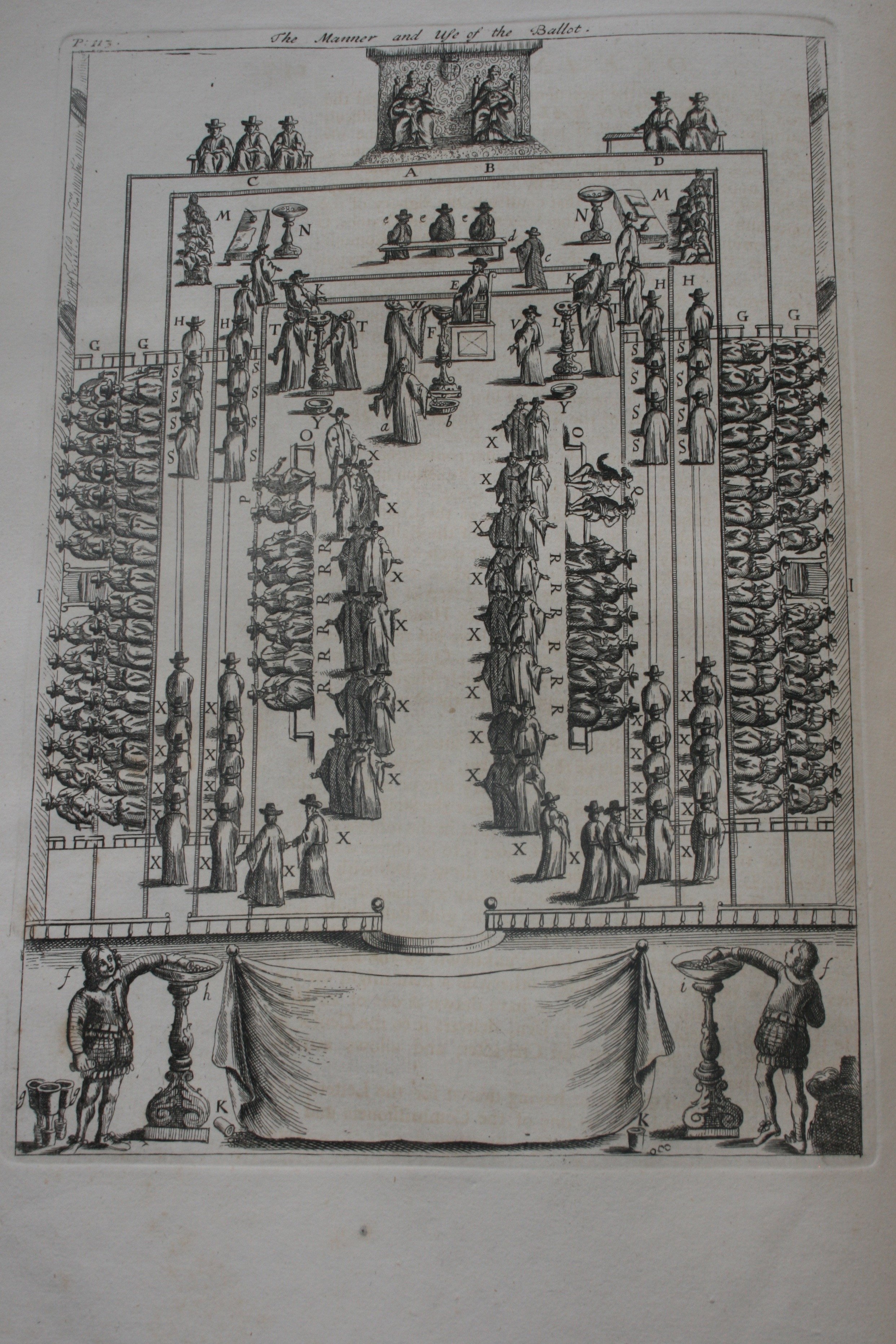
‘The Manner and Life of the Ballot’ - Harrington’s illustration of the ballot of Venice as reproduced in The Oceana and Other Works of James Harrington, ed. John Toland (London, 1737). Author’s own copy.
As well as linking me back to my own early work, the Harrington book also opened new - and sometimes unexpected - research pathways. Rereading Harrington's works with fresh eyes I became aware of elements I had not noticed before. I saw how The Commonwealth of Oceana combined several different genres - the 'First Part of the Preliminaries' is a treatise of political theory, the 'Second Part' is history, the main body is a model constitution - and fictional elements are woven throughout. I also observed Harrington's careful and clever use of language throughout the text - blending traditional and more innovative vocabularies for deliberate effect. Similarly I noted the conscious use of different typefaces in the model constitution, which led me to reflect on the purpose this was designed to serve. Finally, I paid attention to Harrington's decision to produce an image of the ballot of Venice in a bid to make it understandable, and his self-conscious reflection on the relative merits of words, images and experience to convey ideas. All of this prompted my interest in looking beyond the content or substance of political texts to their form - to think not just about what is said but also how it is conveyed. This curiosity formed the basis of the Experiencing Political Texts project that I carried out in 2022-23 together with my colleague and friend Dr Katie East. Though that project officially finished three years ago, it has informed much of the research I have done since. This includes my current work on Thomas Spence - another thinker who experimented with genre and paid careful attention to the form as well as the substance of the works he produced.
The Experiencing Political Texts project also encouraged me to vary the ways in which I write as an historian. As well as continuing to write academic journal articles and books, I have also authored a textbook on Republicanism and I have recently been enjoying the challenge of writing a trade book on Spence. While this book remains grounded in detailed academic research, I have endeavoured to present it in a way that is engaging for a more general audience. In a curious way this led me to think more deeply about precisely what the sources reveal and how best to convey their content.
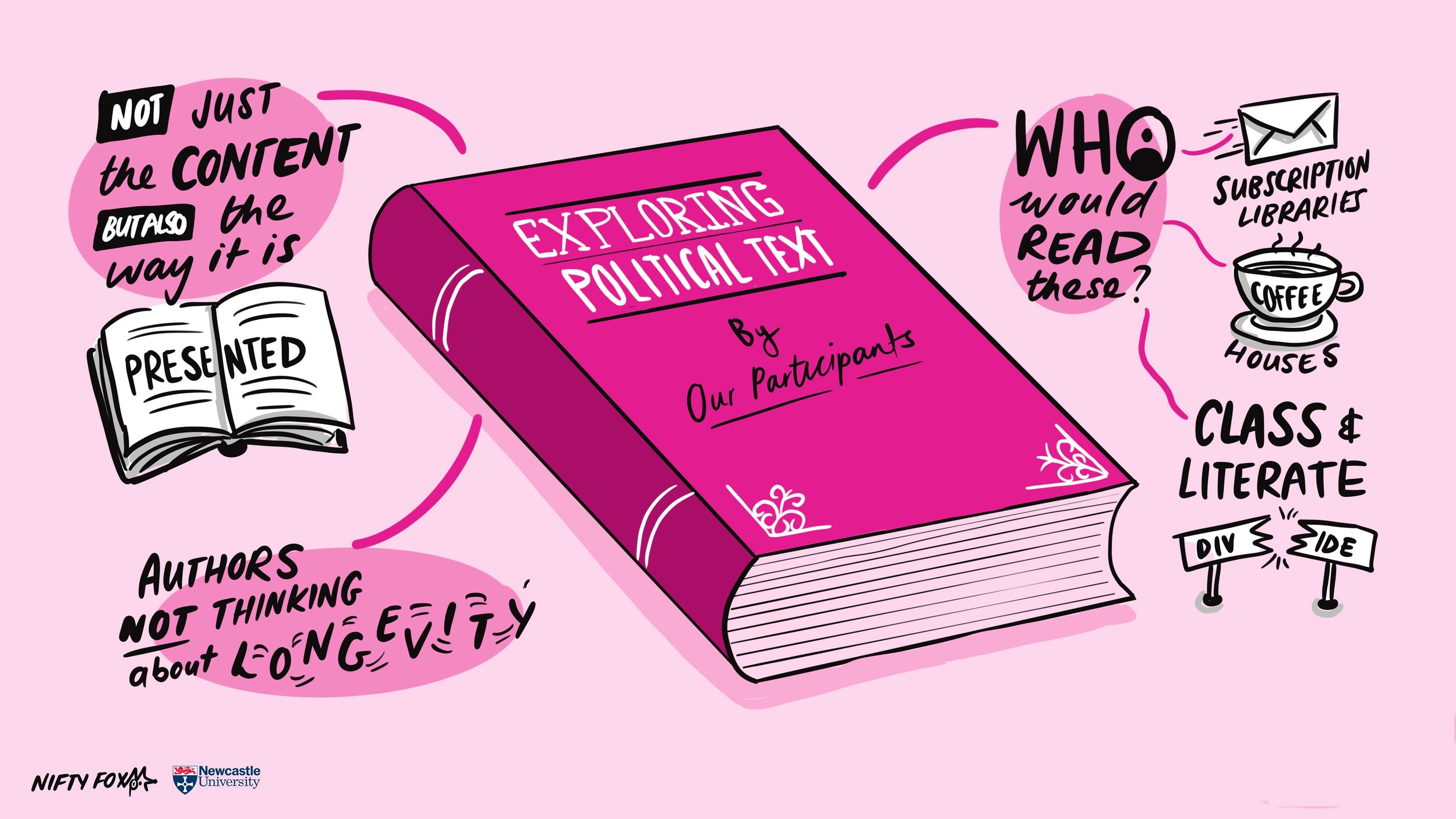
One of several infographics for the Experiencing Political Texts project created by Nifty Fox. Nifty Fox Creative 2023.
Now, as in 2016, I find myself once again scoping out a new project. Spence was not the only eighteenth-century figure who sought to make political ideas accessible to a wide audience - and saw the importance of doing so. This new project will trace the development of this initiative across the eighteenth century. It will examine various examples of this including: Thomas Hollis's dissemination of key political books; the educational proposals and practices of such figures as Joseph Priestley, Thomas Cooper and John Thelwall; and the activities of organisations like the Society for Constitutional Information (SCI) and the London Corresponding Society (LCS).
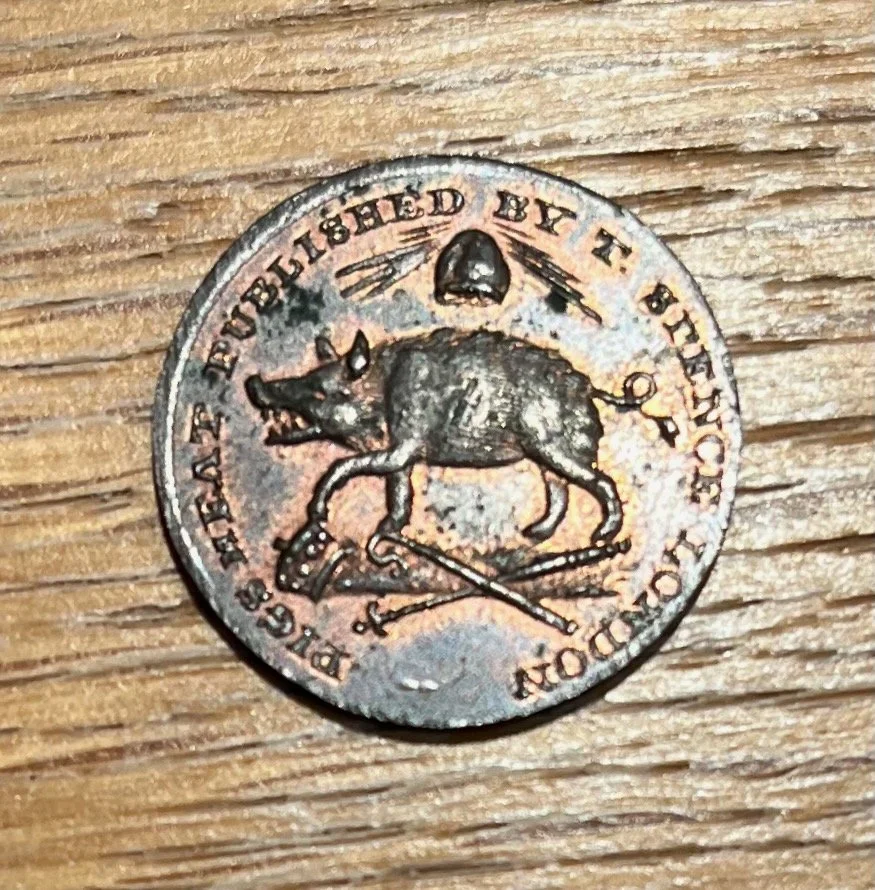
The reverse of Thomas Spence’s Three Thomas’s token which depicts an advertisement for Pigs’ Meat. Both that periodical and the tokens were means by which Spence disseminated political ideas to a wide audience. Image by Rachel Hammersley, 2026.
The purpose of spreading knowledge of politics for these figures was two-fold. In the first place, the aim was to ensure that people could recognise tyranny and could therefore work to frustrate its rise and to secure liberty and - increasingly - basic rights. Secondly, political knowledge was necessary for those who were to participate in the political system. At the beginning of the eighteenth century the emphasis was on providing political texts to the educated elite who were already in positions of political power. By the end of that century, members of the LCS - including Spence, Thelwall and Daniel Isaac Eaton - were making political knowledge much more widely accessible and were simultaneously calling for universal manhood suffrage and - in the case of Spence - even votes for women. Making sense of this story will require me to draw on what I learned from the Experiencing Political Texts project and to pay attention not just to the kind of political knowledge that was thought to be required for participation in politics but also to the ways in which that knowledge was presented and the methods used to engage audiences.
Thinking about what citizens need to know about politics, and how best to present that information to them, remains important today. As I write this blog, Andy Burnham has recently been sworn in as the new British Prime Minister. He is the sixth person to hold that office since I wrote my first blogpost back in 2016. Yet whether despite - or because of - the frequent change of officeholder, politics now feels more precarious than ever. At home, the NHS and social care are in a state of crisis, while cost of living pressures are making life hard for many families. Abroad, there are wars in Ukraine, the Middle East, and Africa and Asia, prompting politicians to call for greater spending on defence at the expense of health, education and welfare. Above it all, the threat from climate change remains immense as the recent heat waves, wildfires and floods have reminded us, and those incidents only increase the pressure on essential services. Now, more than ever, it seems important that citizens understand the pressing political issues of the day and the costs of addressing - or not addressing - them. Moreover, at a time when we are subject to constant distractions and when political debate is often conducted in a partisan and combative manner, how we convey political ideas is almost as important as what we say. This project will be an historical study, grounded in the ideas and concerns of the eighteenth century, yet I hope it might also offer insights of relevance to our own situation.
I will continue to reflect on these ideas in this blog in the months to come, but ten years feels like a good moment to step back a little. I will no longer commit to posting every month, but will instead write and upload posts from time to time when I feel I have something to say. Even so I might still be adding blogposts in another ten years.