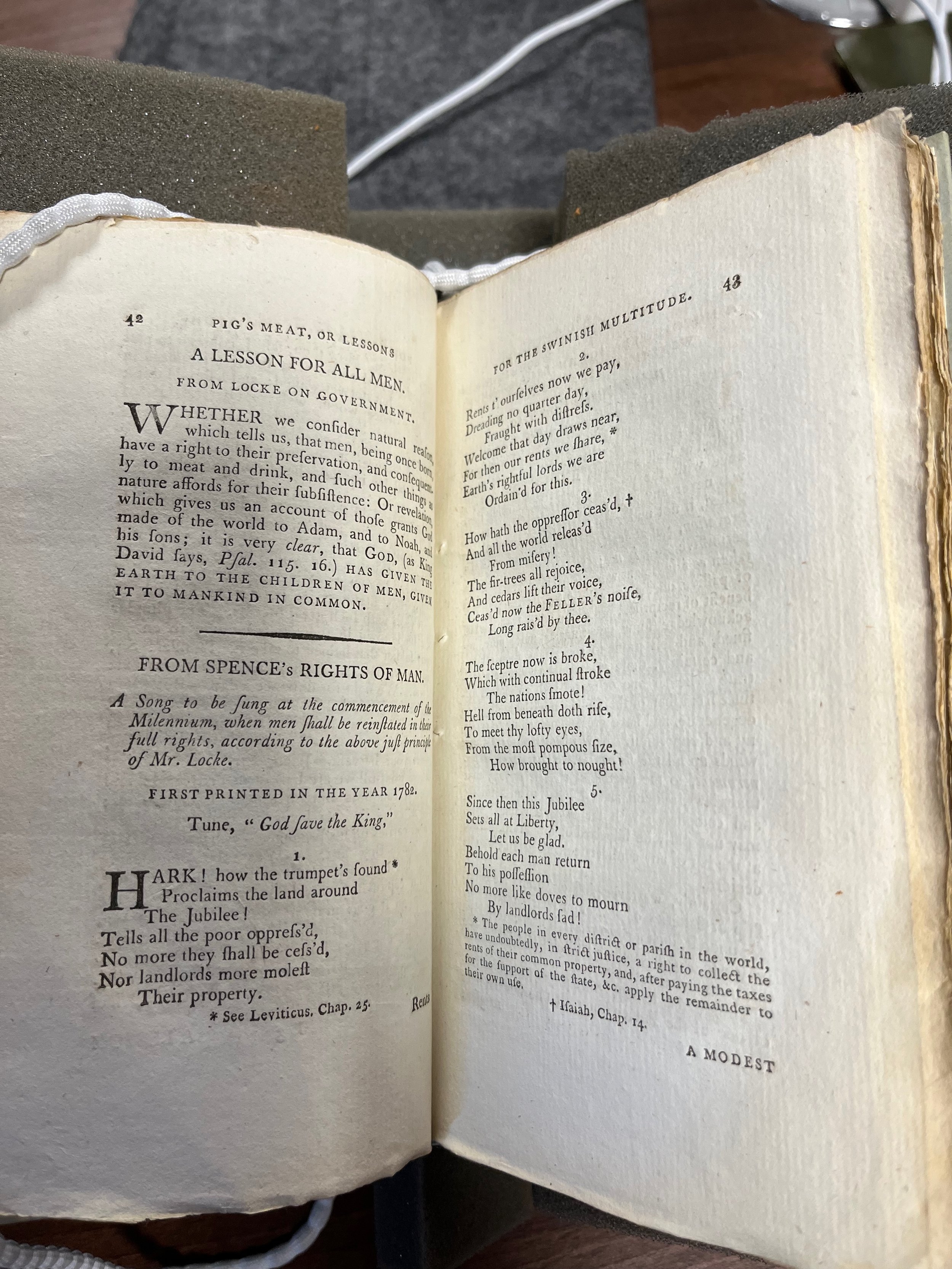
Lessons on Inequality from the Eighteenth Century

Economic inequality is a perennial issue. Recent news items have reminded me of this, and of the fact that it has sometimes been justified by appeal to the arguments of eighteenth-century writers, notably Adam Smith. This misconceives what he actually wrote, and ignores the arguments of other eighteenth-century thinkers - such as Jean-Jacques Rousseau - against economic inequality.
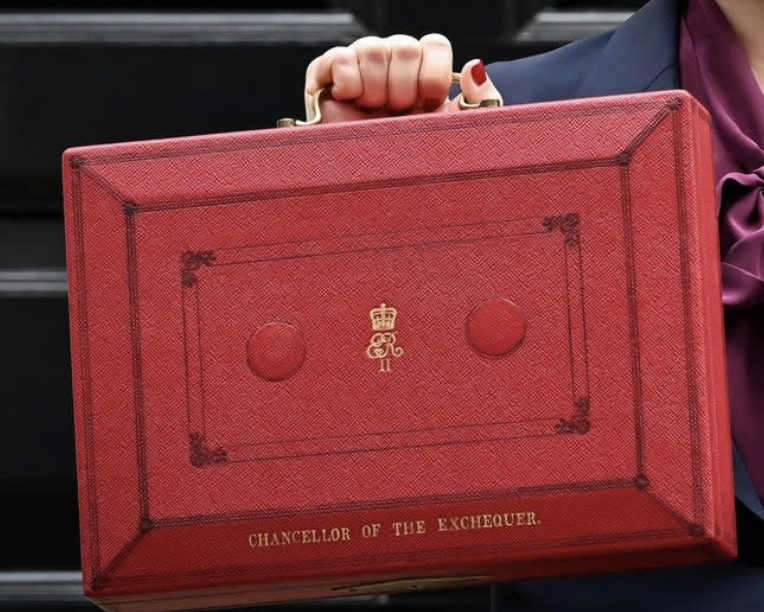
Image from Wikimedia Commons.

In advance of last week's budget there was much speculation as to whether Rachel Reeves was going to break Labour's manifesto pledge and raise income tax. Public services are currently struggling and raising the tax paid by those in the additional rate band (who earn over £125,140 of taxable income per year) and in the higher band (those earning £50,271 to £125,140) would have been the most straightforward way of providing a welcome boost to the public finances. Taxing those in the top two bands more heavily would also have served to reduce the growing inequalities in income within our society.

The Labour Market Statistics published by the Office for National Statistics in October reported that the mean average weekly wage (including bonuses) is £733 before tax - equating to an annual pre-tax average salary of around £38,100. Yet, as Forbes Magazine noted, this hides huge inequalities between individuals. The median annual pay of top chief executives was £4.22 million in 2024, while three million UK workers earn the minimum wage (£12.21 for those over 21, £10 for those aged 18-20 and £7.55 for those aged 16-17) (https://www.forbes.com/uk/advisor/business/average-uk-salary-by-age/#overview_of_earnings_in_the_uk); amounting to around £25,000 a year at best.
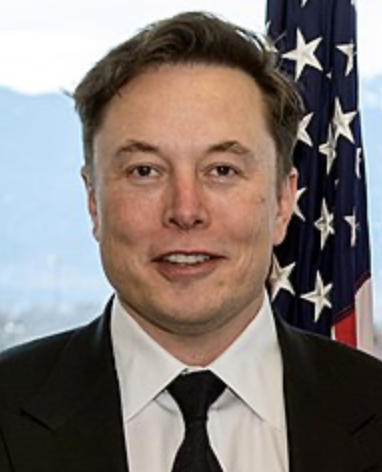
Image of Elon Musk from Wikimedia Commons.

Another story this month that highlighted the issue of extreme inequalities in income was the announcement on 7th November that Tesla shareholders had approved a record breaking trillion dollar pay package for Elon Musk (already the world's richest man). The package is dependent on the company raising its market value over ten years and hitting various targets, and Musk will be paid in shares, but it is still an obscene amount of money to award to an individual. The Tesla board justified the deal on the grounds that it feared that without that incentive Musk might leave the company and it could not afford to lose him.

The notion that the outrageous salary package offered to Musk is necessary to keep him at Tesla draws on the argument that it is better for companies (and by extension for society) to keep rich people on side because vast inequalities of wealth within a society actually benefit everyone. Drawing on a (skewed) understanding of Adam Smith's thought, the theory of 'trickle-down economics' reassures us that we are all better off as a result of the huge salaries of the rich. Smith's theory of the invisible hand is taken as an excuse to reject state intervention in income distribution on the grounds that it is likely to be counterproductive (https://www.adamsmithworks.org/documents/adam-smith-peter-foster-invisible-hand). Yet, as research by David Hope and Julian Limberg has shown, tax cuts for the rich tend to result in further benefits for them rather than improving the lives of workers or stimulating economic growth (https://eprints.lse.ac.uk/107919/1/Hope_economic_consequences_of_major_tax_cuts_published.pdf).
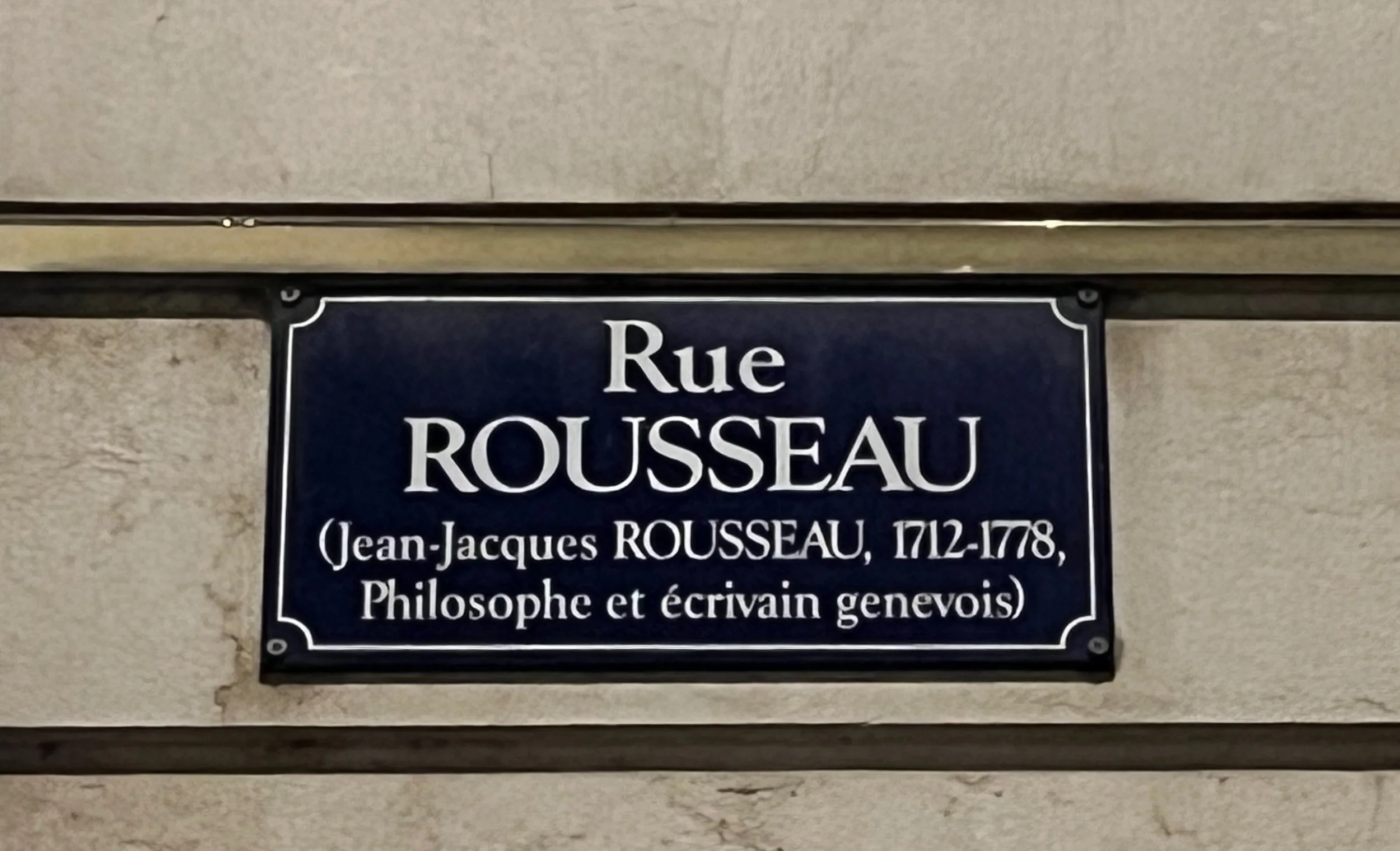
Street sign from Geneva commemorating Jean-Jacques Rousseau. Image by Rachel Hammersley.

While those who argue that vast inequalities in wealth are good for society sometimes seek eighteenth-century roots for their argument, the counter-argument - that growing inequality has negative rather than positive consequences for society as a whole - was also explored at that time. In his Social Contract Jean-Jacques Rousseau insisted on the need for relative equality within a successful state:

as for wealth, no citizen be so very rich that he can buy another, and none so poor

that he is compelled to sell himself: Which assumes, on the part of the great,

moderation in goods and influence and, on the part of the lowly, moderation in

avarice and covetousness.

In a footnote Rousseau continued:

Do you, then, want to give the State stability? Bring the extremes as close together

as possible; tolerate neither very rich people nor beggars. These two states, which

are naturally inseparable, are equally fatal to the common good; from one come the

abettors of tyranny, and from the other tyrants; it is always between these two that

there is trafficking in public freedom; one buys it, the other sells it. (J. J. Rousseau,

Of the Social Contract, ed. V. Gourevitch. Cambridge: Cambridge University Press,

1997, p. 78).

For Rousseau, then, great inequalities of wealth within a state would encourage tyranny and corruption.

Writing just over thirty years later, the Newcastle-born radical Thomas Spence expressed a similar view. He observed the growing inequalities in British society:

Great landlords, and great farmers, now engross the country and these employ

none but great tradesmen. No little masters to be seen now, no medium; but very

great, and very little; very rich, and very poor. (Thomas Spence, 'A Letter from

Ralph Hodge, to his Cousin Thomas Bull, in The Political Works of Thomas Spence, ed.

H. T. Dickinson. Newcastle: Avero, 1982, p. 22).

In contrast to the theory of 'trickle-down economics', Spence insisted that a more equal division of property was the way to ensure that all had the necessities of life. Under the heading 'A Lesson for Antigallicans' he reprinted the following extract from a contemporary pamphlet in his journal Pigs' Meat:
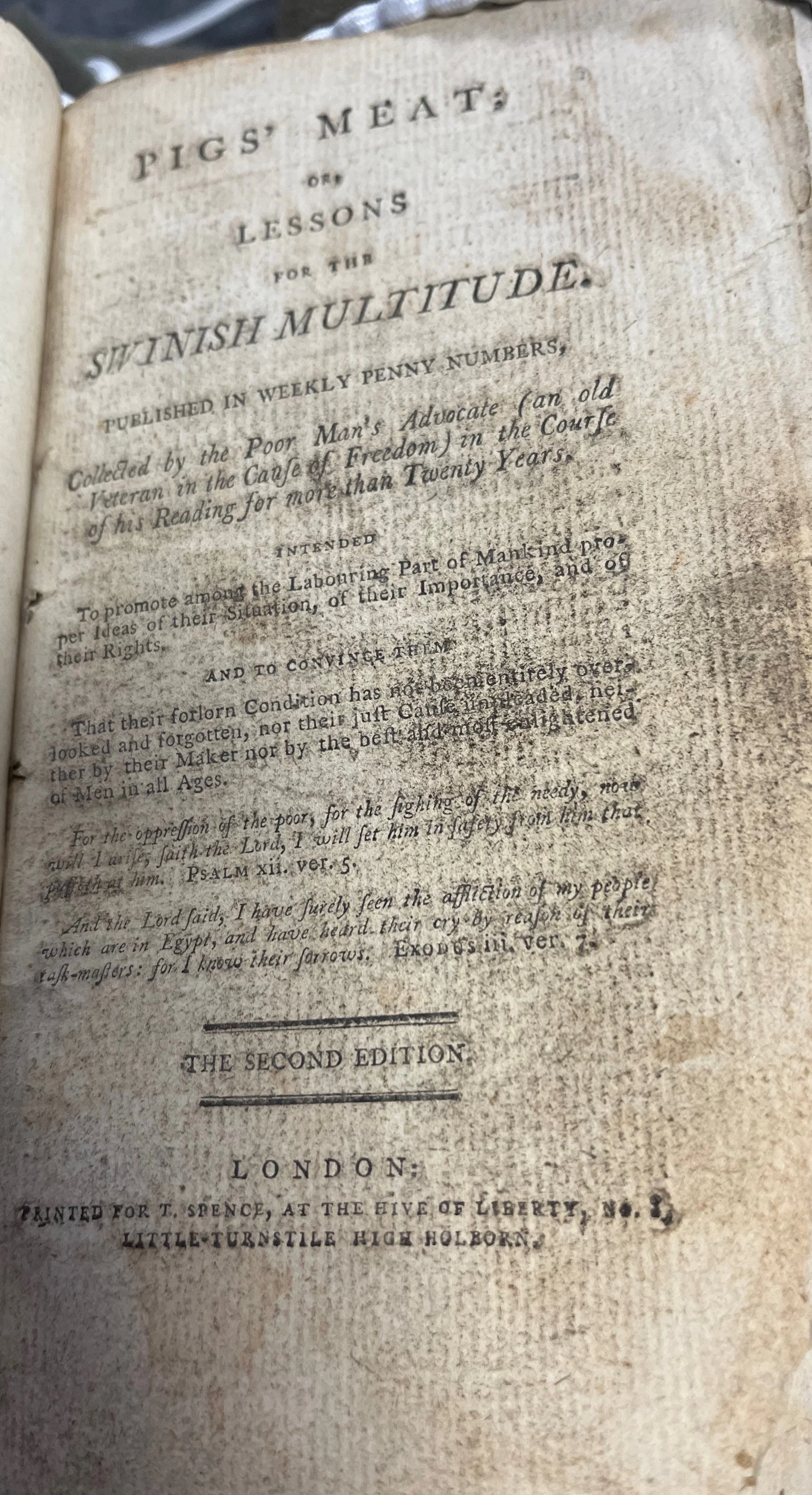
Title page of Thomas Spence’s periodical Pigs’ Meat (London, 1793). Copy from the Philip Robinson Library, Newcastle University. Reprinted with kind permission.

if property were divided with any tolerable equality, a man would begin by

providing amply for his support, comfort, and enjoyment; and would only suffer

the surplus to be exchanged for foreign superfluities; nor would he for superfluities

condemn himself to incessant labour. (Thomas Spence, Pigs' Meat. London, 1793, p.

18)

Similarly in an earlier work of his own, in which he imagined an island society where land was owned collectively, Spence has his narrator observe of the island:

instead of anarchy, idleness, poverty, and meanness, the natural consequences I

narrowly thought of a ridiculous levelling scheme, [there is] nothing but order,

industry, wealth, and the most pleasing magnificence. (Thomas Spence, A

Supplement to the History of Robinson Crusoe. Newcastle upon Tyne, 1782, p. )

On what grounds did these thinkers argue that excessive inequality is bad for society? They claimed that as the gap between rich and poor increases, the pursuit of money comes to be valued more than the promotion of the common good. As a result, wealth starts to be viewed as a marker of merit regardless of the means by which that wealth was gained. In the language of the eighteenth century, people start rising to power simply because they are rich rather than because they are virtuous. Looking at the world today, I cannot help feeling that we are well past that point.

For eighteenth-century thinkers, the solution to this problem was easy to understand, though not necessarily straightforward to implement. If excessive inequalities of wealth within society were dangerous to the public as a whole, then it was incumbent on the government to introduce some degree of redistribution of wealth to keep those inequalities in check. This would ensure that the government operated in the public interest.
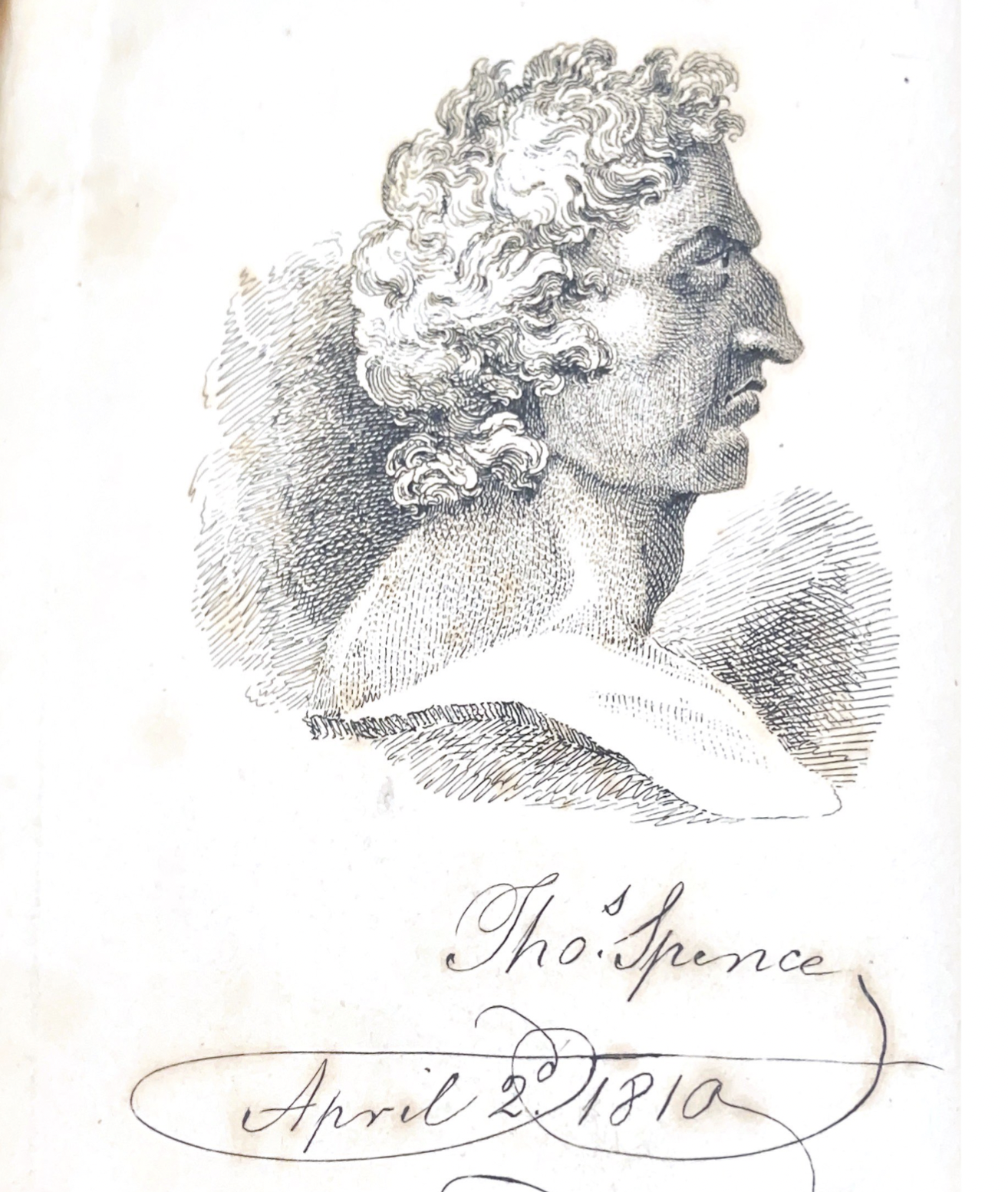
Image of Spence from the Hedley Papers at the Newcastle Literary and Philosophical Society. Reproduced with kind permission.

Spence took a rather extreme view of what this government intervention should involve. While he did not call for the abolition of moveable property, believing this was a spur to industry, he did insist on the communal ownership of land (organised at the level of the parish). That proposal was ridiculed in his own time and seems even less like a workable solution today. But we do have a ready-made system that is designed to allow the government to redistribute wealth in the interest of the public good and to keep a check on the inequalities of income between the richest and poorest in society. That system is income tax. What a shame Rachel Reeves did not find the courage to pull that lever last week.
The Power of Editors

Last month's blogpost centred on the radical periodicals produced by Thomas Spence and Daniel Isaac Eaton during the 1790s. This month I am extending that discussion by considering Spence's role as editor, and his use of his position to curate the words of others in such a way as to advance his own political ideas.

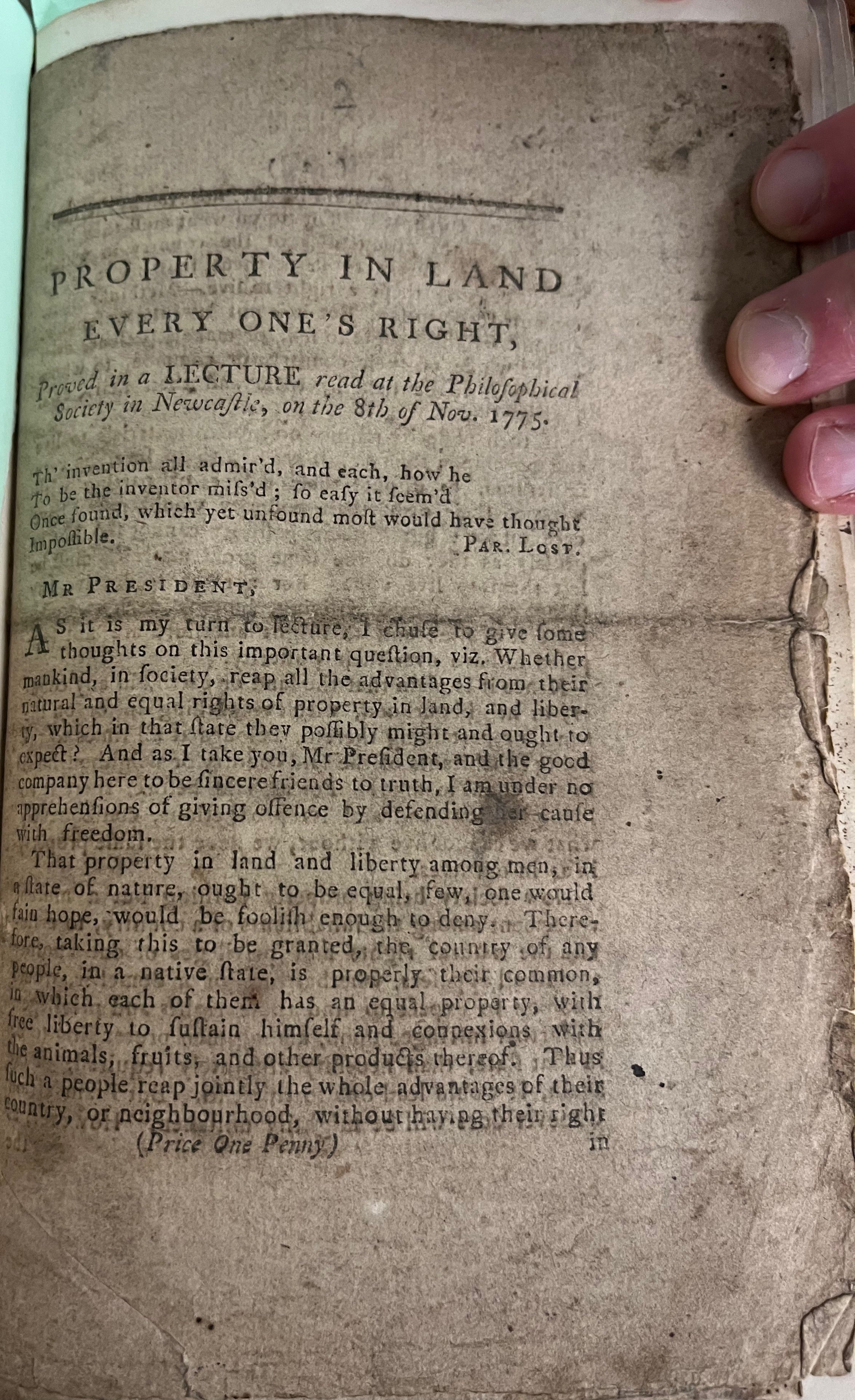
Spence’s Lecture, ‘Property in Land Every One’s Right’. From the collection of the Literary and Philosophical Society of Newcastle upon Tyne. Hedley Papers, Volume 1. Reproduced with kind permission.

Pig's Meat was composed almost entirely of extracts from a variety of political texts. Spence chose his extracts carefully, deliberately presenting key political themes. Prominent among these were: the importance of free speech and thought; the rights of man; and the superiority of republican over monarchical government. But Spence's main concern throughout was the oppression of the poor by the rich.

That theme also lay at the heart of Spence's Land Plan, which he first set out in a lecture to the Newcastle Philosophical Society on 8 November 1775. He argued that, in the state of nature, land was shared equally among all inhabitants for them to use to secure their own subsistence. On this basis, he insisted that 'the land or earth, in any country or neighbourhood, with everything in or on the same, or pertaining thereto, belongs at all times to the living inhabitants of the said country or neighbourhood in an equal manner' and that the state ought to protect this right to land (Thomas Spence, 'Property in Land Every One's Right'). In reality, however, land had been claimed by a few and divided among them for their own ends, making others dependent on them for subsistence. This injustice had been perpetuated through inheritance and purchase. Although this was the current state of affairs, Spence argued that things could be different if people were to acknowledge the injustice and take action. He suggested that each parish could form a corporation with the power to let, repair, or alter any part of the land, but without the power to sell the land. Individual inhabitants would pay rent to the parish for a portion of the land and those rents would be used to provide local and national amenities.

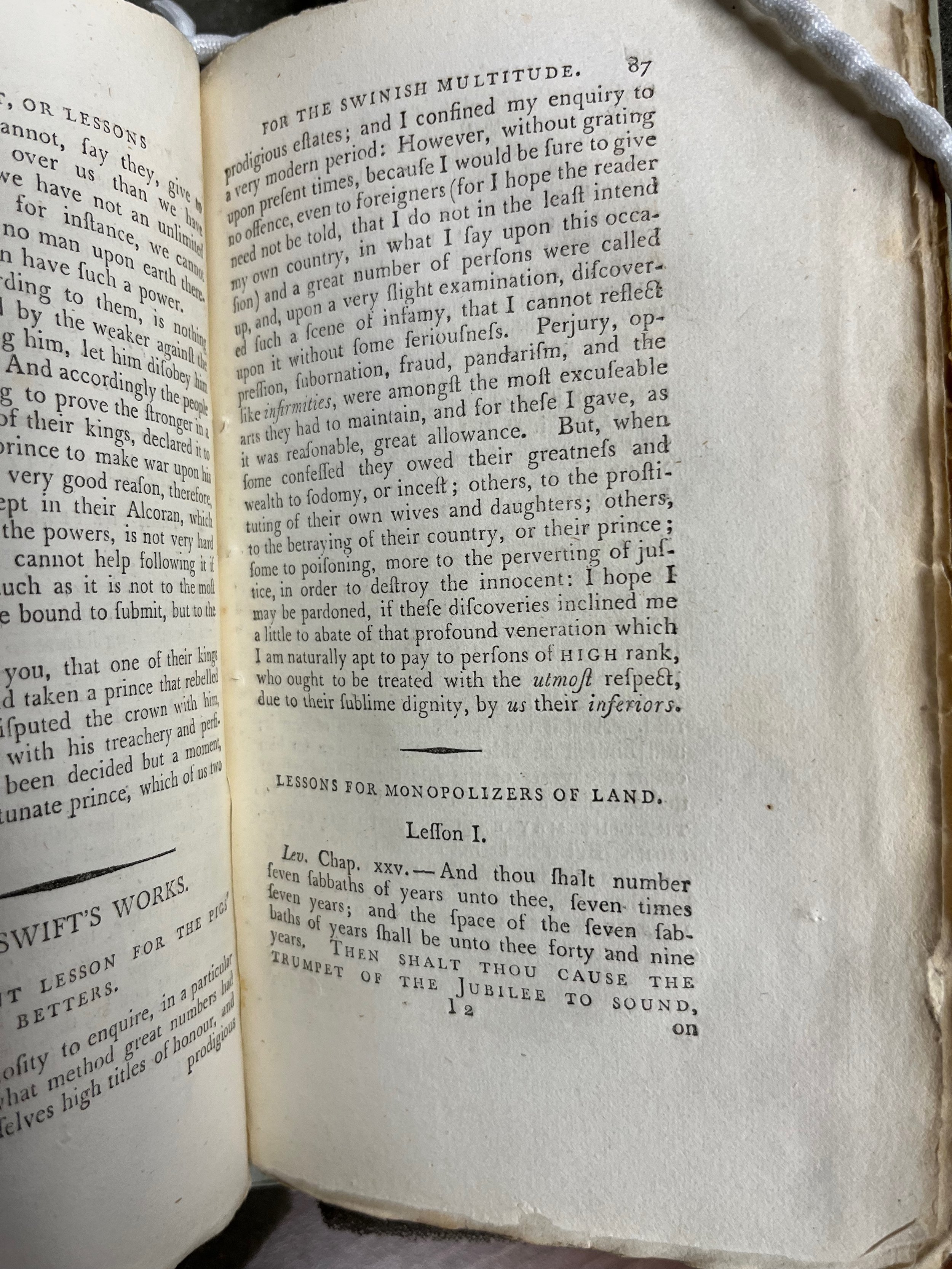
The section ‘Lessons for Monopolisers of Land’ from Thomas Spence, Pig’s Meat, Volume 1 (London, 1793). Robinson Library, Newcastle University. Rare Books RB 331.04 PIG. Reproduced with kind permission.

Throughout his lifetime, Spence produced a number of his own works (including political pamphlets, fictionalised utopias or travel writing, and even songs) which presented the key elements of his plan. The plan is also central to Pig's Meat, but here it is presented not in Spence's own words, but through those written by others. We can see how he does this by focusing on several extracts that appeared in the eighth issue (in autumn 1793). Under the title 'Lessons for Monopolisers of Land', Spence presents two biblical quotations. The first, which comes from Leviticus chapter 25, presents the Jewish idea of Jubilee. This required that every fifty years land within the state would be redistributed, reflecting the notion that the land belonged to God and was only granted to the people for their use. The second, which comes from Isaiah (chapter 5, verse 8), condemns those who parcel up land for themselves leaving none for others. These biblical passages are immediately preceded by an excerpt from the works of Jonathan Swift entitled 'An unpleasant lesson for the pigs' betters', which argues that those who enjoy wealth and power in society gained - and maintain - their position by vicious means, including incest, betrayal, poisoning, perjury and fraud. The biblical passages are then followed by an extract from the works of Samuel Pufendorf, to which Spence gives the title 'On Equality. From Puffendorf's Whole Duty of Man, according to the Law of Nature'. This passage includes the line: 'no man, who has not a peculiar right, ought to arrogate more to himself than he is ready to allow his fellows' (Thomas Spence, Pig's Meat, Volume 1, London, 1793, p. 91). Together, these passages reinforce key elements of Spence's Land Plan: that the land and the fruits thereof should benefit all members of society; that the current possessors of land have gained and maintained their position via unseemly means; and that it is possible (as in the example of Jubilee) to overthrow an unfair system.

Presenting what was a controversial plan via the words of others had obvious advantages for Spence, who was at this point an unknown London bookseller, recently arrived from Newcastle. Spence gives the impression that his Land Plan was in line with the views of serious political philosophers such as Pufendorf and respected authorities such as Swift. By labelling the Pufendorf extract 'On Equality' Spence was, of course, reinforcing this point. The inclusion of biblical quotations was another clever move. It simultaneously showed the poor that their cause was in line with the word of God (giving them greater confidence to assert their rights) and alerted wealthy elites to the fact that in oppressing the poor they were disobeying biblical injunctions and therefore God.

Spence’s ‘Rights of Man’ song from Pig’s Meat. Volume 1 (London, 1793). Robinson Library, Newcastle University. Rare Books RB 331.04 PIG. Reproduced with kind permission.

Very occasionally, Spence includes his own writings among the Pig's Meat extracts. The first volume includes a couple of his songs, and a version of his Plan in question and answer form. Here too, the juxtaposition of the extracts serves a deliberate purpose. Spence's first song appears immediately after an extract from John Locke's Two Treatises of Government; his second, between an extract from James Harrington and a speech by Oliver Cromwell; and the question and answer piece is sandwiched between two biblical quotations. By this means, Spence implies that his works are on a par with the texts surrounding them, thereby giving his works greater power and authority than if he had simply presented them in a pamphlet bearing his own name.

I discussed these ideas at a recent workshop on 'The Role of the Editor' at Newcastle University. Just as Spence's words gained greater power by being set alongside those of others, so my thoughts on this topic were enriched by listening to the other speakers.

The titles of the papers in the programme immediately raise questions about what we mean by 'editing'. The speakers discussed various examples including: authors editing of their own texts (Emily Price on William Lithgow, Joe Hone's paper which drew on evidence from proof copies); those editing texts written by others (Katie East on early modern editions of Cicero's works, Filippo Marchetti on John Toland's editions of the works of Giordano Bruni); the curation of a range of other 'texts' in periodicals and miscellanies (Kyra Helberg on the Lancet, Tim Somers on jestbooks); and even the editing of an archive (Harriet Gray on the Hedley Reports of the Newcastle Literary and Philosophical Society). By the end of the workshop we were wondering whether it would be better to think of editing as a task that various people undertake rather than a job title assigned to specific individuals.

Title page of the Hedley Papers. From the Collection of the Literary and Philosophical Society of Newcastle upon Tyne. Reproduced with kind permission.

Just as the notion of an 'editor' proved more slippery than we had appreciated, so too the 'audience' to which editors addressed their works was far from static. Anthony Hedley may originally have produced the reports on the Newcastle Literary and Philosophical Society for himself (they appear to have only been presented to the Society by his daughter after his death) or at most as working documents for a small number of Society members. As Harriet Gray noted, this might explain why he was able to include details of controversies relating to the Society which were kept out of more public accounts. In his paper, Filippo Marchetti observed that Toland had more than one audience in mind when seeking to spread knowledge of Bruno's works, and that he deliberately produced different versions of the text for different audiences - adjusting the wording and accompanying evidence accordingly. Where Toland produced different texts for different audiences, Thomas Wakely (the subject of Kyra Helberg's paper) sought to address several different audiences through a single publication. The Lancet was intended for the medical profession (including both surgeons and students) but there is also evidence that it was directed towards - and read by - the wider public. As Emily Price's paper demonstrated, editors were not always in control of their audiences. She showed how Lithgow's travel narrative was originally directed towards members of the Court as a vehicle for advancing Lithgow's career and furthering anti-Catholic arguments, but that after his death it became a forerunner of the Baedeker or Rough Guide for travellers to the Continent.

There was also much discussion of particular editorial techniques, with a plethora of these on display in the papers. Katie East suggested that the context in which particular texts appeared could significantly affect how they were read - and even whether a particular text was considered 'political' or not. Cicero's speeches on Catiline were presented to early modern audiences in a range of formats: including in editions of Cicero's speeches; in collections of ancient speeches by various orators; in compilations of Cicero's works; in collections presenting historical evidence relating to the Catiline conspiracy; and even as interventions in contemporary political affairs, such as the South Sea Bubble. In each case the setting will have affected how the speeches were read. Both Harriet and I addressed the role that curation - and especially the juxtaposition of particular texts - can play in presenting a particular reading of an event or text. Emily and Tim both provided examples of adapting a text to fit new circumstances. And Kyra showed that Wakley was not above inventing correspondents to the Lancet to introduce particular topics or pursue his own ends.

The title page of the first edition of Gulliver’s Travels. Image courtesy of Joe Hone.

Finally, Joe Hone provided more insight into the question hovering over much of our discussion, namely how we can be sure of precisely who was responsible for editorial decisions in any given case. Emily had noted that Lithgow was away on his second voyage in 1614 when the first edition of his work appeared, and she wondered how his absence affected his editorial input. Joe demonstrated that the issue is complex. He showed us proof sheets in which an author insisted that particular words be rendered in italics - suggesting a high level of authorial intervention was possible. Yet he also explained how Jonathan Swift was furious when his printer removed the sharpest satirical barbs from the first edition of Gulliver's Travels, without informing him before publication. Of course, in most cases we simply do not have the evidence to be sure where responsibility lay. Yet, as the workshop made abundantly clear, there is much to be gained from thinking more deeply about editorial activity, and how this has shaped the documents that scholars use as evidence.

Liberty, Equality, Fraternity

Since the anniversary of the start of the first lockdown in the UK is approaching, it seemed appropriate to interrupt my 'Experiencing Political Texts' series of posts to reflect on the current situation.

The Covid-19 pandemic has brought restrictions to our liberties of a kind that would not previously have been imagined. Under the current lockdown the reasons for which we can leave our homes are severely limited, our right to gather with others in public places is almost completely denied us, and even the control we have over our own bodies is compromised through the requirement to wear a face covering in shops and on public transport. There is also pressure being exerted on us to be vaccinated, and there have even been suggestions that some types of worker will be forced to do this.

This situation has led me to reflect in more detail on the concept of liberty and its history. The right to liberty in the abstract - as well as to the more concrete liberties of free movement, gathering in public spaces, and control over one's own body - were by no means a given in the past. They were only secured after hard fought battles and painful individual sacrifices. Nor are they universally enjoyed across the globe today. Nonetheless, liberty is central to contemporary political philosophies, and politicians of all stripes in the UK are keen to defend and protect liberty.

libertyequalityfraternity.png

The virus challenges all of this not only by inducing governments to limit individual freedoms, but also by raising the uncomfortable question of whether the dominant place accorded to liberty in certain societies (including the UK) has actually increased the threat the virus poses to us and our lives. Many commentators have drawn attention to the fact that countries where restrictions on the freedoms of their citizens are more common often have far lower numbers of coronavirus cases and deaths than those countries that prize liberty. Vietnam is often cited on this point. At the time of writing it had recorded just 2,448 cases and only 35 deaths as compared with 4.18 million cases and 123,000 deaths in the UK. While I do not underestimate the value and importance of liberty, I do wonder whether we are paying too high a price for it just now.

Declaration fo the Rights of Man and of the Citizen. Image from Wikimedia Commons.

Declaration fo the Rights of Man and of the Citizen. Image from Wikimedia Commons.

Liberty has always had to be set against other values - and not just the right to life. Our modern veneration of liberty owes much to the revolutionary upheavals of the late eighteenth century, especially the French Revolution. Its motto was Liberté, Egalité, Fraternité. These three concepts were highlighted (and the relationship between them articulated) in the Declaration of the Rights of Man first issued in 1789, which began 'Men are born and remain free and equal in rights. Social distinctions may be founded only upon the general good.' Soon after 'Liberté, Egalité, Fraternité was being emblazoned on everything from official documents and political texts to medals and even buildings.

The pandemic has not only brought restrictions to our liberties, but has also raised questions about our commitment to equality. In recent times, equal treatment, in various respects, has been extended for example to women, those from ethnic minorities, and those with disabilities. This equality is widely recognised today and enshrined in legislation such as the 2010 Equality Act in the UK. However, our experience of the impact of Covid-19 might lead us to question (if we had not done so before) the extent to which equality operates in practice. Commentators have noted that in many homes the burden of childcare and home schooling is falling more heavily on women than men. A recent government advert that was quickly withdrawn after complaints that it was misogynistic in its depiction of lockdown life, was perhaps more realistic than we might care to admit. As a result, the long term effect of the pandemic on women's careers may be more significant and long-lasting than its impact on the careers of men. There is also clear statistical evidence that both infection and death rates have been higher in people from ethnic minority backgrounds than among the population as a whole. There may be several reasons for this, but it is certainly clear that those with lower levels of income, amongst whom ethnic minority families are overrepresented, have been more harshly affected by the virus. This is true both in terms of rates of illness and death and as regards the impact on employment and household income. Rather than complaining about the restrictions on our liberties imposed by Covid-19, perhaps we ought to be inquiring more deeply into the unequal nature of its impact on our lives.

Fraternity is perhaps less central to political life today than liberty or equality. Not only are the masculine connotations of the word off-putting, but it sits sharply at odds with the liberty of the individual that we so highly prize. Yet for the French revolutionaries, liberty and fraternity were seen as complementary rather than competing concepts, capable of both reinforcing and tempering each other. Certain phenomena this year - including the Thursday night clapping that punctuated the first lockdown and the actions of individuals like Captain Tom Moore - suggest that the sense of altruism and community to which the  concept of fraternity refers has certainly not disappeared completely. Yet at the same time the stockpiling of provisions and ugly scenes in supermarkets that were a feature of the first lockdown, together with vaccine nationalism, raises questions about this me-first attitude remains not just strong but also acceptable.

Early in the French Revolution, not long before the Declaration of the Rights of Man was drawn up, Emmanuel Sieyès published his pamphlet What is the Third Estate? In that work he considered what a nation requires in order to survive and prosper. The nation, he observed, could continue to function efficiently without the privileged orders (the clergy and the nobility). But without the third estate everything would fall to pieces. The third estate, Sieyès argued, contains within itself everything that is required to form a complete nation. He then used this observation to justify the third estate's claim to political representation on an equal footing to that of the other two estates. Within six months of its publication, What is the Third Estate? had been used to justify the establishment of the National Assembly which represented the nation as a whole, but was made up simply of the third estate and those members of the other two estates who chose to join it.

Portrait of Emmanuel-Joseph Sieyès. Image taken from Wikimedia Commons.

Portrait of Emmanuel-Joseph Sieyès. Image taken from Wikimedia Commons.

I was reminded of Sieyès's pamphlet, and of the notions of equality and fraternity it upholds, in the first period of lockdown, when our attention was drawn to the list of key workers who would have to continue working because our society cannot function without them. Despite their importance, it was apparent that many of these roles are neither the best paid nor high status in our society.

We should use the forthcoming anniversary of the lockdown to reflect more deeply on what we have learnt this year, on what Covid-19 has revealed about our society, and on what measures we need to take to construct a better future. Rather than rushing to recapture our lost liberties, I suggest that we devote our energies to reinvigorating our understanding of the other two concepts in the triad - equality and fraternity.