Vice, Corruption and Decay

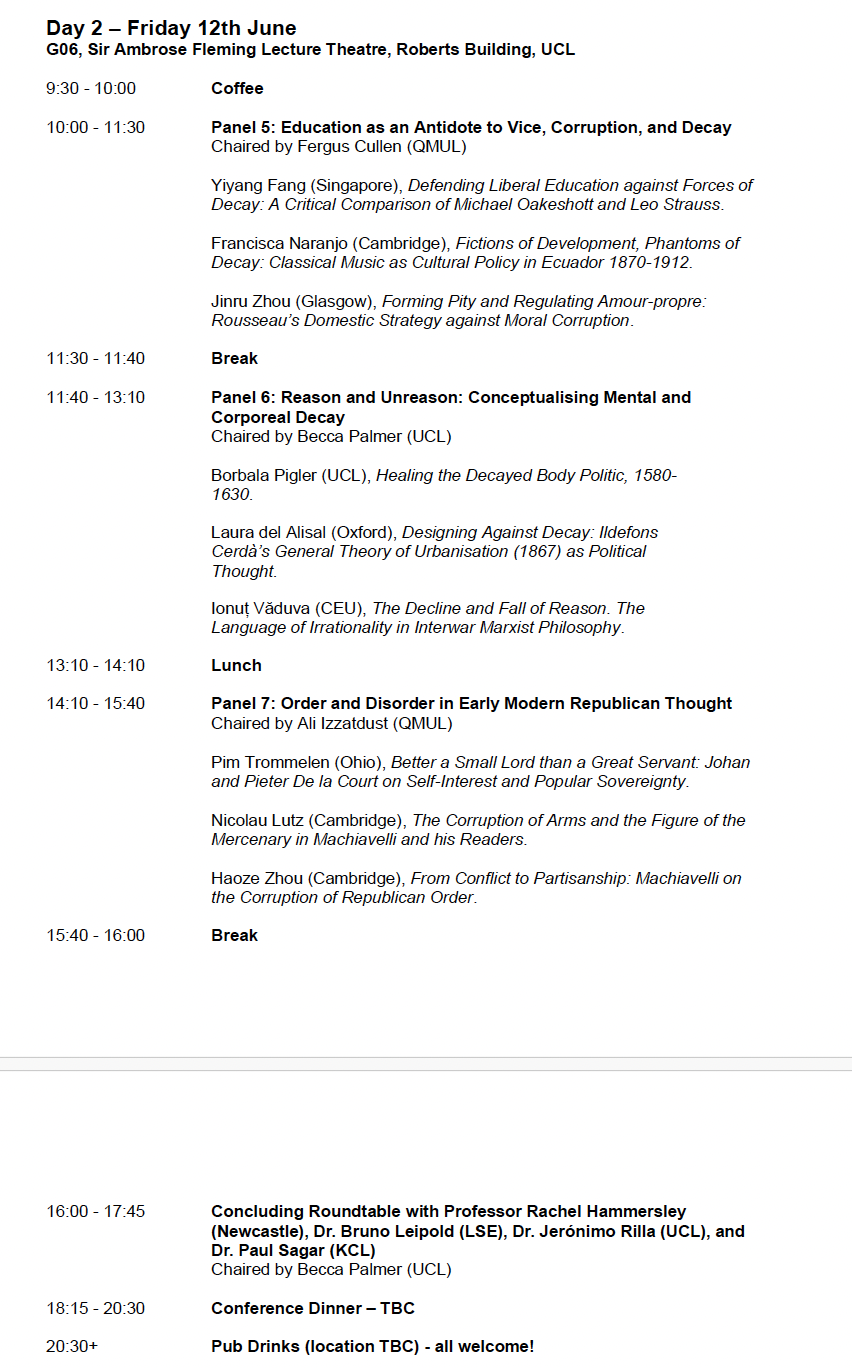
In June I attended the 17th Annual London Graduate Conference in the History of Political Thought. As several participants noted, it seemed sadly fitting to be at a conference on the theme of 'Vice, Corruption, and Decay' on the opening day of the 2026 World Cup. Despite the potentially depressing theme, the conference proved remarkably stimulating and upbeat. As always, what follows are my personal reflections on the event.
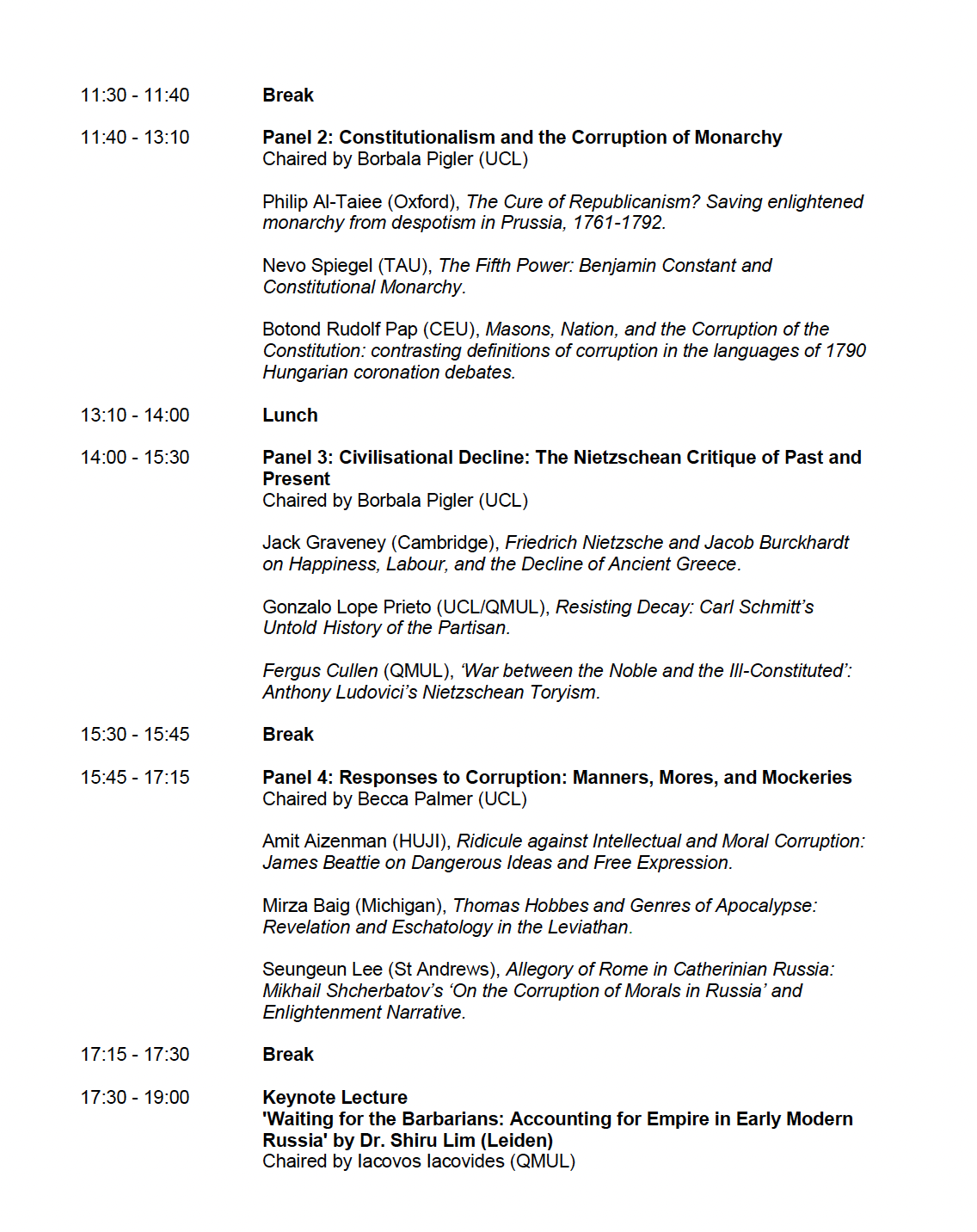
While the three words of the conference title are closely related, each has a different meaning and distinct connotations. One contrast drawn out in the papers was between cyclical and terminal decline. Platonic and Aristotelian ideas of political corruption involve states cycling through a series of constitutional models with a degeneration from one to the next. Consequently, this can be viewed as a process of constant change. By contrast the biological image of decay implies that the decline is terminal and that the result will be complete destruction or death.
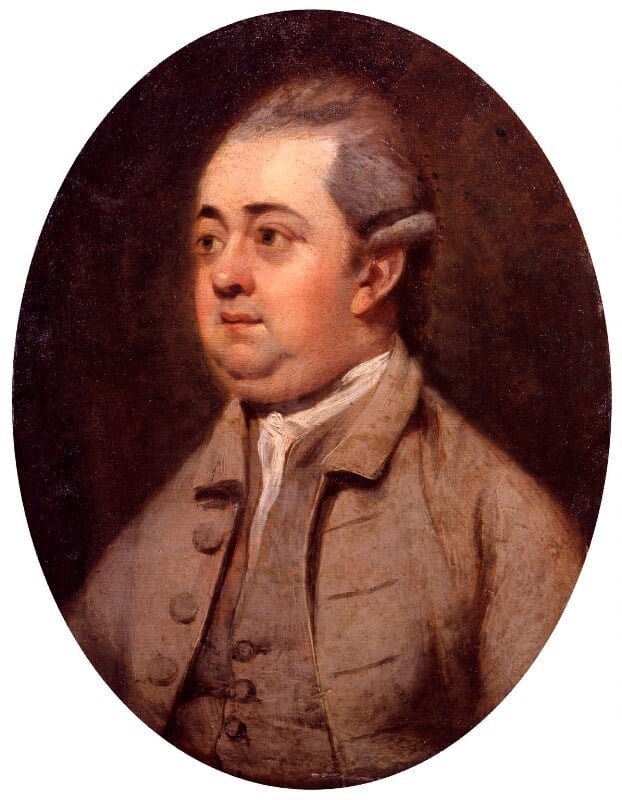
Edward Gibbon by Henry Walton, 1773. National Portrait Gallery, NPG 1443. Reproduced under a Creative Commons Licence.

Several papers explored the possibilities for interrupting or postponing decline. Ming-Yan Shih presented the ideas of Thomas Pownall, a British politician and Governor of the Province of Massachusetts Bay. Pownall drew on the medieval idea of Translatio Imperii to suggest that the decline of the British Empire could be delayed by shifting the centre of the empire westward from London to the American continent. Similarly, Harun Ali observed that Edward Gibbon's well-known account of the decline and fall of Rome was complicated by the need for him to address the Eastern portion of the Empire, which survived the fall of Rome albeit in a state of 'premature and perpetual decay'. Harun pointed out that this means that Gibbon's 'decline' narrative is not quite what it seems. Mirza Baig's exploration of Hobbes's use of an apocalyptic narrative presented a similar disruption of the expected model. Having demonstrated that the apocalyptic was a standard literary genre at the time, Mirza went on to show how Hobbes re-temporalised that narrative. He thus presented the apocalyptic as marking the end of a world, rather than the end of the world, and consequently a moment of renewal or regeneration rather than destruction. Finally, Francisca Naranjo pointed out that progress and degeneration are not always in opposition but can exist simultaneously with degeneracy operating as a kind of shadow of development.

These issues were further explored in our closing discussion. Mirza observed that a cyclical model need not always return to the point of departure - as illustrated by the image of a spiral. Paul Sagar raised the question of whether there is a distinction between attitudes to corruption and decline on the Left as compared with the Right. Paul suggested that there is a tendency for the Right to think in terms of decline from a past golden age, whereas those on the Left are perhaps more likely to look forward to a better future. Yet Ionut Vaduva's paper provided an interesting counterpoint to this - in looking at the discourse of the decline and fall of reason in the writings of the Marxist philosophers György Lukács, Herbert Marcuse and Ernst Bloch. They perceived a contrast between the rationalism of the Enlightenment which was then developed by Hegel and Marx and the irrationalism of the ideas of counter-revolutionary thinkers such as Schelling, Schopenhauer and Kierkegaard, perhaps leading to Fascism. While Ionut's paper and other participants made clear that the picture is more complex, there did seem to be something in the notion of the Right seeing the move from aristocracy to democracy as a sign of corruption. This was, of course, central to Nietzsche's understanding, which was touched on in several papers.

Jack Graveney compared Nietzsche with his contemporary Joseph Burkhardt. For Nietzsche the slavery of the masses was necessary for the flourishing of the few. Burkhardt rejected Nietzsche's notion of the happiness of the past as an optical illusion, suggesting that Nietzsche's idea that the slave was happy on account of being free from modern delusions was a myth. Fergus Cullen showed how Nietzsche's veneration for aristocracy was picked up by the conservative Anthony Ludovici who contrasted a positive image of ancient aristocracy with a notion of modernity as marking the triumph of the weak and ugly. While not presented in the same Nietzschean vein, Gonzalo Lope Prieto's account of Carl Schmitt's idea of the partisan offered a similar notion of decline from an aristocratic original to a corrupt democratic form.
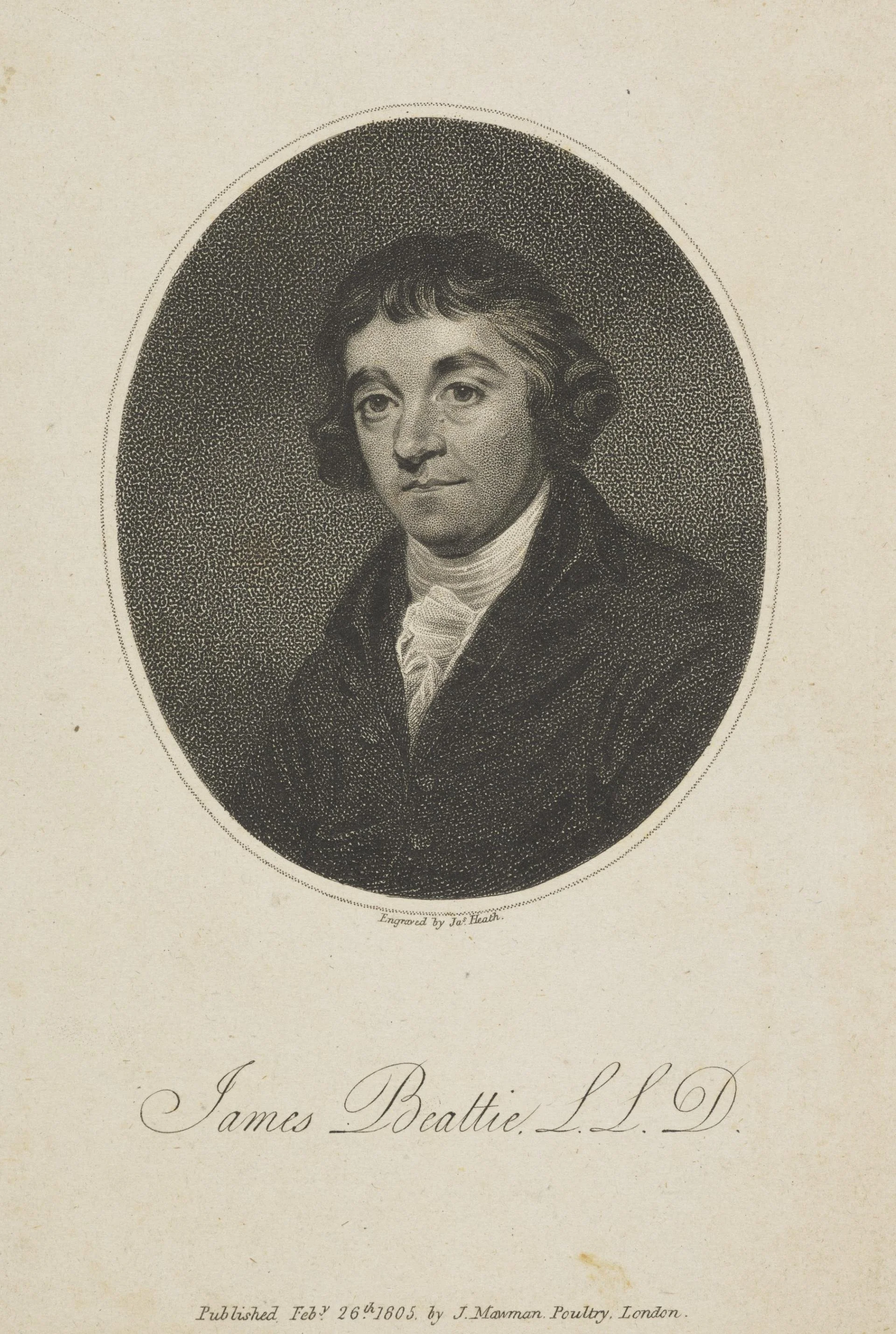
James Beattie, 1735-1803. Poet and moral philosophe. Image engraved by James Heath and published by J. Mawman, 1805. ‘National Galleries of Scotland’.

Other papers reflected the shift from aristocracy to democracy as constituting decline in more practical terms. Botond Rudolf Pap showed that for at least one of the late eighteenth-century Hungarian thinkers he studies, the nobility were the true and sole proprietors of the nation and any weakening of their power was viewed as decline. Seungeun Lee suggested that Mikhail Shcherbatov adopted a similar perspective on corruption in eighteenth-century Russia. He looked back to the noble virtues of the past and insisted on the need for the monarch to be tempered by aristocratic restraint. Similarly, Leo Strauss's concept of a Liberal Education - which was explored by Yiyang Fang - was designed to cultivate the 'perfect gentleman' and motivated by a rejection of mass democracy and culture. A similar sort of aristocratic disdain was even documented in Amit Aizenman's paper on James Beattie. Amit showed that Beattie's concern about Hume's scepticism was less about the ideas themselves, than their becoming fashionable among the general population. As Amit explained, this was why Beattie's solution was to challenge Hume's position via ridicule - since this was a means of damaging the social standing of the ideas and the philosopher associated with them.

As Botond noted, one person's decline is another's progress, and this was brought home in Pim Trommelen's paper on the De la Court brothers. In contrast to many republican thinkers, they did not favour aristocracy over democracy, nor did they believe that the cultivation of virtue was necessary to prevent corruption. Instead, they argued that the advancement of each person's self-love is an expression of the common good and on this basis argued that popular government is actually the best form. Bad behaviour on the part of the mob, they argued, is not due to human nature and so must instead be the result of material inequality. If that inequality is reduced and all are given the opportunity to participate in politics then vicious actions can be avoided.

Pim's paper was not the only one to address potential solutions to the problem of corruption. Some of the solutions explored across the 23 papers were familiar and expected, others less so.
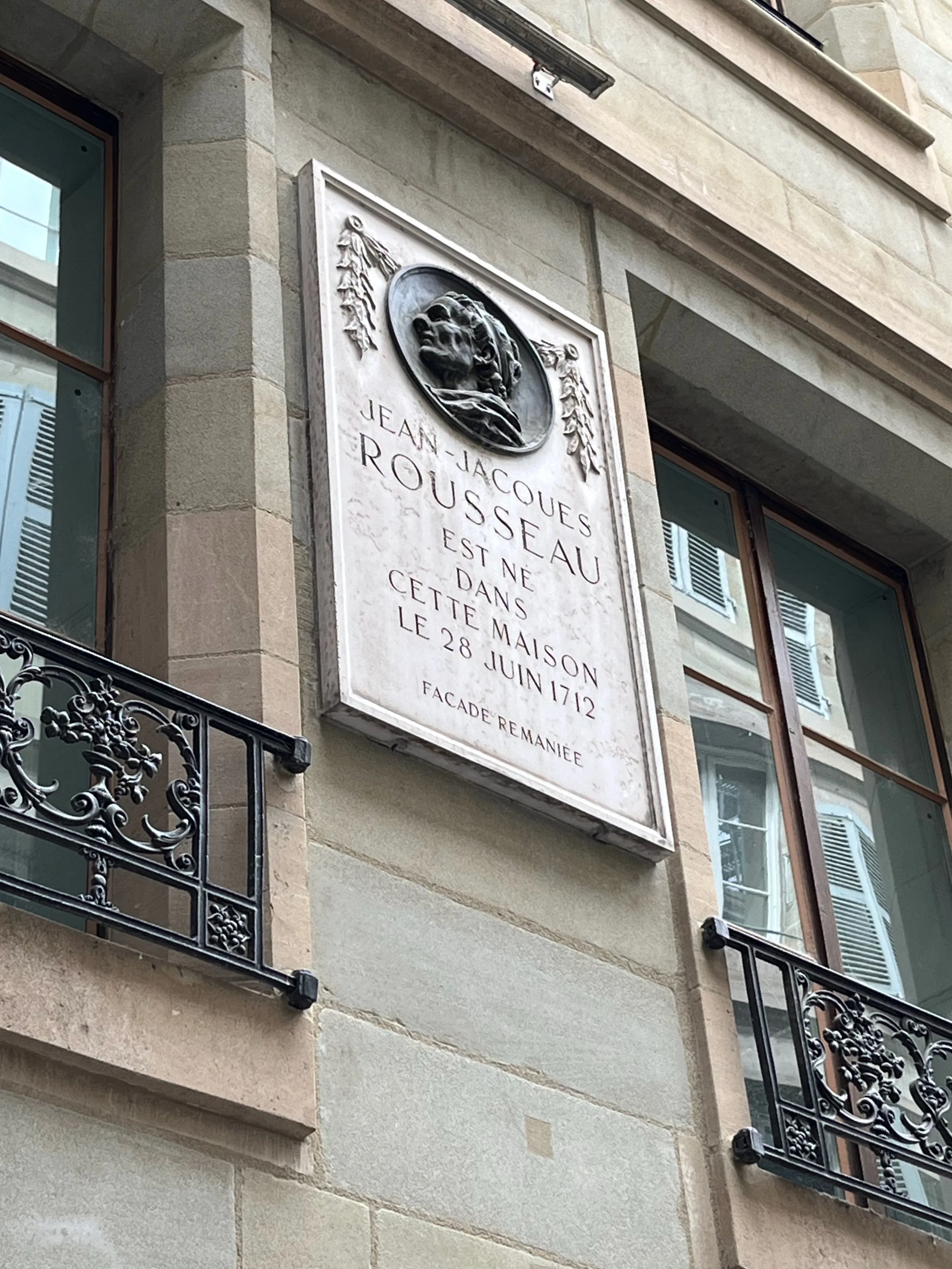
Plaque commemorating Jean-Jacques Rousseau’s birthplace in Geneva. Image by Rachel Hammersley, 2025.

Panel 5 as a whole focused on education, though what was interesting here was the diversity in how education was conceived. Yiyang compared the Liberal Education programmes of Michael Oakeshott and Leo Strauss. Both advocated reading the 'great books' in the history of political thought as crucial training, but Yiyang suggested that whereas for Strauss the goal of this programme was to seek the truth, for Oakeshott it was more about students being initiated into a tradition. Francisca highlighted the importance of music education in the new Equadorian republic in the late nineteenth century. In an historical context in which Latin America was seen as a developing region, while the West was perceived to be in decline, classical music was viewed simultaneously as a symptom of decay and a potential antidote to it. While Rousseau also valued music, his approach to addressing moral decay, as Jinru Zhou demonstrated, centred on the notion of pity. Jinru drew out the contrast between the natural pity of the Second Discourse - which is instinctive and anterior to reason - and the refined pity of Emile, which required imagination and judgement and which, if cultivated, could offer a domestic remedy to human corruption

Legal frameworks offer another conventional solution to the problem of corruption. Laws are a means of controlling the flawed behaviour of human beings and the rule of law can even constrain the actions of the ruler. In this vein, Philip Al-Taiee noted the rejection of personal decrees in a Prussian context and Botond observed that his Hungarian thinkers criticised breaches of the law by rulers such as Joseph and Maria Theresa. As Bram Sturley demonstrated in his discussion of the writings of early twentieth-century Austrian socialists, laws also have to be adapted to fit new circumstances - not least when seeking to incorporate different nationalities within the Hapsburg Empire.
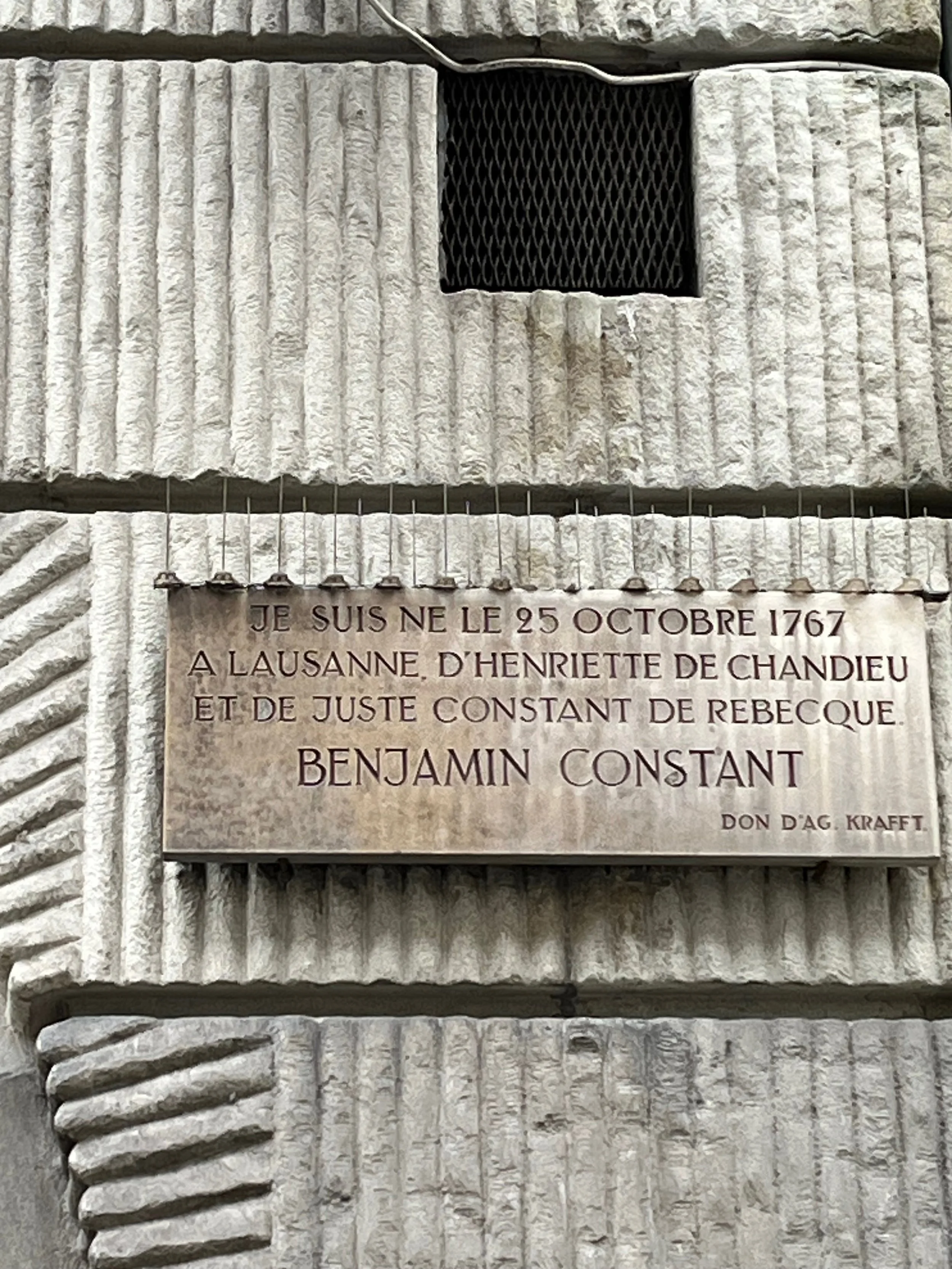
Plaque commemorating the birthplace of Benjamin Constant in Lausanne. Image by Rachel Hammersley, 2025.

Closely linked to the rule of law is the idea of a mixed constitution. The original formulation - dating back to Polybius - featured relatively little in our discussions, but we did explore modern adaptations. Philip revealed that some of his Prussian intellectuals used republican solutions to protect monarchy from slipping into despotism. In the same panel, Nevo Spiegel showed how Benjamin Constant's later writings advocated a monarch as a vertical balancing power to solve the republican problem of resolving conflicts between the legislative, executive, and judicial branches of the constitution. Pim reminded us that not all republican writers favoured the mixed constitution. Dutch thinkers like the De la Courts explicitly rejected that model on the grounds that it introduces competition into the system and so is liable to generate civil conflict.

For Machiavelli civil conflict was, of course, part of the solution rather than the problem, with active citizenship, tumults, and armed citizens all working to postpone decline. Yet, even here, the papers suggested that the story is more complex than we might think. Haoze Zhou showed that while the account offered in the Discourses is that conflict between the patricians and plebs rendered the Roman republic free and powerful, in the History of Florence civil conflict is a source of political decay. Haoze showed that the key for Machiavelli was to have conflict without sects and that this required good institutions that could contain private interests. Nicolau Lutz's paper complicated another key aspect of Machiavelli's thought - his preference for citizen soldiers over mercenaries. Nicolau showed that while Machiavelli saw mercenaries as morally corrupt, the Straussian critique of the civic humanist position, which suggested that Machiavelli believed strong leadership could make mercenaries more like citizen soldiers, is not entirely incorrect.

Interestingly religion as a solution to the problem of moral corruption was less prominent in the papers. It only surfaced in the final panel when Haoze presented religious institutions as one means by which Machiavelli thought private interests could be contained. Its almost complete absence from our discussions probably says as much about twenty-first-century intellectual historians' preoccupations as the importance of religion to the topic itself.
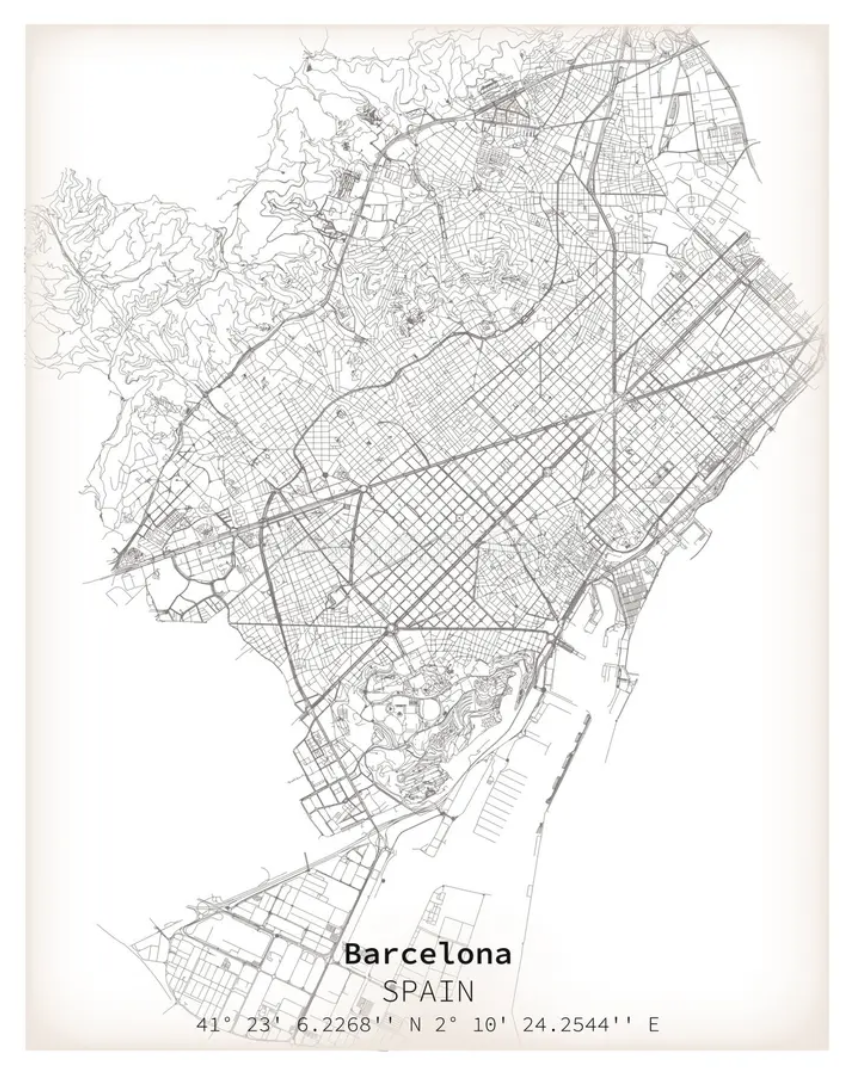
Map of Barcelona which was remodelled according to Cerdàs’s plan. Taken from narodnatribuna.info.

Alongside these conventional solutions were some that were more surprising. In her paper on the political thought of the architect Ildefons Cerdàs, Laura des Alisal highlighted Cerdàs's belief that making improvements to the environment in which people live not only improves their physical well-being but can also have moral and political implications. She convincingly argued that his book General Theory of Urbanisation, which is usually viewed as a manual for urban planners, can also be read as a text in political thought.

While imperial expansion was a source of corruption in the Roman, British, and Hapsburg cases, two papers presented it as a potential solution. Borbala Pigler showed how in early modern England, colonisation was seen as a solution to the problem of overpopulation. The issue, as she explained, was not simply quantity - that there were too many people - but also quality - the type of people - in particular those who were idle. Following medical models relating to an excess of blood, advocates of colonisation called not merely for bloodletting, but insisted on the need to purge the state of the idle by sending them to the colonies. This would both cleanse the English body politic and reform those individuals through hard work. In her keynote address Shiru Lim suggested a similar model was at work in the Russian Empire. Here Siberian exile was used as a means of purging a sick body politic by using it to absorb prisoners of war and political prisoners.
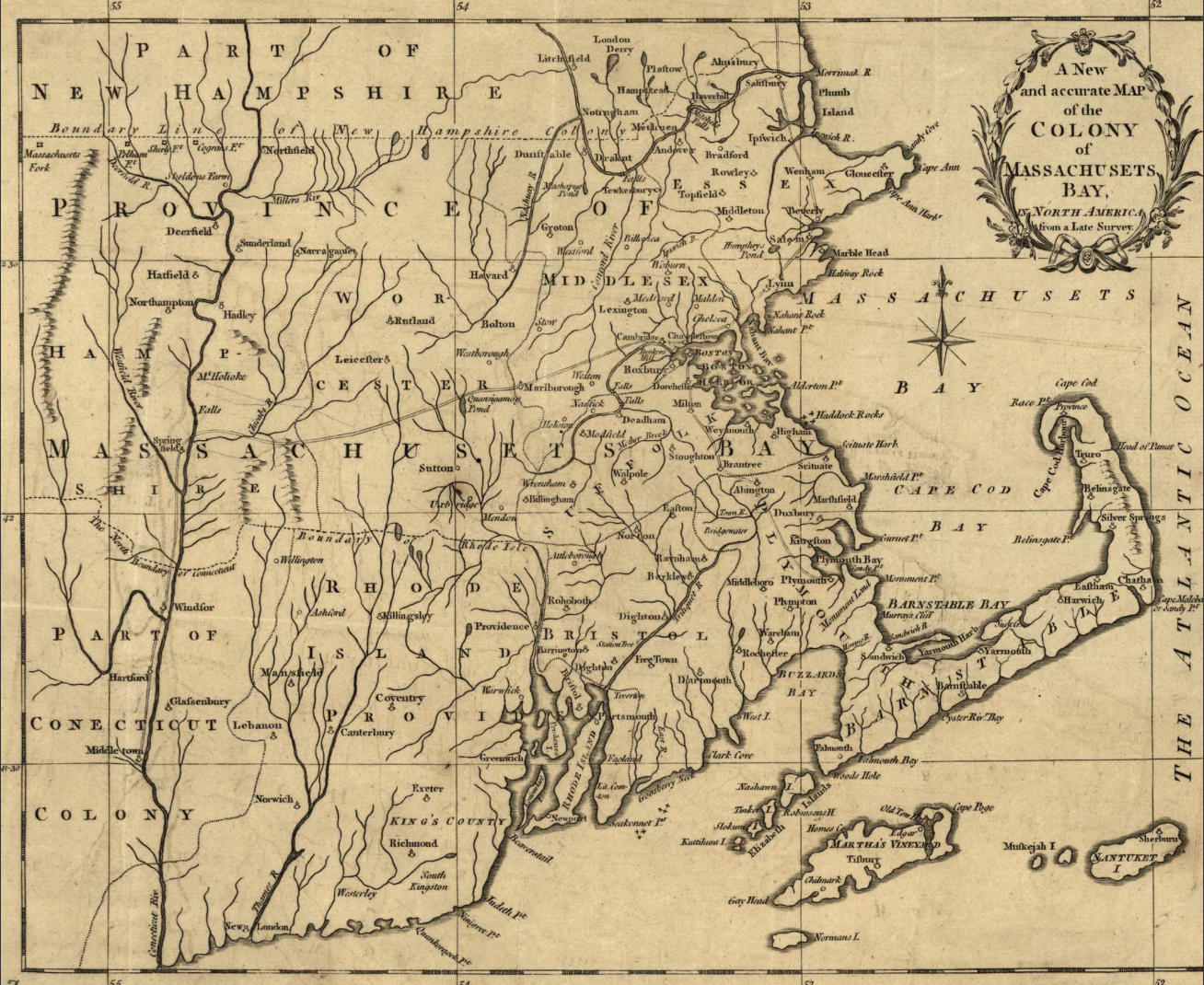
Early map of Massachusetts Bay from https://pacificpalisadesmap.github.io/new-rdcrrp-charting-the-beginnings-a-journey-through-the-map-of-the-massachusetts-bay-colony-yckbkr-pics/#

Finally, I was struck by the fact that while we did discuss Machiavelli, Hobbes, Rousseau and Nietzsche, we also had many papers on less well-known thinkers who were engaged in day-to-day politics. Ming-Yan showed how Thomas Pownall had interesting things to say about empire and imperial fragility that were influenced by his practical experiences of governing. Philip talked about his thinkers 'grappling' with the problems of the day. Nevo reminded us that constitutional theorists cannot rely solely on rules and idealisations but must attend to their particular historical moment. Perhaps the topic encouraged this practical focus but I cannot help thinking that it is also a reflection of the current state of the field. If that is the case, then we are perhaps heeding Georges Dumézil's point as highlighted in Katie Ebner-Landy's opening talk. Katie compared the methodologies of Harold Bloom and Quentin Skinner and sought to explain why the former is - to use Dumézil's phrase - now of 'mere historical interest', while the latter remains relevant. Dumézil's point was that in order to avoid decline a methodology must continue to be useful. This means that it must not simply be frozen in time but must instead be 'transformed by future generations'.

Republican Bodies

Durham on the morning of Thursday 18th September 2025. Image by Rachel Hammersley.

On Thursday 18th September I enjoyed a last fling of summer freedom before term began in earnest. On a bright and sunny morning I took the train to Durham for a workshop I had planned alongside two colleagues, Jamie Gianoutsos and Amanda Herbert. The seed had been sown at a conference almost exactly two years earlier, when I heard Jamie speak about her research on the medical writings of Marchamont Nedham and their relevance for his political ideas. It struck me that there were interesting similarities between Nedham's thought in this area and the ideas of his fellow republican author James Harrington. Both men drew on Helmontian thought, particularly the notion of vital spirits; and in both cases there appeared to be a direct connection between medical theories and republican politics. My intellectual biography of Harrington includes a chapter on his natural philosophy in which I explored his ideas on this topic, but I had always felt that there was more to be said

The plan to pursue our shared interests in this topic was encouraged by two factors. First that Jamie, who is based in Maryland in the US, was going to be in Dublin for the autumn semester of 2025, and secondly that in the intervening period I kept coming across other scholars whose work seemed to touch on similar ideas - including Gio Maria Tesserola on Harrington and John Streater and Tom Ashby on Algernon Sidney. Slowly, the plans for the workshop began to take shape. IMEMS at Durham very kindly agreed to host us. Keen to keep things as informal as possible - and to involve colleagues based abroad who could not travel to Durham for the occasion - we opted for a hybrid format and for sharing and discussing primary sources rather than presenting full papers. By the beginning of September we had nine speakers and several other interested participants. What follows are my reflections on some of the themes that emerged from our discussions.

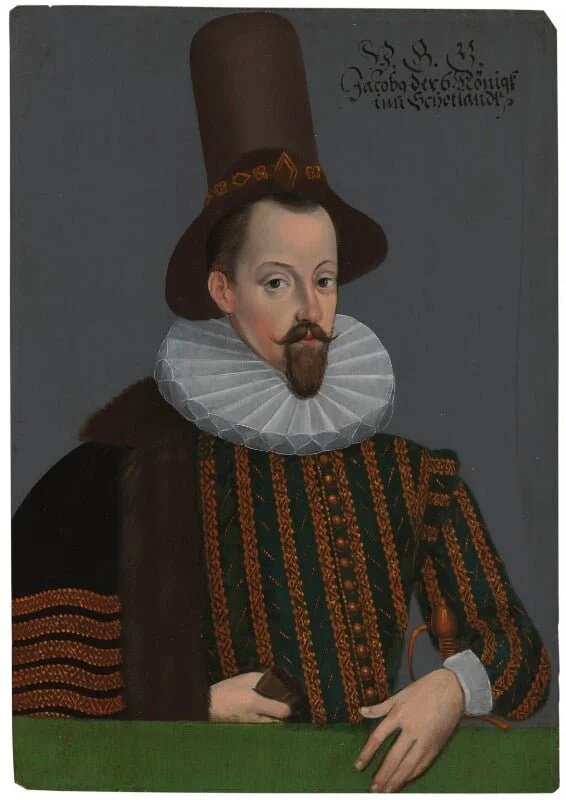
The metaphor of the body politic was not distinctive to republican thought, it had also been central to traditional monarchical understandings of kingship. James VI and I drew on the idea in The Trew Law of Free Monarchies:

And the proper office of the king towards his subjects agrees very well with the

office of the head towards the body and all members thereof, for from the head,

being the seat of judgement, proceeds the care and foresight of guiding, and 

preventing all evil that may come to the body or any part thereof. The head cares

for the body: so does the king for his people. As the discourse and direction flows

from the head, and the execution according thereunto belongs to the rest of the

members, every one according to their office, so it is betwixt a wise prince and his

people.

(James VI and I, The Trew Law of Free Monarchies (London, 1598).

The body politic metaphor was also deployed by Thomas Hobbes who described the state as a union understood as a civil person or an artificial man. This raises the question of why republican thinkers of the seventeenth and eighteenth centuries drew on this monarchical commonplace of the body politic to articulate their understanding of politics?

One obvious reason for the widespread deployment of this metaphor is its utility. Like human bodies, bodies politic tend to be subject to periods of health and sickness, and just as doctors seek ways of establishing and prolonging health and preventing illness in their human patients, so those interested in politics and government are keen to promote the well-being of the body politic and stave off corruption and decay.

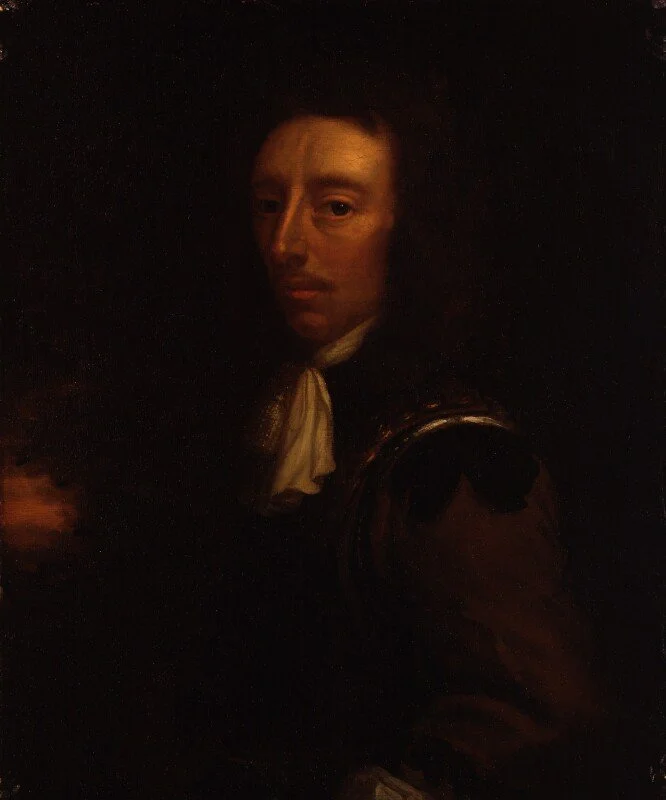
Algernon Sidney, after Justus van Egmont, based on a work of 1663. National Portrait Gallery, NPG 568. Reproduced under a Creative Commons Licence.

In this regard, the experience of ancient Rome was an obvious exemplum for early modern thinkers. Several workshop contributors commented on the fact that the decline and fall of Rome often served as a reference point. For example, Jamie noted that the advanced age (and associated corruption) of the Roman state was said to be reflected in the fact that the men were perfumed and had soft hands. In his paper, Tom Ashby pointed to Algernon Sidney's views on this issue. Sidney insisted, that owing to the Fall, corruption and death (of both the human body and the body politic) were unavoidable and the perfection of virtue impossible. He used analogies with athleticism and physical perfectibility to illustrate this. In the Discourses Sidney described the accumulation of wealth in Rome by the state and by private men as 'a most dangerous disease, like those to which human bodies are subject when they are arrived to that which physicians call the athletick habit, proceeding from the highest perfection of health, activity and strength' (Algernon Sidney, Discourses Concerning Government, Chapter 2, 14). Sidney saw value in striving for perfection (even if it was unattainable), but he cautioned that as the state got close to the peak of perfection greater vigilance was needed to maintain health and stave off corruption.

Other papers, too, emphasised this idea of vigilance. In her discussion of colonial America, Becca Palmer noted the intertwining of the moral and the political in the republican ideal of a watchful citizenry. In this colonial context, the vigilance of citizens was deemed crucial to the preservation of both bodily and state health and the avoidance of decay. Jamie demonstrated that vigilance was also an important concept for Marchamont Nedham, who emphasised the threat of disease and corruption coming not just from outside the body but also from within. He spoke of the craftiness of disease and of the need to be on guard to prevent it from taking hold.

While some early modern writers stressed the need for vigilance, others insisted on the need to purge corrupt elements. Borbala Pigler noted that in the sixteenth century colonisation was seen as a means of purging a diseased and stagnant body politic, by offering an outlet for the excessive or corrupt elements of the population. By the eighteenth century, as Amanda explained, the purging of the body through blood letting was likened to elections - for example by Benjamin Rush. On his account, elections were a means of casting out corrupt members and replacing them with fresh alternatives.

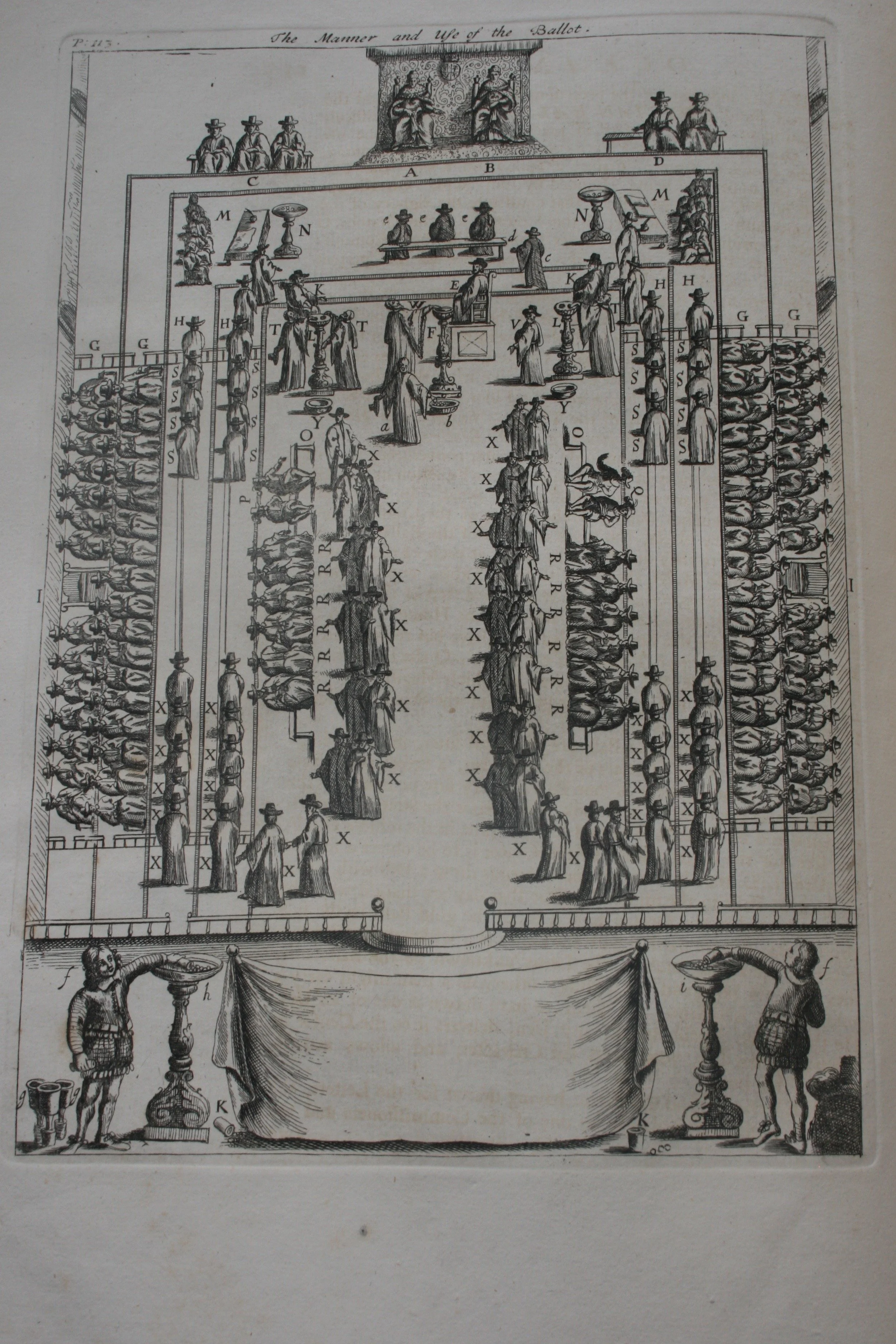
‘The Manner and Life of the Ballot’ from John Toland’s edition of The Oceana and Other Works of James Harrington (London 1737). Volume author’s own. Image by Rachel Hammersley.

Frequent elections were also seen as a means of staving off corruption in the writings of seventeenth-century republicans. Here the emphasis was on avoiding stagnation and decay through constant movement - drawing on the idea of flowing water in a river or blood in the body. Both Harrington and Nedham insisted that there should be constant movement of the people within the body politic through rotation of office, since allowing any individual to remain in power for too long ran the risk of corruption. Becca noted that in eighteenth-century America paper money was viewed in similar terms as a way of ensuring constant movement within the state and thereby staving off degeneration.

A second theme that emerged from our discussions centred on the idea that while bodies epitomise our shared humanity (and therefore our shared membership of the republic) there was also a sense in the past of the need to treat different bodies differently. This problem was introduced in theoretical terms in Borbala's contribution on 'The justice of the body politic' in which she showed how in sixteenth-century England Aristotle's notion of distributive justice was applied to both the state and the human body. According to this understanding, each separate part (each organ or each member of the body politic) had to function well in order for the whole to remain healthy. This was, of course, different from saying that all had to be treated the same or to be given the same role, and in this way it allowed for the inclusion of different groups. For example in the publication Here Begynneth the Kalender of Shepardes (London, 1518) which, as Borbala showed, was suffused with the Aristotelian conception of justice, women were included as a category in their own right (not simply as wives or daughters) and their main duty was obedience. Though it is interesting to note that the Kalender also refers to female shepherds who serve the same function - and are therefore to be treated the same - as their male counterparts.

Leila Marhamati gave a striking example of an unconventional female bodily metaphor for the body politic taken from Machiavelli's Discourses that was originally highlighted by John Freccero. Alongside the conventional allegory of the passive female body politic that was subject to violation by invaders, Machiavelli offered the example of Caterina Sforza. When her fortress was under attack, Sforza is said to have responded to the threat that her sons would be killed, by lifting up her skirts and reminding her opponents that if they carried out this threat, she had the power to make more children. As Leila highlighted, this used the generative power of women as the basis for their claim to a more active role within the body politic. Of course, the notion of republican motherhood was an idea that was picked up later on, not least in a colonial context. Yet Leila cited letters sent to John Adams when he was President that demonstrate the complexity of this notion. Some women reported urging their sons to fight for the defence of their country, clearly accepting the sacrifice they may have to endure as a result. Others appealed to Adams as a parent himself, insisting that his focus should be on striving for a more secure and prosperous future for their children and grandchildren.

In practical terms there was a recognition that male and female bodies were different and needed to be treated differently. Amanda explained that eighteenth-century spas were open to men and women but that women tended to go with different ailments from men; and there was also a sense that women might need a gentler regime to avoid being overwhelmed. By contrast, black male bodies, which were also treated at colonial spas, would often be subjected to particularly harsh regimes on the grounds that it would make them more productive labourers.

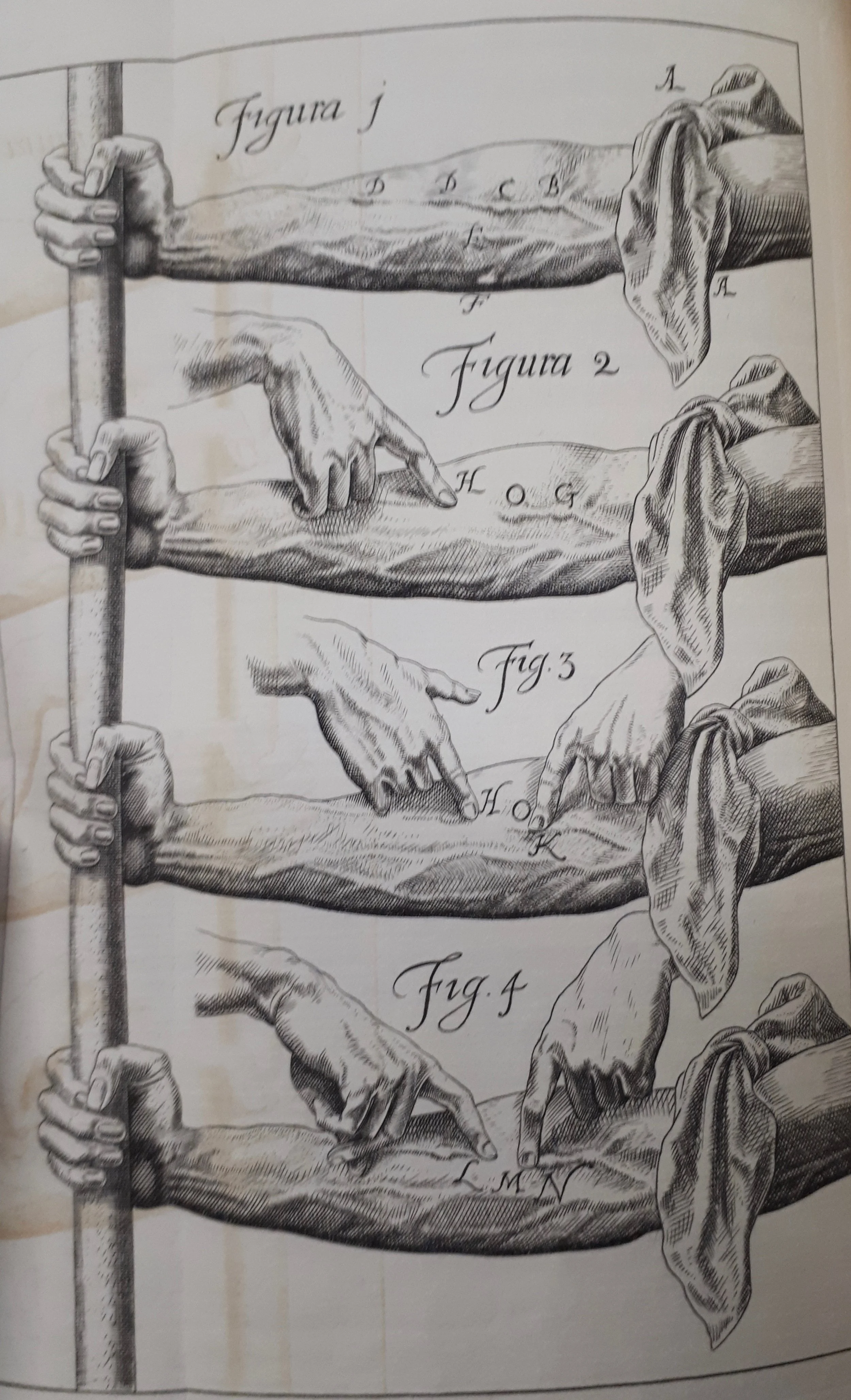
Image from William Harvey’s Exercitatio Anatomica de moto cords et sanguines in animali (1628). Reproduced with permission from the Philip Robinson Library. Special Collections. Pybus Collection Pyb. C. v.9.

Finally, our discussions prompted some methodological reflections on approaching a topic like this from a modern perspective. The disciplinary boundaries that we take for granted did not exist before the nineteenth century, so a thinker like Nedham would probably not have seen his medical work as divorced from his political thinking as we do today. Moreover, in the case of those (like Nedham, Harrington, and Streater) who were influenced by Helmontian thought, there is the difficulty of trying to make sense of their understanding of ideas that we now know to be false. As Gio Maria noted when thinking about Harrington's debt to the scientific theories of Francis Bacon and William Harvey, we need to remember that these figures too were influenced by alchemical, magical and theological approaches to the study of nature. Gio Maria reminded us that the seventeenth century was a transitional period, one in which thinkers were deliberately seeking to adapt older ideas to the new republican cause.

Samantha Wesner's talk on the application of theories about electricity to politics during the French Revolution suggested that something very similar was going on at that transitional moment. She showed that electricity became an important metaphor for republican politics at the time. This was in part because it helped to make sense of the difficult - but crucial - republican concept of the general will. French republicans in the early 1790s were grappling with just how a republican nation could be made to cohere and move as one. At that time electricity was a new scientific discovery and, like the general will, it was invisible and therefore difficult to comprehend. Yet, in the demonstrations that were common at the time, groups of people could be made to feel the power of electricity as a small shock was passed around the group. Electricity then was a helpful metaphor as republicans reached towards new political ideas that they did not fully comprehend.

So, while it may have started out as a metaphor for monarchical politics, the body politic - and the application of scientific theories to politics that was associated with it - proved useful to the articulation, and even understanding, of new republican ways of thinking about politics.

The Inspiration Behind Oceana: 6. Sir John Fortescue

James Harrington is often seen as an aristocratic republican who like others in that tradition placed power in the hands of a narrow political élite. It is certainly true that he believed that within every society there was a natural aristocracy whose members were 'wiser, or at least less foolish, than all the rest' (James Harrington The Commonwealth of Oceana and A System of Politics, ed J. G. A. Pocock, Cambridge, p. 23). For this reason, in his constitutional system, he insisted that only the senate should debate legislation, the lower house being restricted to voting to accept or reject the senate's proposals. Yet his views were more complicated than this might suggest. As noted in last month's post, he was explicitly committed, via the mechanism of an agrarian law, to ensuring that landed property within the country did not become concentrated in the hands of a few, but would in future be relatively evenly spread among the population. Moreover, he was emphatic that his natural aristocracy was determined not by birth, but by wealth and election, embracing the role that social mobility could play within society. 

Harrington's relative political inclusivity is encapsulated in his manipulation of the traditional idea of the body politic. He was innovative in how he used that metaphor, subverting an idea conventionally used to shore up kingship so as to support democratic government. (The full case for Harrington's democratic credentials is made in my forthcoming book). Yet, novel as his conception was, it was indebted to the ideas of the fifteenth-century legal and political theorist Sir John Fortescue.

Sir John Fortescue by William Faithorne, line engraving, published 1663. Reproduced under a Creative Commons License from the National Portrait Gallery - NPG D22739.

Sir John Fortescue by William Faithorne, line engraving, published 1663. Reproduced under a Creative Commons License from the National Portrait Gallery - NPG D22739.

Fortescue, who lived c.1395-1477, was a key figure in the government and judiciary of fifteenth-century England, serving as MP eight times between 1421 and 1436 and being made Chief Justice of the King's Bench in January 1442. Exiled following the defeat of the Lancastrians under Henry VI at the Battle of Towton (1461), Fortescue ploughed his extensive knowledge and experience into works such as In Praise of the Laws of England. Having repudiated his former support for the Lancastrians following the Battle of Tewkesbury (1471), he was pardoned and presented his work The Governance of England to King Edward IV.

In his works Fortescue employed the metaphor of the body politic. Though the use of this idea dates back to Plato and Aristotle, the understanding of the concept in the early modern period owed much to medieval developments. An analogy was drawn between the human body and the state (and within it usually between the head and the king) and both were generally viewed as microcosms of a divinely inspired natural order

Fortescue was crucial in adapting the metaphor to fit the particularities of the English system. His major contribution to political thought was to contrast 'royal dominion', which he associated with continental nations, and especially France, with the 'political and royal dominion' of England. As he explained at the beginning of The Governance of England:

There are two kinds of kingdoms, one of which is a lordship called in Latin dominium regale, and the other is called dominium politicum et regale. And they differ in that the first king may rule his people by such laws as he makes himself and therefore he may set upon them taxes and other impositions, such as he wills himself, without their assent. The second king may not rule his people by other laws than such as they assent to and therefore he may set upon them no impositions without their own assent. (Sir John Fortescue, The Governance of England, in On the Laws and Governance of England, ed. Shelley Lockwood, Cambridge, 1997, p. 83).

This understanding required Fortescue to adapt the conventional notion of the body politic. He accepted that a people cannot constitute a body without a head, and therefore when a people 'wills to erect itself into a kingdom or any other body politic' it 'must always set up one man for the government of all that body' (Fortescue, In Praise of the Laws of England, p. 20). Nevertheless, he insisted that the body was prior to the head, drawing on Aristotle's theory about the heart being the first part of the body to be formed: 

And just as in the body natural, as the Philosopher said, the heart is the first living thing, having in itself the blood which it sends forth to all the members, whereby they are quickened and live, so in the body politic the intention of the people is the first living thing, having in it the blood, namely, political provision for the interest of the people, which it transmits to the head and all the members of the body, by which the body is nourished and quickened. (Fortescue, In Praise of the Laws of England, pp. 20-1).

The heart, representing the people, is then both prior to the head and crucial for giving life to the whole. Moreover, Fortescue likened the laws of a nation to the sinews of the physical body in their capacity to hold that organism together. And he argued that just as the head of a physical body cannot change its sinews 'or deny its members proper strength and due nourishment of the blood' so a king could not change the laws or deprive the people 'of their own substance uninvited or against their wills' (Fortescue, In Praise of the Laws of England, p. 21).

Harrington's articulation of the body politic analogy combined Fortescue's insights with observations based on William Harvey's theory regarding the circulation of the blood (which I discussed in more detail in an earlier post):

So the parliament is the heart which, consisting of two ventricles, the one greater and replenished with a grosser store, the other less and full of a purer, sucketh in and gusheth forth the life blood of Oceana by a perpetual circulation (Harrington, Oceana, p. 174).

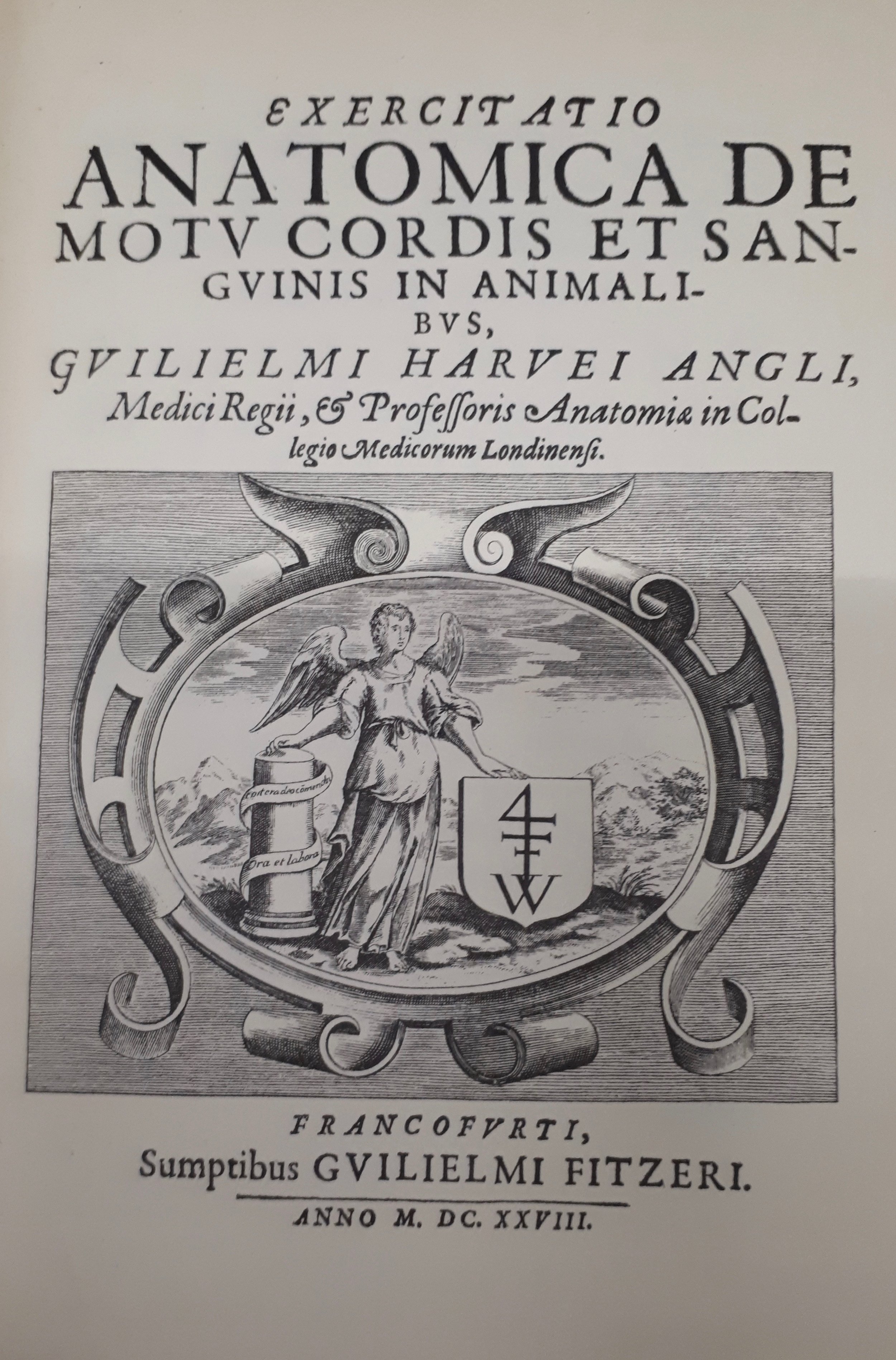
The frontispiece to William Harvey, Exercitatio Anatomica Motu Cordis et Sanguinis in Animalibus (Florence, 1928). Reproduced from a copy held in the Special Collections department of the Robinson Library, Newcastle University. Pybus X.v.09.

The frontispiece to William Harvey, Exercitatio Anatomica Motu Cordis et Sanguinis in Animalibus (Florence, 1928). Reproduced from a copy held in the Special Collections department of the Robinson Library, Newcastle University. Pybus X.v.09.

Here the heart represents not simply the people, but specifically the legislature. In addition Harrington, like Fortescue, emphasises the role of the blood, though he uses this to justify his theory of rotation of office. Just as blood moves around the body being constantly replenished but never completely replaced, so rotation ensures that the popular element of the political system is continually in existence and yet regularly renewed. Harrington's account of the body politic, then, builds on that of Fortescue, but pushes it in a more democratic direction through the emphasis on rotation and the associated idea that all should rule and be ruled in turn. At the same time, using that metaphor and associating the legislature with the heart, implied that there would still be a single figurehead at the apex of the system. In Oceana that position was to be held by the Lord Archon, a role that Harrington appears to have designed for Oliver Cromwell. Yet, just like Fortescue, Harrington insisted that such a ruler had to be constrained by the laws.

Harrington's body politic metaphor thus encapsulates the complexity of his system. While he was clearly influenced by classical and Renaissance thinkers from the republican tradition, their ideas were combined with native legal perspectives such as that offered by Fortescue. Similarly, Harrington's republicanism was not simply aristocratic, but also incorporated important democratic and monarchical elements. While some republicans were intent on securing the rule of a narrow political élite, the recent tendency to see that as the republican position and, consequently, to dismiss the insights that republicanism could offer us today is a mistake. The republican tradition was not uniform. Competing views were expressed by its exponents and it was flexible and adaptable. It has the potential to offer a more open and democratic vision of government, one that could serve us in the twenty-first century.

The Inspiration Behind Oceana 3: Hobbes Again

Last month's blogpost focused on the relevance of the title and frontispiece of Hobbes's Leviathan for Harrington's work. In this month's post I want to develop these observations by examining Harrington's engagement with the language and argument of Hobbes's Introduction to that book, and the contrasting approaches to 'political science' of these two seventeenth-century thinkers.

The opening passage of Leviathan not only provided Harrington with his title, as I showed last month, but is also referenced repeatedly in his works. It is, therefore, worth quoting in full:

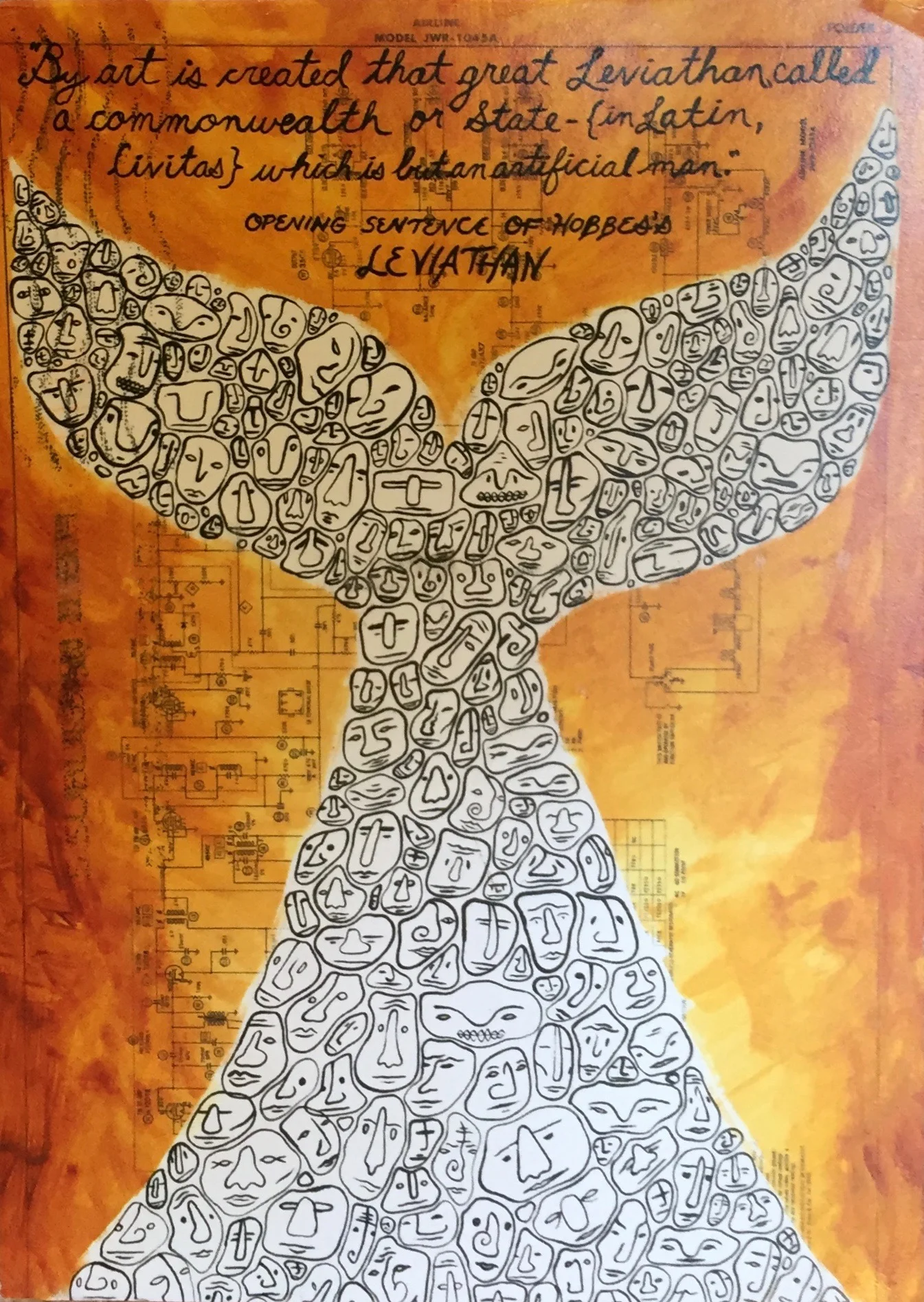
Postcard depicting an artistic reinterpretation of Hobbes’s Leviathan by Matt Kish.

Postcard depicting an artistic reinterpretation of Hobbes’s Leviathan by Matt Kish.


NATURE (the Art whereby God hath made and governes the World) is by the Art of man, as in many other things, so in this also imitated, that it can make an Artificial Animal. For seeing life is but a motion of Limbs, the beginning whereof is in some principall part within; why may we not say, that all Automata (Engines that move themselves by springs and wheeles as doth a watch) have an artificiall life? For what is the Heart, but a Spring, and the Nerves, but so many Strings; and the Joynts, but so many Wheeles, giving motion to the whole Body, such as was intended by the Artificer? Art goes yet further, imitating that Rationall and most excellent worke of Nature, Man. For by Art is created that great LEVIATHAN called a COMMON-WEALTH, or STATE (in latine CIVITAS) which is but an Artificiall Man; though of greater stature and strength than the Naturall, for whose protection and defence it was intended; and in which, the Soveraignty is an Artificiall Soul, as giving life and motion to the whole body (Thomas Hobbes, Leviathan, ed. Richard Tuck, Cambridge, 1991, p. 9).

Harrington even gave the title The Art of Lawgiving to one of his books. Taken from: The Oceana and other works of James Harrington, ed. John Toland (London, 1737). Private copy. Image by Rachel Hammersley.

Harrington even gave the title The Art of Lawgiving to one of his books. Taken from: The Oceana and other works of James Harrington, ed. John Toland (London, 1737). Private copy. Image by Rachel Hammersley.


In The Mechanics of Nature Harrington echoed Hobbes in describing 'Nature' explicitly as 'the Art of God' (James Harrington, The Mechanics of Nature in The Oceana and Other Works of James Harrington, ed. John Toland, London, 1737, p. xlii). Elsewhere he too presented constitution-building or 'lawgiving' as an art, suggesting that by practising it humans could imitate God's creativity. And like Hobbes, Harrington also drew on the analogy of the body politic:


AS the Form of a Man is the Image of God, so the Form of a Government is the Image of Man.

...

FORMATION of Government is the creation of a Political Creature after the Image of a Philosophical Creature; or it is an infusion of the Soul or Facultys of a Man into the body of a Multitude (James Harrington, A System of Politics in The Oceana and Other Works, p. 499).


Of course, the body-politic analogy had a long history and was, by the mid-seventeenth-century, a rather outdated metaphor. Yet neither Hobbes nor Harrington was using it in a purely conventional way. Both men sought to revolutionise the idea of the body politic and, with it, politics more generally.

Hobbes saw the body politic as an artificial rather than a natural body - more like a machine than a human being. Against this, Harrington was keen to emphasise that while government is a human creation, legislators are still bound to follow the dictates of nature as laid down by God:


Policy is an Art, Art is the Observation or Imitation of Nature, Nature is the Providence of God in the Government of the world, whence he that proceeds according unto Principles acknowledgeth Government unto God, and he that proceeds in defiance of Principles, attributes Government unto Chance, which denying the true God, or introducing a false One, is the highest point of Atheisme or Superstition (James Harrington, The Prerogative of Popular Government, London, 1658, 'The Epistle Dedicatory').


It is in this context that we can understand Harrington's choice of title as a response to Hobbes. While the Leviathan cannot be constrained by any human form (as the quotation from the book of Job that appears on Hobbes's frontispiece declared), it is nonetheless constrained in only being able to survive in the ocean and not on land.

William Harvey, Exercitatio Anatomica Motu Cordis et Sanguinis in Animalibus (Florence, 1928). Reproduced from a copy held in the Special Collections department of the Robinson Library, University of Newcastle. Pybus C.v.09. With thanks to Sam Petty.

William Harvey, Exercitatio Anatomica Motu Cordis et Sanguinis in Animalibus (Florence, 1928). Reproduced from a copy held in the Special Collections department of the Robinson Library, University of Newcastle. Pybus C.v.09. With thanks to Sam Petty.


While rejecting the idea of government as machine, Harrington nevertheless did not revert to the traditional notion of the body politic. Where these supported monarchy (with the king generally associated with either the head or the heart) Harrington offered a more democratic interpretation. He also drew an analogy between this interpretation and the ideas of one of the leading scientists of his day - who was also, significantly, a friend of Hobbes - William Harvey.


Harrington justified his bicameral legislature, and the rotation of office that operated in both houses, by reference to Harvey's theory of the circulation of the blood:

So the parliament is the heart which, consisting of two ventricles, the one greater and replenished with a grosser store, the other less and full of a purer, sucketh in and gusheth forth the life blood of Oceana by a perpetual circulation (James Harrington, Oceana, London, 1656, p. 190).


Through adopting Harvey's notion of the heart as a pump composed of ventricles with distinctive functions, and of the blood as the life-force of the body - here equivalent to the people - Harrington implies that his theory is in tune with current scientific development. Yet the heart, on this account, represents not the king (as Harvey himself had suggested) but the legislature, thereby turning Harvey's (and by association Hobbes's) monarchism against them by showing that the body politic metaphor is capable of a democratic reading.


Harrington's desire to demonstrate his credibility as a scientific thinker has tended to be obscured by the recent emphasis on his status as a classical republican. Yet, like Hobbes, he was keen to put politics on a scientific footing.

Harvey, Exertatio Anatomica, pp. 56-7 from the Robinson Library edition.

Harvey, Exertatio Anatomica, pp. 56-7 from the Robinson Library edition.


Hobbes set out his vision of a science of politics in The Elements of Law and in De Cive. The approach he took was hinted at in the title of the former, which echoed that of the English translation of Euclid's famous work: The Elements of Geometry. For Hobbes, true scientific knowledge was not 'prudence' but 'sapience' and could only be arrived at via deductive reasoning. Hobbes dismissed prudence as mere experience of fact which was used 'to conjecture by the present, of what is past, and to come' (Thomas Hobbes, The Elements of Law Natural and Politic, ed. Ferdinand Tönnies, Cambridge, 1928, p. 139). Harrington, by contrast, adopted this inductive approach as the foundation of his scientific knowledge, expressing the basic principle of his own political reasoning as follows: 'what was always so and no otherwise, and still is so and no otherwise, the same shall be so and no otherwise' and he insisted that we can be as certain of this as we are of other scientific principles. Responding to the criticism Hobbes had made of Aristotle and Cicero - that they had derived their politics not from the principles of nature, but from the practices of their own commonwealths, just as grammarians produce the rules of language from the writings of poets - Harrington suggested that this was equivalent to saying that Harvey had discovered the circulation of the blood not on the basis of the principles of nature, but through studying the anatomy of a particular body (James Harrington, Politicaster, pp. 47-8). Harrington, thereby, likened his political methodology to the scientific methodology of anatomy:


Certain it is that the delivery of a model of government (which either must be of none effect, or embrace all those muscles, nerves, arteries and bones, which are necessary to any function of a well-ordered commonwealth) is no less than political anatomy (James Harrington, The Art of Law-giving, London, 1659, III, p. 4).


In Politicaster he repeated this point in language that deliberately echoed Hobbes: 'Anatomy is an Art; but he that demonstrates by this Art, demonstrates by Nature, and is not to be contradicted by phansie, but by demonstration out of Nature. It is no otherwise in the Politicks' (Harrington, Politicaster, p. 44). What this indicates is that Harrington was intent on basing his analysis not, as Hobbes did, on deductive logic, but, as Harvey did, on the analysis of specific models, both living and dead. In drawing on Harvey, and in coining the phrase 'political anatomy', Harrington further underlined the modern and scientific character of his thinking, pursuing Hobbes's aim to set politics on a scientific footing, while showing that Hobbes at best offered too narrow an account of what this would involve and at worst had misrepresented scientific methodology.


Harrington was playing a cunning game with Hobbes, opposing his politics 'to shew him what he taught me'. However, it was not successful. While Harrington frequently refers to Hobbes in his work, both explicitly and implicitly, the interest was not mutual. Hobbes never responds directly to Harrington's provocations, and does not appear to have engaged with his ideas. It would seem he had little interest in what he had taught Harrington - or in what Harrington might have been able to teach him.